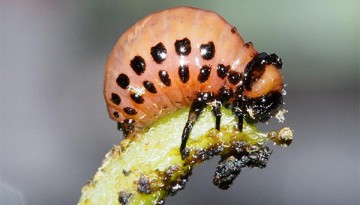
A novel insecticide targets a specific gene in a pest, killing only that bug species on crops and avoiding collateral damage to beneficial insects caused by today’s pesticides.
A new study published in BMC Biology describes greenhouse trials of a genetically engineered diamondback moth that suppresses populations of pest diamondback moths and reduces their resistance to Bt.
Students Kelley McElfresh ’16, Devin Hegelein ’17 and Katie Kraft ’17 are making substantial contributions to sales and manufacturing at Ithaca Hummus in Groton, New York.
This summer, Cornell Law School welcomes new clinical faculty member Beth Lyon, founder of Cornell’s Farmworker Legal Assistance Clinic, which assists farm workers and rural immigrant communities.
Cornell researchers have found that when a green fluorescent protein (GFP) is exposed to specific wavelengths of laser light, it turns red. The discovery has potential for researchers studying cell organelles and proteins.
Todd Walter, associate professor in the Department of Biological and Environmental Engineering, has been appointed director of the New York State Water Resources Institute, effective July 1.
Vanquishing the agony of defeat, Cornell food scientists now have better grasp on the sweet, thrilling taste of victory. And in the face of loss, the researchers found prompts for emotional eating.