Led by Cornell, a new analysis offers seven practical recommendations and other guidance on how organizations and researchers can use open practices more effectively.
Artificial intelligence is aiding the search for better battery materials while using a creative approach to chemistry to expand the design space for electrolytes, unlocking new possibilities for safer, higher-performing energy storage.
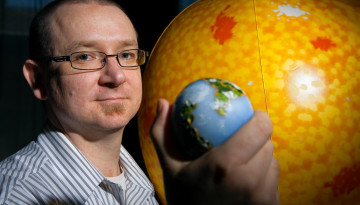
James Lloyd, professor of astronomy in the College of Arts and Sciences who worked at the intersection of astronomy, instrumentation and spacecraft engineering to find innovative ways to study and characterize exoplanets, died on July 15 in Ithaca.
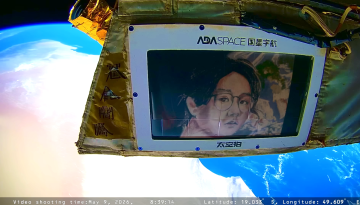
Claire Choi '28 transformed her engineering research into CO2, a space-based artwork exploring humanity's relationship with carbon dioxide that was selected for the Xu Bing Space Art Residency Program and recorded aboard an orbiting satellite.
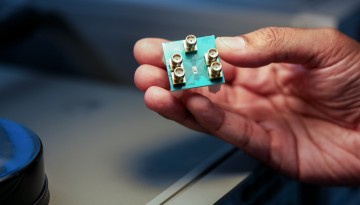
One year after unveiling a first-of-its-kind “microwave brain” microchip capable of computing on ultrafast data and wireless signals, researchers from the Cornell Duffield College of Engineering have shown how the chip can encode information into its own language.
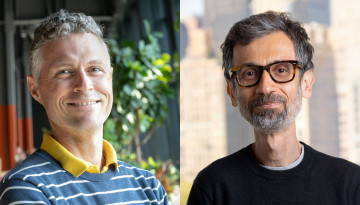
Researchers studying ribosomes, AI and quantum computing are among 13 early-career professors from Cornell who’ve recently been awarded National Science Foundation Faculty Early Career Development Awards.
Light typically interacts with a material the same way whether it enters through the front or the back. Cornell researchers have demonstrated a simple route to breaking that symmetry, with possibilities for photonics and quantum information processing.