A new NATO-funded effort led by assistant professor Greg Falco ’10 seeks to make the internet less vulnerable to disruption by rerouting its flow of information to space.
Michael Kim is a Precollege commuter student from Pebble Beach, CA who is studying Calculus for Engineers on the Cornell campus this summer. Michael talks about what it's been like to take a Cornell course on campus as a high school student.
Cornell Engineering’s Scientific Artificial Intelligence Center has partnered with Pasteur Labs, an alumnus-founded startup, to establish new research projects in human-AI collaboration for scientific discovery and industrial applications.
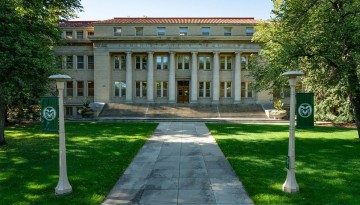
Colorado State University has joined the NSF-funded Center for Research on Programmable Plant Systems (CROPPS), led by Cornell University, with Arjun Khakhar spearheading projects on plant genome editing and enhancing nitrogen and water use in crops.
Forty-five high school students from across the country took part in the 2024 CURIE Academy, a Cornell Engineering program for high school students interested in pursuing undergraduate studies in engineering.
Over 10 weeks, 22 teams of would-be entrepreneurs developed products ranging from multilingual children's toys to innovative greenhouse hoops for small-scale farmers.
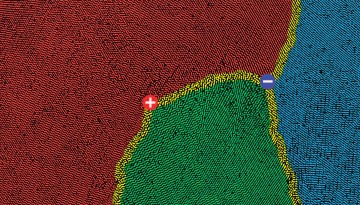
Cornell Engineering researchers are part of a research group that has applied a new X-ray-based reconstruction technique to observe topological defects in a nanoscale self-assembly-based cubic network structure of a polymer-metal composite material.
A supercrystal formation previously unobserved in the thin-film Mott insulator Ca2RuO4 was discovered by a Cornell-led research team, potentially unlocking new ways to engineer materials and devices with tunable electronic properties.
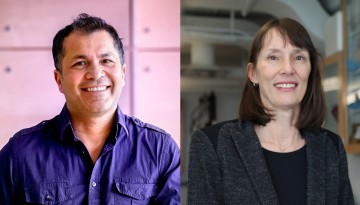
Hector Aguilar-Carreño and Marjolein van der Meulen join Natalie Bazarova, who was appointed to the role in 2023, to support research communities and core facilities, labs, institutes and centers that span colleges and campuses.