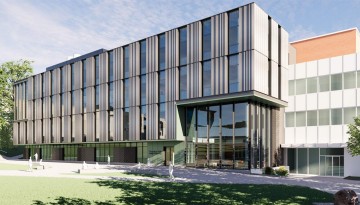
The $40 million, four-story addition will add 30,000 square feet and transform the stone and brick façade, originally built in 1951, into a contemporary glass and metallic exterior.
Students and lifelong learners are invited to explore a new interest, enhance their resume or strengthen their professional skills through Cornell’s Fall Part-Time Study Program, which runs Aug. 22 – Dec. 17, 2022. Registration for most students begins August 1.
Professor emeritus Thomas O’Rourke was honored July 14 with the inaugural Cornell Program in Infrastructure Policy Award for his research, teaching, and consulting services to more than 140 projects in 13 countries.
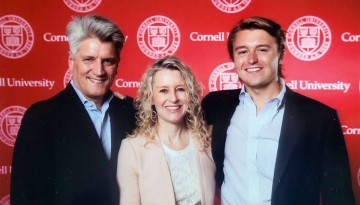
After losing his mother to breast cancer, Ryan Nowicki '16 crowdfunded for a novel cancer treatment that had once piqued the interest of his mother at Cornell.
New research by Cornell engineers provides a blueprint for developing roads equipped with energy storage systems that can wirelessly charge electric vehicles.
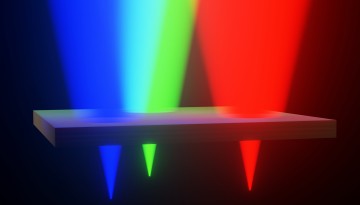
In the quest to miniaturize camera lenses and other optical systems, Cornell researchers have, for the first time, defined the fundamental and practical limits of spaceplates.
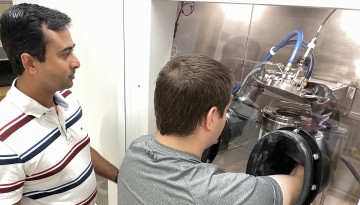
A new metal organic chemical vapor deposition system will be used to engineer and study gallium oxide, an important material for the future of high-powered electronics.