Taking on a tropical parasite, with women in mind
By Susan Kelley Noël Heaney
This is Part 4 of a five-part multimedia feature, Dispatches from Mwanza, about Weill Cornell Medicine’s collaboration with Weill Bugando School of Medicine to improve health care in Tanzania, the U.S. and around the world.
Dr. Jennifer Downs, an infectious disease expert at Weill Cornell Medicine, drove around a bend on a dirt road in Tanzania when the vast expanse of Lake Victoria appeared. She had arrived in Igombe. The fishing village is the first place she'd ever seen such a massive burden of schistosomiasis, a parasitic worm infection that affects more than 250 million people worldwide. People get infected just by touching contaminated water.
“That’s why it is so, so hard to prevent,” said Downs, M.D. ’04, M.Sc. ’11.
Lake Victoria is infested with it.
Twice the size of Maryland, Lake Victoria is the second-largest freshwater lake in the world and a primary source of water for Tanzania, Uganda and Kenya; the parasite in it puts lives at risk across the continent.
Downs chatted in Swahili with women carrying basins of lake water on their heads for their family’s bathing and laundry. Others stood knee-deep in the lake, filling their buckets. A baby in a sling slept on one woman's back.
The parasite larva burrows through unbroken skin and grows into a flatworm that lays hundreds to thousands of eggs per day. A species of the Schistosoma worm is particularly brutal for women. The eggs lodge in the vagina and cervix, causing severe lesions that do not heal and symptoms that resemble sexually transmitted infections. The damage may also increase the risk of infertility, HIV and the virus that causes cervical cancer.
Left untreated, various species of the parasite can cause fatal liver disease and blockage in the ureters that leads to kidney failure – all for lack of sanitation and safe water.
“It’s a horrifying disease,” said Downs, who has spent much of her career at Weill Bugando School of Medicine, Weill Cornell’s long-time collaborator in Tanzania. “If 5% of the U.S. population had this, there would be a public outcry. And 50% of people in Tanzania are infected.”

Dr. Jennifer Downs, (center) the Ehrenkranz Family/Orli R. Etingin, M.D. Associate Professor in Women’s Health and associate professor of medicine at Weill Cornell Medicine, looks at schistosomiasis test strips in a lab at Mwanza Intervention Trials Unit in Mwanza, Tanzania, with Dr. Jane Maganga, (left) a research scientist at MITU, and Loyce Mhango (right), a lab technician at MITU.
As the Ehrenkranz Family/Orli R. Etingin, M.D. Associate Professor in Women’s Health at Weill Cornell, Downs and her team are conducting a five-year study funded by the National Institutes of Health on female genital schistosomiasis (FGS) – a disease that persists in 70% of women even after treatment. The work is also providing leadership opportunities for researchers in Tanzania.
When Downs first visited Igombe in 2009, she conducted a study that found 85% of residents are infected with a species of Schistosoma that attacks the gastrointestinal tract.
“It broke my heart,” said Downs, who is also associate professor of medicine at Weill Cornell. “As I learned more about the effects of the parasite, not only in the gastrointestinal tract, and the damage for women, and all the ensuing complications, like increased risk of getting HIV and infertility, it just further compelled me to commit my career to it.”
Debilitating consequences
The social stigma associated with FGS can be just as damaging as the physical disease, said Dr. Jane Maganga, a research scientist at the Mwanza Intervention Trials Unit (MITU) who oversees the NIH study.
Gender roles play a part. Most Tanzanians live in rural areas, where women and girls are responsible for providing water for their families from a young age, Maganga said. “It is the women who do the chores. In places where there is no potable water, they have to go to the lake, they have to fetch water.”

Women and girls at Igombe, Tanzania, collect water from Lake Victoria for their families.
Once infected, they get symptoms such as abdominal pain, genital discharge, itching, bleeding, and pain during intercourse. Those symptoms are often misinterpreted as a sexually transmitted infection (STI) – a source of shame in Tanzania’s religious, conservative culture, where premarital sex is taboo, Maganga said.
In reality, couples do have sex before marriage. “Normally people start early, and they don’t tell their parents,” she said. “But then once a woman starts to show symptoms of STIs, it appears that, ‘Oh, she’s already engaged in this.’ That’s where the stigma comes from.”
Women with FGS may think they have an STI and feel too ashamed to seek treatment. If they do, health care workers may not be familiar with FGS. They may misdiagnose them with an STI, admonish them and treat them with medications that do nothing to help their symptoms. Partners may accuse women with FGS of having affairs and seek out other partners, Downs said.
FGS is also linked to infertility, which carries more stigma than HIV in a culture that highly values children and childbearing. “It leads to disrupted relationships, or they can’t have children, which is just vital to society’s view of their value as women,” Downs said. “So they’re abandoned for that, or it affects their own sense of self-worth. There are debilitating consequences not only on the body but the woman’s whole well-being.”
Downs learned about FGS from her mentor, Dr. Warren Johnson, founder of Weill Cornell’s Center for Global Health.
She had come to Tanzania in 2007, for a six-week rotation as a senior resident in medicine who was planning to train in infectious disease at Weill Cornell. After her final year of clinical training at Weill Cornell, she returned to Mwanza as a senior infectious disease fellow. She was 32. “I remember seeing women younger than I was coming in with advanced HIV, so late for medication that some would pass away,” she said. “I wondered, what can we do to prevent this?”
But Johnson encouraged her to pursue a disease that few researchers were studying: FGS.
“I had never heard of it,” Downs said.
She learned nearly 90% of all cases are in sub-Saharan Africa, and that the Schistosoma parasite spends part of its life cycle in a freshwater snail. The snail ejects the larva into water, where people come into contact with it multiple times a day – when men fish, for example, or when women work in flooded rice paddies or fetch water. When people urinate or defecate in open spaces and near water, the eggs are excreted in the urine or feces and the cycle begins again.

Women at Igombe, Tanzania, collect water from Lake Victoria, which is infested with the parasitic Schistosoma worm.
Downs also learned some research hinted that FGS – caused by Schistostoma haematobium eggs that lodge themselves in the genital tract – might be linked to an increased risk of HIV infection.
“I thought, that’s really interesting,” she said. “Maybe that was part of the reason there are so many young women infected with HIV, and maybe this would be a way I could address it.”
In 2008, she put together a small Tanzanian study team. They visited clinics near Mwanza, mapping the prevalence of the infection with gynecological exams and testing blood, urine and stool. This project and a subsequent study in 2017 found women with FGS were four times more likely to also have HIV.

Women near Igombe, Tanzania, work in a flooded rice paddy, at risk of getting schistosomiasis from standing in the water.
Early on, they started treating women with praziquantel. It kills the Schistosoma quickly – but the women still had genital lesions. “Then a lot of my work shifted to, how can we better study what’s happening in the genital tract so that we can figure out how to treat this? And that has been my focus for the last eight years.”
In the process, Downs has increased the visibility of the disease, said Dr. Dan Fitzgerald, director of the Center for Global Health at Weill Cornell. “By bringing really rigorous science to it, she’s brought to the forefront that this is one of the major manifestations of schistosomiasis,” he said. “I don’t think people had really thought about how this affects women very uniquely and very profoundly. She has played a major role in changing that.”
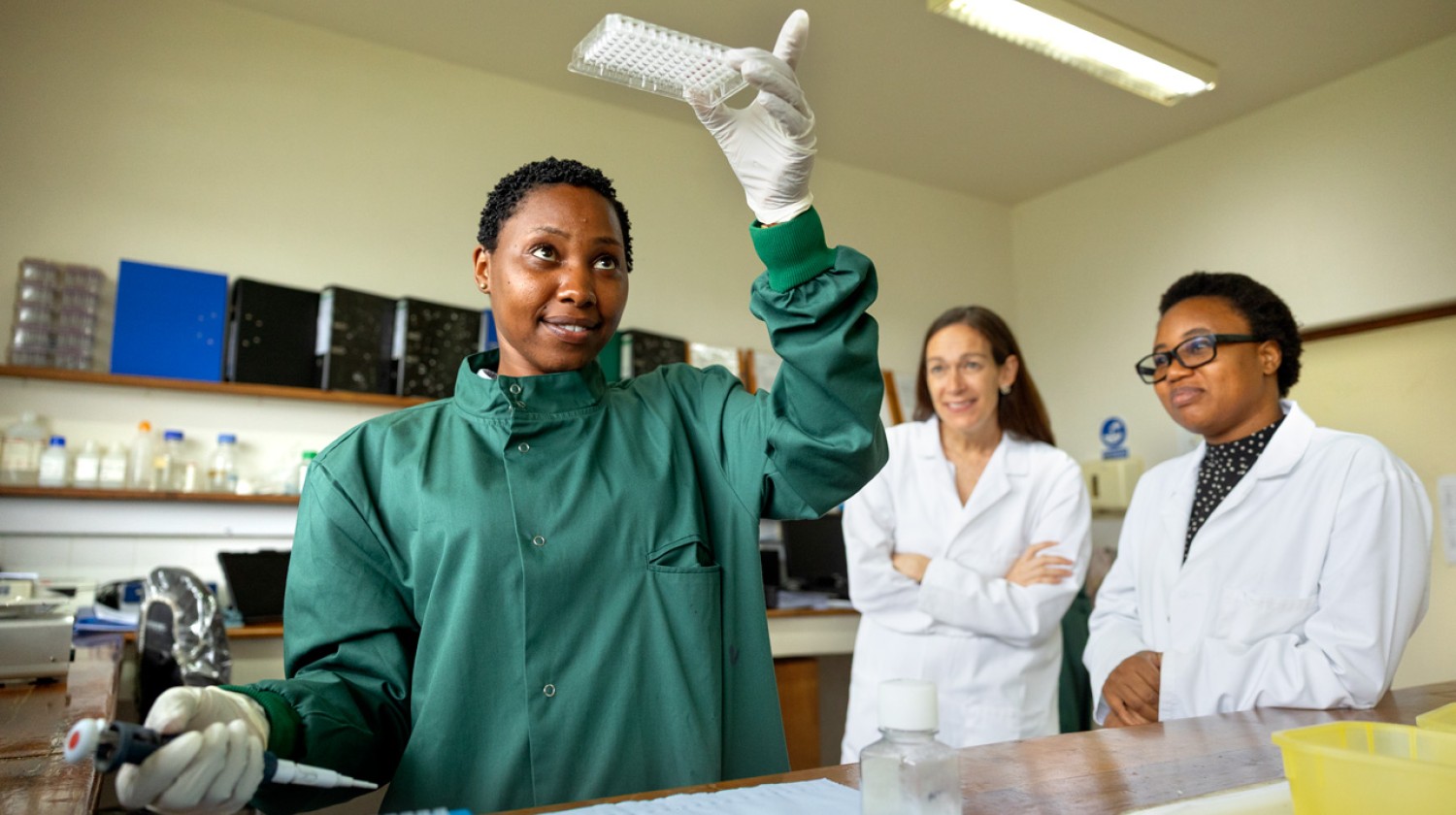
Lab technician Loyce Mhango (left) looks for evidence of Schistosome infection in a study participant’s blood at the Mwanza Intervention Trials Unit in Mwanza, Tanzania. Looking on are Dr. Jennifer Downs (center) and Dr. Jane Maganga (right).
Helping women heal
Lab technician Loyce Mhango pipetted a tiny drop of serum from a study participant’s blood into a laboratory tube and placed a test strip into the tube at MITU. She was looking for the antigen – a molecule secreted by the parasite into a participant’s blood stream during S. haematobium infection.
It’s part of the team’s effort to find out how FGS affects the female genital tract on the cellular and molecular level. The goal is to find a way to heal the lesions that remain even after praziquantel treatment.
“We really don’t know how to treat the lesions,” Maganga said. “Once patients are given the drugs, the lesions don’t resolve, because the drug mainly kills the worm – not the eggs.”
Their hypothesis is that S. haematobium eggs decrease cervical immunity and antiviral immune cells, and cause breakdowns in the epithelial barrier. “We think that results in the persistent symptoms of FGS even after treatment with praziquantel,” Maganga said. They also think the breakdowns make women more susceptible to viruses like the herpes simplex virus-type 2.
To test that hypothesis, the team is studying 180 women, half of whom have FGS and are getting treated with praziquantel initially and during a year of follow-up if it recurs.

A graph illustrates schistosomiasis antigen testing at the Mwanza Intervention Trials Unit in Mwanza, Tanzania.
The team will collect cells from the women to define the composition of genital mucosal immune cells before and after infection. And they’ll determine the molecular mechanisms that break down the epithelial cells of women with FGS.
Last, they’ll quantify the effects of the FGS on the frequency, intensity and duration of the herpes simplex flareups, to see if FGS does in fact make women more susceptible to developing other virus infections in their genital tracts. Poor control of genital tract viruses in women with FGS has been hypothesized, said Maganga, “but we want to prove it.”


In January, they published a study with Maganga as lead author that described the importance of schistosome infection in women: compared to men, not only are they likely more susceptible to HIV, but they also have a greater risk of death from HIV.
“It was not well understood that these parasitic infections change the person’s immune system, so that maybe they’re not fighting off viruses well, and how important that is,” said Fitzgerald, the B.H. Kean Professor in Tropical Medicine and professor in medicine in microbiology and immunology at Weill Cornell. “It’s a new paradigm.”
Downs’ goal is not only to better understand FGS, but also to increase Tanzania’s capacity to do research. The team is helping to develop a urine test that could be given at the point of care, at rural health care centers. “We could know within the hour if a woman is infected,” Downs said.
And Downs is acting as Maganga’s mentor as she earns her Ph.D. in parasitology from the University of Leiden, the Netherlands, supported by a Fogarty Fellowship sponsored in part by Weill Cornell and MITU. Working with Maganga, who has singlehandedly run the study since 2020, has been “an absolute privilege,” Downs said.
“She has managed the team, the field work, the study participants, the data, the lab testing,” Downs said. “She is just completely outstanding, and I’m so excited to see her trajectory as a rising female scientist and leader in Tanzania.”
So far in the study, they’ve discovered that women with FGS generally don’t seek treatment, and they are more likely to have persistent human papillomavirus, which causes cervical cancer if it persists for 10 years. “That’s helping us understand what this parasite does to a woman’s genital tract,” Downs said.
And they’ve learned women with FGS in the study are half as likely to get pregnant during a year of follow-up. “And these are all women who were not using contraceptives, most were married and desired pregnancy,” she said. “They just weren’t getting pregnant.”

Gender roles in Tanzania put women at high risk for schistosomiasis infection, from working in flooded rice paddies and fetching water for their families.
The findings could lead to better understanding of other helminth infections, such as hookworm, which infect people in the southern U.S. For example, other research has shown hookworm affects how women’s bodies deal with HPV. “If we can understand more about this immunity and how to normalize this alteration from the parasite,” Downs said, “it would also help us understand how we can vaccinate better and how we can eradicate genital viruses better.”
The team thinks one potential path to FGS treatment is to give women not only praziquantel but also another medication – perhaps ibuprofen – to change the way the immune system is primed and to decrease inflammation.
“We’re not looking for big, expensive unrealistic treatments,” Downs said, “but some simple, practical things that could help women heal.”
This story and videos were developed and produced with support from Matt Fondeur, Lindsay France, Eduardo Merchán and Ashley Osburn.
Media Contact
Get Cornell news delivered right to your inbox.
Subscribe