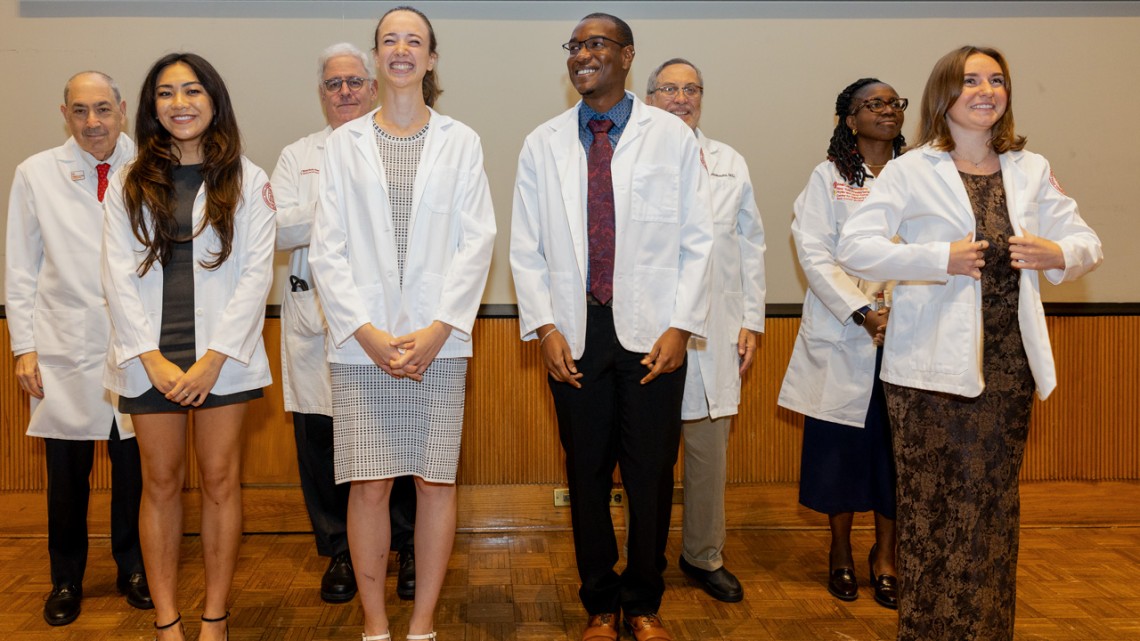
Medical students don their white coats with a little help from faculty.
First-year medical students celebrate their new white coats
By Nadia Halim and Alyssa Sunkin-Strube
Jennifer Weiss’s path to medicine began as a young child, when an ambulance responded to her New Jersey home to care for her father, who has heart disease. During the scary episode, one of Weiss’ earliest memories, the emergency medical technicians and paramedics offered empathy and compassion, and put everyone at ease.
Inspired to help others, Weiss ’24, M.D. ’29, trained as an EMT at age 16 and joined her local first aid squad. But she quickly realized that she wanted more.
“I wanted to have a greater impact on my patients than just the short ride to the hospital,” she said, “where my knowledge and skills stopped and receiving the physician’s skills took over.”
Surrounded by friends and family, Weiss and 105 of her fellow students in the Class of 2029 participated in Weill Cornell Medical College’s annual White Coat Ceremony on Aug. 12, officially marking the beginning of their medical education.
Weiss nurtured her scientific curiosity studying human biology, health and society at the College of Human Ecology, where she also worked as an EMT for Bangs Ambulance of Ithaca and volunteered as a firefighter and EMT for Cayuga Heights Fire Department in Cayuga Heights, New York. In responding to emergency calls, Weiss noticed health inequities that limited some patients’ access to primary care.
So, during her senior year at Cornell she created the EMS Equity Project, which offered monthly clinics in downtown Ithaca, focused on helping patients find resources and navigate the health care system. These undergraduate experiences reinforced her decision to pursue a career in medicine, and to do so at Weill Cornell Medicine, with its particular strength in caring for a diverse population.
At the White Coat Ceremony, Dr. Geraldine McGinty, the E. Darracott Vaughan, Jr., M.D. Senior Associate Dean for Clinical Affairs and senior associate dean of faculty, read the Hippocratic Oath, articulating the principles underpinning the professional and ethical foundations of medicine. With the help of faculty, students donned their new coats and received stethoscopes, both provided by the Moss Family Foundation and the Paul F. Miskovitz, M.D. ’75 Stethoscope Fund for Medical Students.
“The white coat is a symbol that I’m going to be the person who walks into the room and eases anxiety for individuals, providing empathy and compassion,” said Weiss, who will be the first in her family to be a medical doctor. “Having been exposed to many white coats, it’s surreal that I’m going to eventually be a physician who provides comfort and care for other families.”
A milestone in their medical journeys, the ceremony also represents the students’ entrance into a new ecosystem that requires nurturing and balance, said Dr. Joseph Safdieh, senior associate dean for education. He urged students to embrace that ecosystem and to cultivate their own professional identities within it.
“You are not here to become a version of someone else,” said Safdieh, who is also the Richard P. Cohen, M.D. Professor of Medical Education and a professor of neurology. “You are here to become the best version of yourself — as a physician. And part of my job — and the job of every educator and mentor you’ll encounter — is to help you do that with honesty, curiosity and support.”
Physicians can also effect change, using the power imbued in the white coat to do something that benefits the public good, said keynote speaker Dr. Sallie Permar, chair of the Department of Pediatrics and the Nancy C. Paduano Professor in Pediatrics. She noted how, as an undergraduate volunteer at a mission hospital in Zambia during the AIDS epidemic, she was overwhelmed by the devastation to the health of the adult population, and became outraged when she saw babies dying of HIV. Yet, when measles capitalized on the weakened immunity of children in the same village, there was a solution: a vaccine. That passion to end devastating epidemics turned into a call to action and led her to become a vaccine scientist.
“The white coat you’re about to wear is your canvas,” she said. “Let it reflect your story and how you turned passion into action, and action into good that will benefit humanity. Wear it well, protect your well-being, and never forget the power you hold to shape lives far beyond the clinic.”
The students in the Class of 2029 reflect a breadth of backgrounds, interests, accomplishments, experiences and talents that will enable them to contribute to the communities Weill Cornell Medical College serves. They attended 51 different undergraduate institutions across 23 states, and 11 are Cornell alumni. And 18% are first-generation college graduates.
The group also has strong global connections. Students were born in 11 countries, and 37% are bilingual or multilingual. They have lived, studied and worked in 30 countries.
“You are truly a remarkable class,” said Dr. Janine Katzen, associate dean for admissions and an associate professor of clinical radiology. “We are eager to see the energy and vibrancy you will bring to Weill Cornell Medical College. We warmly welcome each of you and look forward to your continuing the legacy of engagement, discovery, intellectual curiosity, collaboration and service that defines our community.”
A version of this article first appeared on the Weill Cornell Medicine’s news website.
Nadia Halim is science editor, and Alyssa Sunkin-Strube is assistant director of editorial, at Weill Cornell Medicine.
Media Contact
Garret Sulak
Get Cornell news delivered right to your inbox.
Subscribe
