From leaky pipeline to leadership: Women boost health equity in Tanzania
By Susan Kelley Noël Heaney
This is Part 5 of a five-part multimedia feature, Dispatches from Mwanza, about Weill Cornell Medicine’s collaboration with Weill Bugando School of Medicine to improve health care in Tanzania, the U.S. and around the world.
A group of college students gathered in a classroom in Mwanza, Tanzania, to act out a scenario they say is all too common. A male student played the part of a professor while a female student pretended to face an excruciating decision: accept his unwanted romantic advances – or accept a failing grade.
Fortunately, the student had a place to report the sexual harassment and get help: the “gender desk” at Catholic University of Health and Allied Sciences, the home of Weill Bugando School of Medicine, a long-time collaborator with Weill Cornell Medicine. The desk, or gender office, has become a model for other universities in Tanzania.
The students created the skit, filmed it and posted it on social media to spread the word that the office, which serves both men and women, ensures confidentiality.
“Nobody’s going to tell about their situation, and the gender desk is going to help bring back their self-worth, their self-confidence, so they can focus on their academics,” said Tuskige Mercy Aswile, who helped write the script as a fourth-year medical student at Weill Bugando.
“A lot of students, male and female alike, are not able to reach their goals because they’re being harassed” – a common problem in schools in many parts of the world, she said. “And this affects them not only physically, but also psychologically, so the students aren’t able to fulfill their dreams.”
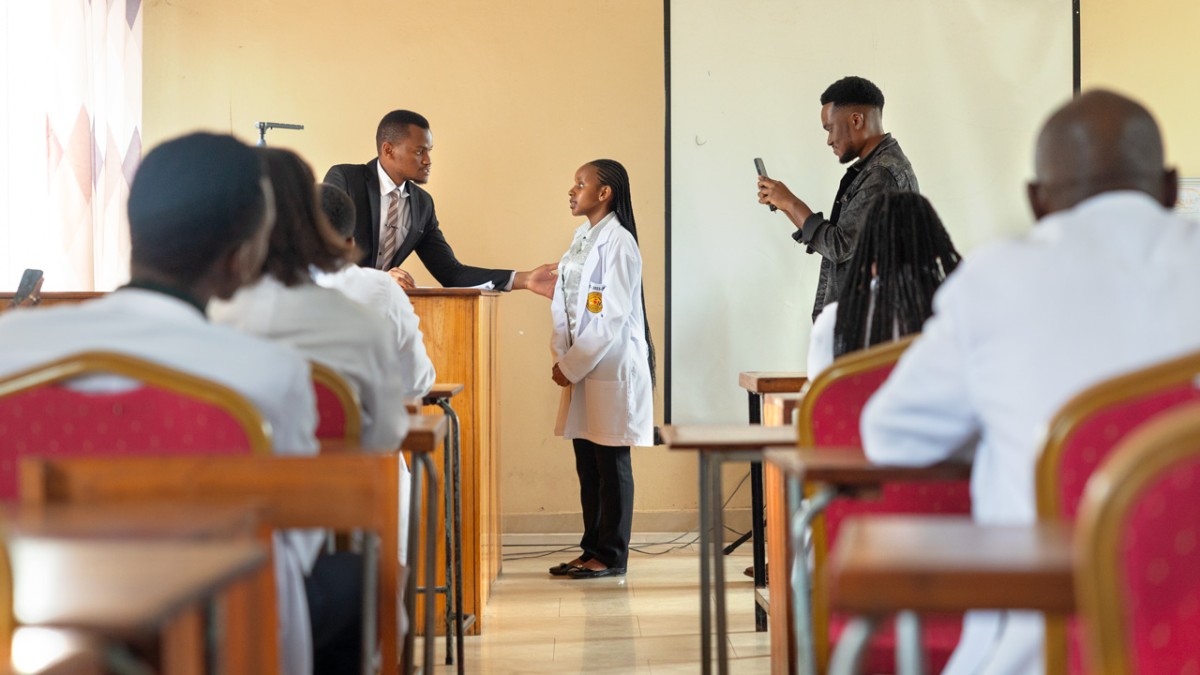
Students at the Weill Bugando School of Medicine perform a skit they wrote to illustrate how their school’s “gender desk” can offer help in the face of gender discrimination and workplace harassment.
The office is a major accomplishment of the Weill Bugando chapter of the Women in Global Health Research Initiative, a program of Weill Cornell’s Center for Global Health. The initiative aims to break down the barriers – such as sexual harassment – that prevent women from taking on leadership roles in global health. The initiative also focuses on increasing research on women’s health.
About 75% of global health undergraduates are women, but only 25% of global health leaders are women, according to a Weill Cornell study published in 2014.
When women share in leadership, health care improves for everyone, said Dr. Adolfine Hokororo, M.S. ’14, a pediatrician and clinical epidemiologist who is among the founders and an advocate of the Weill Bugando chapter.
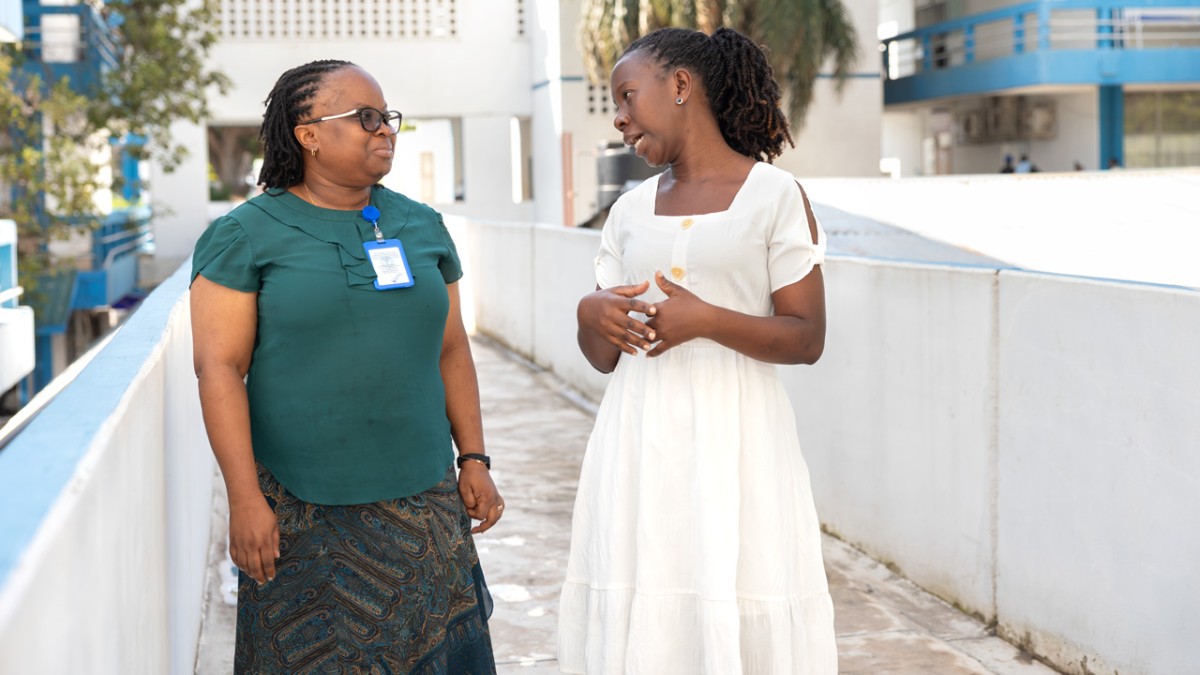
At left, Dr. Adolphine Hokororo, M.S. ’14, a pediatrician and clinical epidemiologist at Weill Bugando School of Medicine, chats with Anea Isaka Lizonga, director of the gender desk at Catholic University of Health and Allied Sciences.
“Studies have shown when women are leading, even in villages, they will give priority to health issues. So, for that reason, we feel like in health, we really need women to take a lead together with men,” said Hokororo, who helped launch the initiative.
Women scientists are also more likely to consider the importance of sex as a biological variable in their analyses, which the National Institutes of Health (NIH) recognizes as an essential part of research. That’s because sex is a critical determinant of health outcomes, said Dr. Jennifer Downs, M.D. ’04, M.Sc. ’11, the Ehrenkranz Family/Orli R. Etingin, M.D. Associate Professor in Women’s Health at Weill Cornell.
“Promoting women to leadership in global health and retaining them in the field as scientists will improve health and science for the whole world,” she said.
Bridging the gap
When Downs was training as a junior physician scientist in the early 2010s, she and her female colleagues noticed a dearth of women leaders to whom they could look as role models. “There were a few, but there were not very many who were at the highest levels of leadership in global health,” said Downs, now an associate professor of medicine at Weill Cornell.
In contrast, about 80% of the Weill Cornell trainees in global health were women. “We started to ask, ‘Well, what’s happening?’ There was a leaky pipeline,” she said.
So in 2014, she and Weill Cornell colleagues Dr. Jyoti Mathad, associate professor of medicine, and Dr. Lindsey Reif, assistant professor of clinical epidemiology in medicine, founded the Weill Cornell Women in Global Health Research Initiative to address the gender gap.

Dr. Jennifer Downs, (center) the Ehrenkranz Family/Orli R. Etingin, M.D. Associate Professor in Women’s Health and associate professor of medicine at Weill Cornell Medicine, looks at schistosomiasis test strips in a lab at Mwanza Intervention Trials Unit in Mwanza, Tanzania, with Dr. Jane Maganga, (left) a research scientist at MITU, and Loyce Mhango (right), a lab technician at MITU.
A year later, they convened a symposium of 80 women health researchers to better understand challenges that cause women to leave the field. That led to a survey of women working at the Center for Global Health’s sites at Weill Cornell and in Haiti, India and Tanzania.
The resulting study, published in The Lancet in 2019, found three main barriers to women achieving leadership positions in global health: balancing career and personal life, gender discrimination, and sexual harassment and assault.
“Across the four countries, 80% of women had experienced at least one of these barriers,” Downs said.
Of those, 78% reported work–life balance issues; 55% experienced sexual harassment or assault; and 53% encountered gender discrimination.
The demands of the field make it difficult to achieve work-life balance, because international field work can send people away from their families. Others must seek advanced training internationally, again away from their families, if it’s unavailable in their home countries. And many cultures require women to do the majority of childcare regardless of their careers. “This takes you out of the academy for a while. And when you go back, the men have gone further, and you are starting again,” said Hokororo, a co-author of the study.
“The challenges of pregnancy during field work can even be dangerous for women’s health,” Downs added.
Gender discrimination comes in the form of societal messages telling women they are inferior to men, and of women being passed over for leadership roles, she said.
And sexual harassment was a problem in every country they studied, Downs said. “Women facing inappropriate words, gestures, touching – any and all of these can contribute to women deciding they can’t stay in the field of global health any longer,” she said.
Since then, the initiative has implemented evidence-based solutions to address these challenges at each Center for Global Health site.

Anea Isaka Lizonga, director of the “gender desk” at the Catholic University of Health and Allied Sciences, talks with a student about her office’s services.
At Weill Bugando, establishing policies against sexual discrimination and creating the gender desk in 2023 was “a huge achievement led by my outstanding colleagues in Tanzania,” Downs said. “Now other universities in Tanzania are following suit, coming to our women colleagues there and saying, ‘How did you do this? We need to establish something like that at our university.’”
The desk is open to everyone, men and women, in the Weill Bugando community. Anea Isaka Lizonga, who directs the office, conducts workshops on topics such as gender-based violence and mental health, and sexual harassment in clinical settings.
In 2024, the office fielded 22 complaints of sexual harassment: 50% from students, 25% from staff and 25% from community members; many involved domestic gender-based violence, said Lizonga.
“We can assist if they need counseling,” she said. “But if we feel like the case needs more effort – police work or they need a lawyer – we connect them with the specific area where they will get more help.”
Equitable health care
The Weill Cornell Women in Global Health Research Initiative also offers workshops and training on how to conduct research on women’s health and on sex as a biological variable. For example, Hokororo, Downs and colleagues at the Center for Global Health conducted a study, published in 2015, of 400 pregnant teens in Mwanza. They found that the teens were far more likely to have sexually transmitted infections (STIs) than their pregnant adult counterparts. Nearly half had at least one STI, and some had as many as five – but Bugando Medical Centre at the time tested only for two.
They also found the pregnant girls who had the most STIs were more likely to be in long-term relationships, started having sex at an early age and were much younger than their sex partners. And many did not seek out prenatal care at all, because they felt ashamed about their pregnancies.
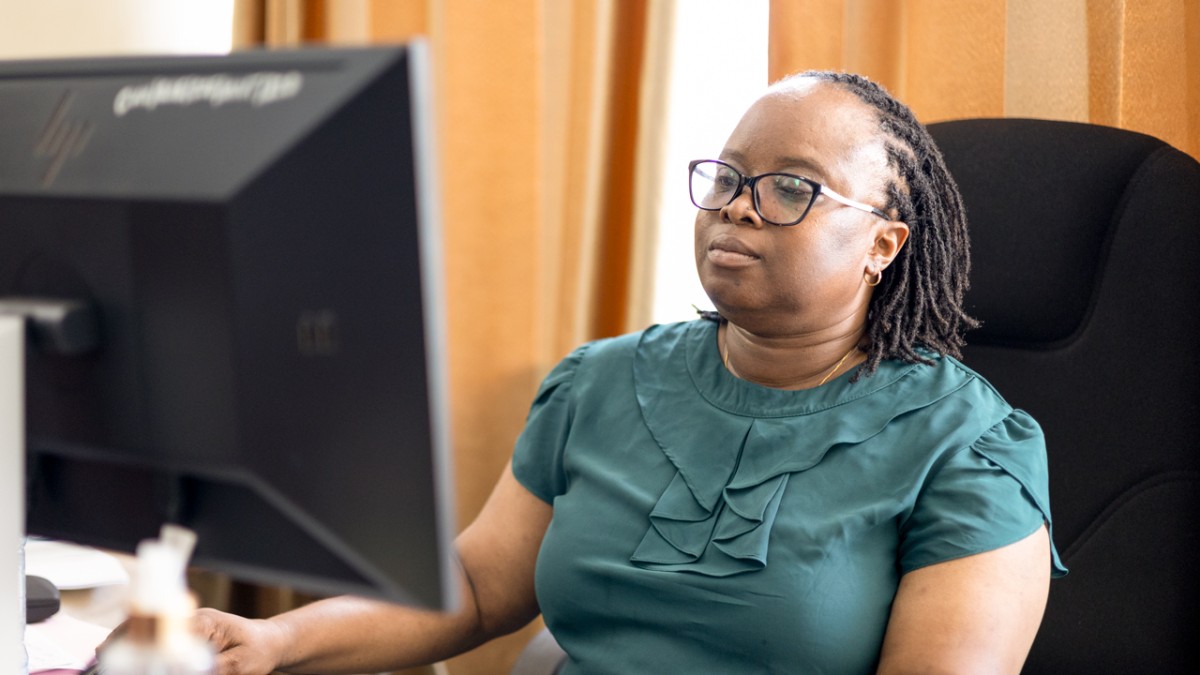
Dr. Adolfine Hokororo, M.S. ’14, a pediatrician and clinical epidemiologist, is among the founders of the Weill Bugando chapter of the Women in Global Health Research Initiative.
“Our work demonstrates the urgent need to expand routine STI testing into prenatal care in Tanzania to prevent morbidity and mortality in young girls and their babies,” the authors wrote in the study.
“This group is vulnerable,” Hokororo said. “We found out that clearly the prenatal services were not adolescent-friendly, and adolescents need particular services which are not being given routinely.”
As a pediatrician, Hokororo said equitable leadership leads to equitable health care. “In order to serve these children better, you have to take care of their mothers,” she said.
More research on women’s health is on the way. In 2023, the initiative won five years of funding from the NIH to train 10 researchers per year – both men and women – on women’s global health, infectious diseases across a woman’s lifespan, sex as a biological variable, professional skills, scientific communication and peer mentorship.

Lab technician Loyce Mhango (left) looks for evidence of Schistosome infection in a study participant’s blood at the Mwanza Intervention Trials Unit in Mwanza, Tanzania. Looking on are Dr. Jennifer Downs (center) and Dr. Jane Maganga (right).
Downs, for example, has been mentoring Dr. Jane Maganga, a research scientist at the Mwanza Intervention Trials Unit. Maganga is earning a Ph.D. and collaborating with Downs to study female genital schistosomiasis.
Maganga said Downs not only understands the challenges of raising a family as a research scientist. She has also helped Maganga improve her capacity to conduct field work, manage research trials, analyze data and write academic papers. “I’ve become a better scientist,” Maganga said. “I’ve formed a lot of collaborations under her guidance, met a lot of people, made a lot of connections, developed a lot of confidence. I’ve improved in my communication, in my presentations.”
Now other Tanzanian health researchers interested in women’s health are reaching out to Maganga for professional guidance, she said.
“I’ve been so lucky to be well-mentored, so I feel that I also have a responsibility to mentor other people,” Maganga said. “It makes you feel good.”
This story and videos were developed and produced with support from Matt Fondeur, Lindsay France, Eduardo Merchán and Ashley Osburn.
Media Contact
Get Cornell news delivered right to your inbox.
Subscribe