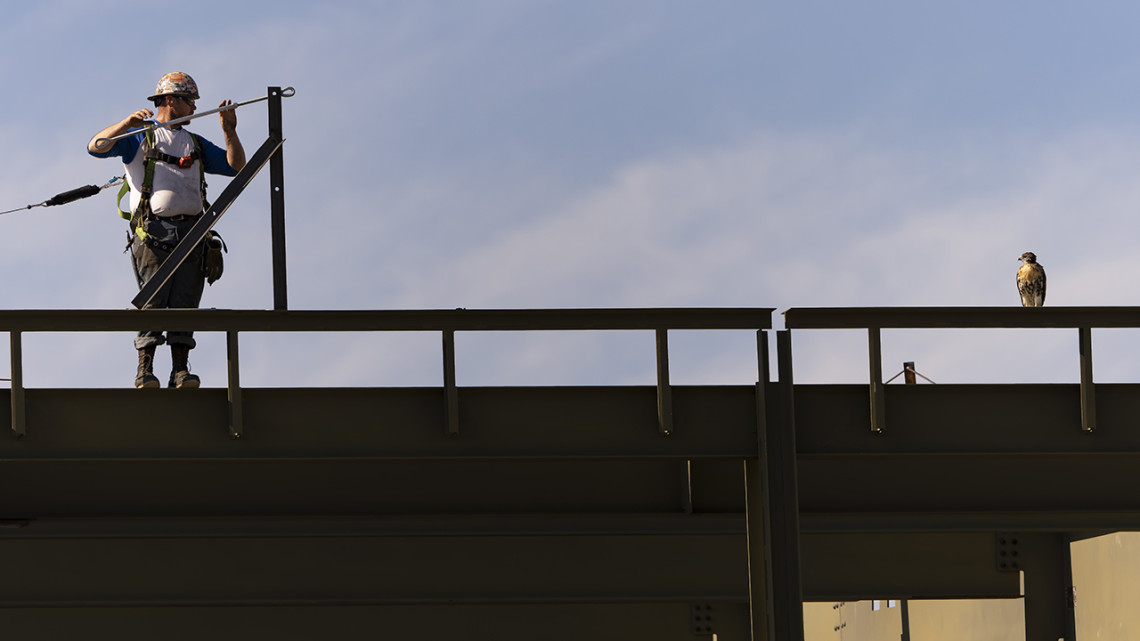
A fledgling perches alongside a construction worker at Meinig Fieldhouse.
Meinig Fieldhouse built to protect iconic red-tailed hawks
By Clarissa Casper
Big Red – a red-tailed hawk known to millions via the Cornell Lab of Ornithology’s Bird Cams – has nested atop the lights of Robison Alumni Fields on central campus for more than a decade. Before construction on the new Meinig Fieldhouse began in 2024, Cornell staff feared the bird might not return.
“If at all possible, we wanted to see if we could maintain the site they were using and maintain the ability to stream from there,” said Charles Eldermire, a Lab of Ornithology multimedia producer whose team runs Bird Cams. “That was an immediate concern.”
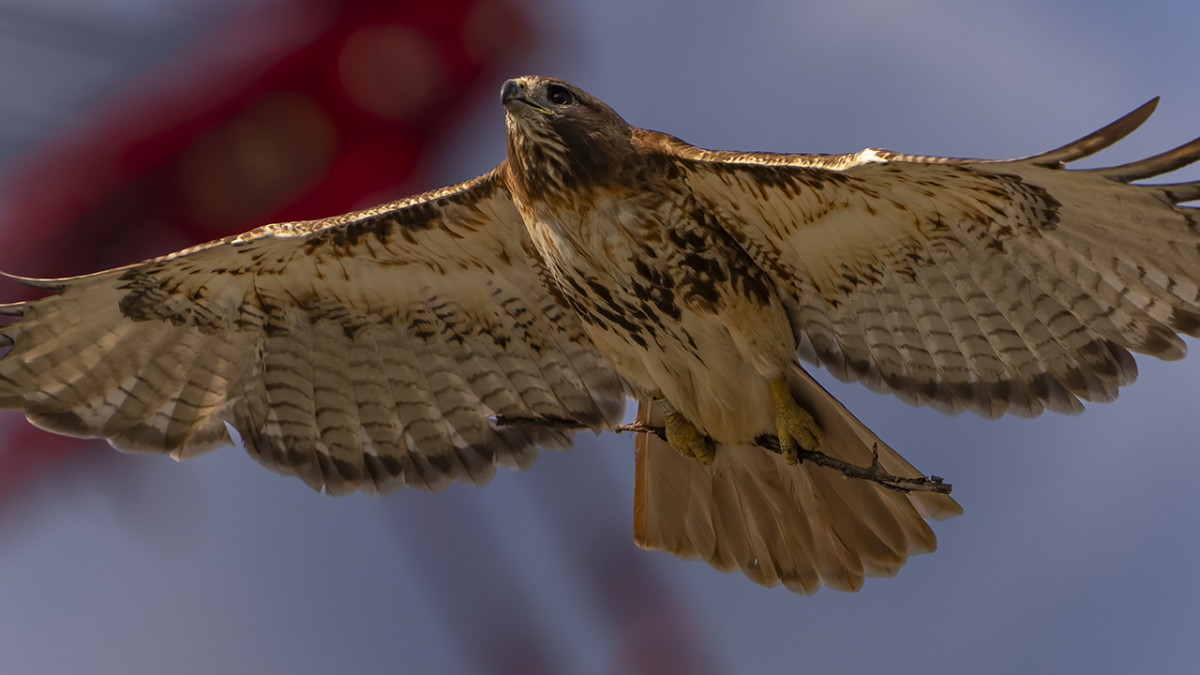
Big Red flies near Meinig Fieldhouse.
Over the next year, Cornell Facilities staff, construction workers and ornithologists collaborated closely to cause minimal disruption to Big Red and her fledglings, and to protect all birds from colliding with the building’s windows.
Along the way, the birds fluttered between steel beams and perched on cranes, charming workers at the site – just as they have inspired birdwatchers around the world. The crew embraced the hawks as part of daily life, even sporting stickers of Big Red on their hard hats and creating and filling a makeshift birdbath to keep them cool.
“It’s funny,” said Jake Duell, Cornell Facilities construction manager, “because they are the most hardened guys that I’ve known forever, and they’re so soft when it comes to these birds.”
Initially, 12 aging light poles were slated to be destroyed as part of the project, which will provide indoor practice, competition and recreation space for students. But two of those poles had held Big Red’s nest in the past, so Facilities worked with the Lab to give her a chance to stay.
“We demoed most of them all down, leaving these two last winter, in the hope that the hawks would come back and nest in them,” Duell said. “It was really just a shot in the dark that they would come back.”
‘You can’t take them for granted’
Big Red is now 22, so maintaining her nesting site is critically important, said Eldermire.
Wild Red-tailed Hawks typically live 10 to 15 years. “Each of these years that we have left, you can’t them take for granted,” he said.
For many viewers, watching Big Red’s eggs hatch and her chicks grow has expanded their identity.
“They become birdwatchers through those cameras,” Eldermire said, “and then share that with other people online and out in the world. That’s the power of that site.”
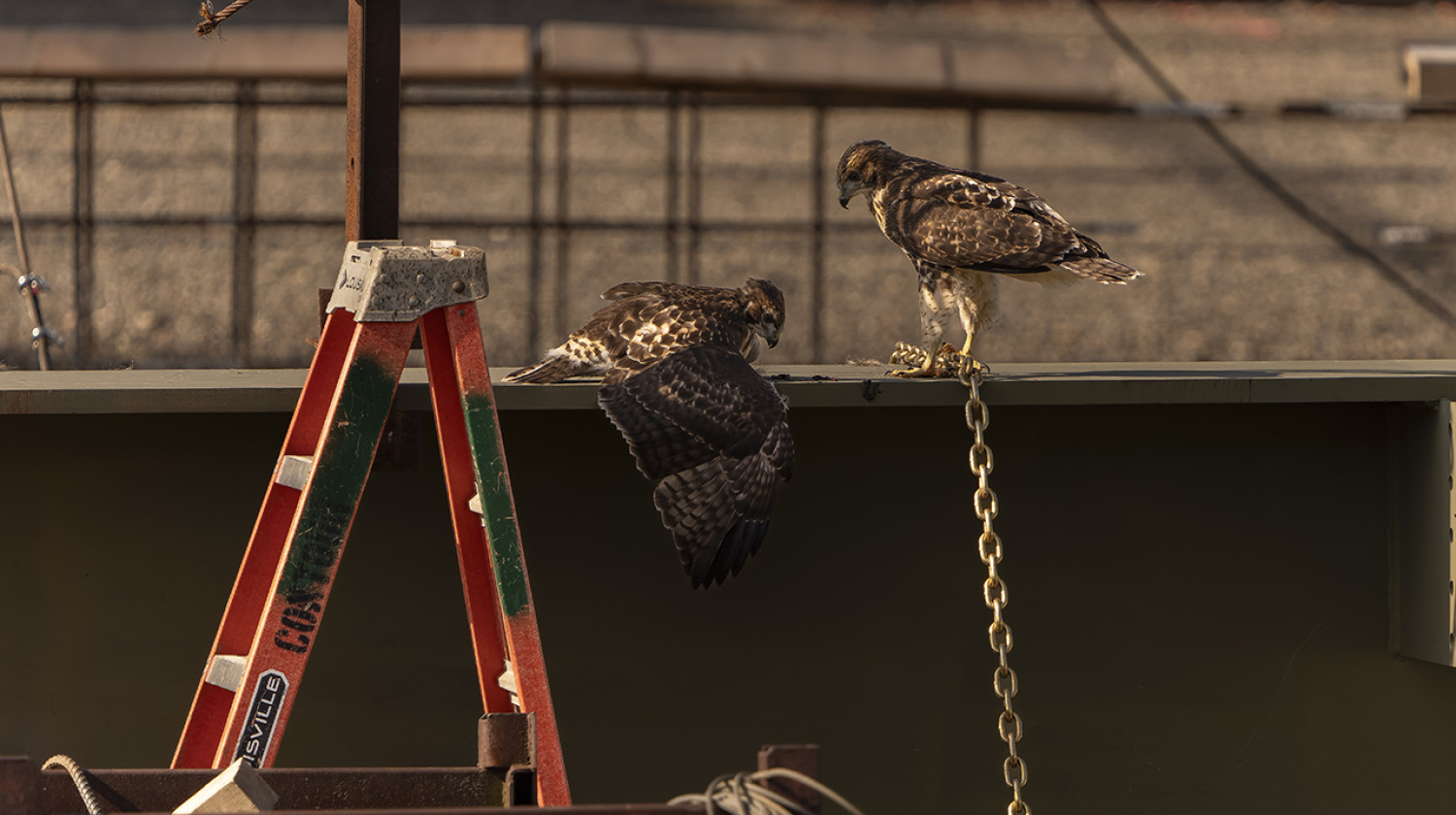
Fledglings enjoy a snack on a truss.
Cynthia Sedlacek ’84 said if a colleague hadn’t told her about the red-tailed hawk cam more than a decade ago, she wouldn’t be the birdwatcher and photographer she is today.
She and her husband, Karel Sedlacek, were immediately hooked, watching the hawks daily and eventually tracking them in real life with cameras and scopes and sharing the experience with others.
“I certainly would not have been aware of birds or hawks without having been introduced through the cams,” Cynthia Sedlacek said. “Absolutely not.”
“I’d be playing golf,” Karel Sedlacek said. “I probably would be oblivious to raptors and things like that.”
Following Big Red closely brings immense joy, the Sedlaceks said, but also heartbreak, as fledglings often die from collisions with buildings and glass. “You’re always holding your breath a little bit with the chicks,” Cynthia Sedlacek said.
One billion birds in the U.S. and Canada die annually from collisions. At Cornell, 13 of the 41 hawks observed on the cam have been injured or killed due to collisions.
Inspired by the hawks, the Sedlaceks joined with other Cornell staff, alumni, students and volunteers to create Bird-Friendly Cornell, a group that’s helping to make campus safer for birds. With the group’s help, the Lab of Ornithology and Stocking Hall installed protective treatments on windows, and construction standards now guide new campus buildings, including Atkinson Hall, which features bird-friendly glass.
For the new building, Facilities ordered glass etched with dots spaced two inches apart to ensure the hawks, and countless other birds, would avoid colliding with the windows.
A much-anticipated return
As construction proceeded, Duell’s crew worked with the Lab to keep the cam running, installing new power and data lines at the remaining poles so the camera would be ready.
On March 5, the cam came back online for its 14th season. Viewers watched Big Red and her mate, Arthur, rearrange twigs left from 2024 on a remaining light pole, shaping the pile into a bowl. Before long, viewers saw the nest gain one brown-speckled egg, then another and finally a third. Cam viewers followed along as Big Red and Arthur raised their fledglings, seemingly unfazed by the new building rising on their territory.
“It worked out perfectly,” Duell said.
Through the construction, manager Doug Sheerer watched Big Red nearly daily. Now, as he and the construction team prepare to wrap up the fieldhouse, which will open in spring 2026, he is anticipating Big Red’s return.
“This project was all about trying to be progressive and build infrastructure and work around nature at the same time,” Sheerer said. “It can be done if you just pay attention to what you’re doing.”
Media Contact
Get Cornell news delivered right to your inbox.
Subscribe