News directly from Cornell's colleges and centers
Winning digital ag idea targets killer ants
By Kathy Hovis
Students inspired by their work with the Jane Goodall Institute won the $3,000 grand prize at this year’s Digital Agriculture Hackathon with an idea to combat driver ants.
“Agriculture is so integrated and involves so many disciplines that can work together to advance new technology,” said Taika von Konigslow, assistant professor in the Cornell College of Veterinary Medicine and one of this year’s hackathon’s organizers. “All of the students here talked to people in industry to identify some real pain points and areas where they can help.”

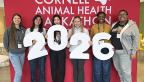
Members of the winning team at this year's Digital Agriculture Hackathon.
The winning team developed a pheromone-based misting deterrent system for beekeepers, which misdirects the driver ants, deterring them from their target without ecological harm. Driver ants are a carnivorous pest that threaten beekeepers, poultry producers and other agricultural products, as well as wildlife, and are a problem through Africa, the Middle East and Asia.
“We were at a wildlife sanctuary with a lot of different primates, and they would pour gasoline around the cages to deter the ants, but they would often have to reapply it and there are wildfires there, so gasoline isn’t a good solution,” said Ava Cabble DVM ’27, a member of the winning team. “We saw animals who had their ear canals eaten out by these ants. And a lot of these animals are endangered in that area.”
Focusing on beekeepers as their initial target market would allow the company to bring in revenue as it seeks to expand into other non-profit areas, team members said.
“Our model that has a method for larger-scale beekeepers that will help us subsidize our other approach, which will provide help for smaller subsistence farmers,” said Shaan Mehta ’26 (CALS). “Our long-term goal is to propose this as a solution to JGI (the Jane Goodall Institute) that they could install at their wildlife sanctuaries.”
“This is really in Jane Goodall’s memory and in her honor and inspired by her,” said Daeden Archer DVM ‘29.
Alexander Harris ’26 (ENG) provided expertise to create the company’s prototype. “We didn’t know much about pheromone-based testing going into the weekend,” Harris said. “We talked with mentors about different approaches we could take and that’s what we landed on.”

The Digital Ag hackathon, sponsored by the Cornell Institute for Digital Agriculture and powered by Entrepreneurship at Cornell, brought 116 students to Atkinson Hall for the weekend of Feb. 27-March 1, where they devised solutions to challenges related to controlled-environment agriculture, climate-smart agriculture, data-driven digital ag innovation, circular agrifood systems and one health (the integrated heath of people, animals and the environment). The students were mentored by 50 faculty, staff and alumni throughout the weekend.
Four other teams — with ideas ranging from an electric weeding robot, a tool to detect insects using audio and wavelength recognition, a same day mastitis test and a robotic arm for flower thinning at apple orchards — took home awards of $1,000 to $1,500.
“This allows young minds who are so keen to contribute to the world to try out ideas and innovative solutions,” said Edmund Mabaya PhD “08, professor of global development in the College of Agriculture and Life Sciences, who was a mentor during the weekend. “The digital ag space is one of the most promising for new areas of technology.”
Fridah Mubichi-Kut, a professor of the practice in the Dyson School of Applied Economics and Management at the SC Johnson College of Business, also served as a mentor during the weekend. She recently connected her Cornell students with students in a Kenyan university in January for a SMART Innovation Sprint in Kenya - a hands-on initiative where students created digital solutions addressing ecotourism, carbon sequestration and social commerce.
“We’re trying to mimic the situation in a real-world setting – how do you work together to solve a problem?’ she said. “This generation is really hungry for their knowledge to have real application.”
Entrepreneurship at Cornell has two more hackathons this semester, a Health AI Hackathon March 6-8 and an AI Unleashed Hackathon March 13-15, both in New York City.
Media Contact
Get Cornell news delivered right to your inbox.
Subscribe