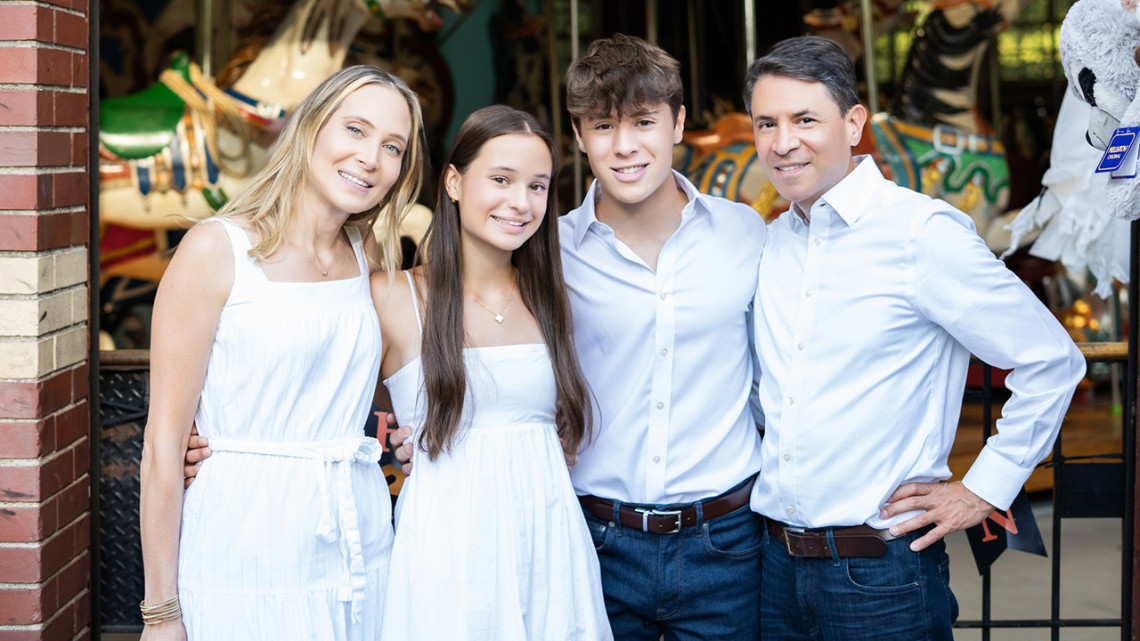
The Uribe family is searching for a stem-cell donor for 15-year-old Max (second from right).
Stem-cell registry drive will mobilize campus to save lives
By Joe Wilensky
“I’m posting this because I need your help to save my son.”
On Feb. 10, Juan Uribe ’96 published a TikTok video urgently seeking a stem-cell donor for his 15-year-old son Max, who faces bone marrow failure and a high risk of blood cancer. The video – Uribe’s first – went viral, reaching 21 million people, nearly 40,000 of whom requested at-home kits to donate.
To help Max and thousands of people in need of life-saving intervention, Cornell is hosting a stem-cell cheek swabbing campaign March 13-20 across the Ithaca campus. The goal: Inspire 10,000 students, faculty and staff ages 18-35 to spend 30 seconds swabbing themselves to join the national stem cell registry.
Cornellians who match with a patient in need could donate stem cells or blood-marrow through NMDP, a nonprofit that facilitates transplants. Donors must be 18-35, making universities ideal places to test for would-be matches. Cheek swabbing on a diverse campus can be especially helpful for patients like Max, as there is a critical shortage of Black and Latino donors.
“Cornell is proud to partner with NMDP to drive science, strengthen the national registry and expand opportunities for Max and the thousands of other patients who are awaiting life-saving transplants,” said President Michael I. Kotlikoff. “I know that our community will enthusiastically come together to help others, advance knowledge and do the greatest good.”
Big Red, Big Impact – the largest such event NMDP has ever hosted – will entail swabbing stations across the campus, with an extensive network of volunteers assisting with signups and handing out kits for Cornellians to swab the insides of their own cheeks. People will be able to swab themselves at sites ranging from North Campus to Collegetown and Willard Straight Hall. More information, and volunteer signups, can be found here.
NMDP has facilitated more than 140,000 transplants overall since 1987, and, in 2024 alone, impacted nearly 8,000 lives. If a match is made, all donor expenses are covered by the organization, including medical and travel expenses, lost wage reimbursement and even child or pet care.
Registry drives on college campuses are crucial because cells from younger donors lead to significantly better long-term outcomes for patients. Joining the marrow and stem-cell donor registry is as simple as submitting a cheek swab, either via a kit sent in the mail or at an organized donor event.
“We constantly have people aging off the registry, and so we have to keep adding new, young, diverse registry members and potential donors,” said Erica Sevilla, spokesperson for NMDP.
About 18,500 patients every year are diagnosed with blood cancers in the U.S., Sevilla said, and most will need unrelated donors for stem cells or blood marrow. Only 25% of patients find a match within their families.
The Uribes learned 10 years ago that Max had low levels of white blood cells and platelets in his blood count. They have been carefully monitoring him ever since. While Max still feels healthy, tests last year showed an alarming change in blood and bone-marrow markers, putting him at high risk for developing myelodysplastic syndrome or acute myeloid leukemia. Doctors recommended a stem-cell transplant.
If a perfect stem-cell donor is found, Uribe said, his son’s five-year survival rate could be 95%.
“This started off as a personal search to help my son find a perfect match donor, but I realize this is a need that many other families have – and that could help save thousands of lives,” Uribe said, whose story has made headlines across the country, from CNN and CBS to People Magazine and USA Today.
Max’s Colombian heritage makes finding an ideal match particularly challenging. Across the NMDP and other global donor registries, white patients have an 80% chance of a perfect match. For Latino and Hispanic patients, it’s 50%; and for Black patients, 30%.
Juan Uribe’s ambitious mission now aims to not merely add 1 million new potential donors to the 43 million people in the worldwide database by April, but to significantly diversify the donor pool.
That message has already been heard: Of the thousands of at-home kits sent out since Uribe’s online postings, 57% were requested by people of Hispanic or Latino heritage.
But because only about half of at-home testing kits typically get returned, stem-cell registry drive events – where people submit 30-second cheek swabs right then and there – are key to boosting registration.
While the word “transplant” is used in conjunction with bone marrow and stem-cell therapies, the word may be off-putting or scary for potential donors, said Dr. Catherine McGuinn, a pediatric hematologist and oncologist at Weill Cornell Medicine who has treated Max since he was 6.
Unlike donating a kidney or donating organs after death, “this is a resource that you’re able to give that is renewable,” McGuinn said. “This is really low risk, high reward – it’s a couple of cheek swabs that give you the opportunity to match with someone.”
About 90% of the time, blood stem cells are collected through a simple nonsurgical outpatient procedure that is very similar to donating platelets or plasma. The process also requires five days of shots leading up to the donation to boost production of the blood stem cells.
In about 10% of cases, patients require donations of bone marrow, which is a same-day procedure performed under anesthesia, where liquid marrow is drawn from the pelvic bone.
“The majority of donors say they would absolutely do it again,” Sevilla said. “It’s a very selfless act to donate, and it’s a living donation: We regenerate our blood stem cells, we make millions every single day. And for the patients, this is a life-or-death matter.”
In addition to connecting with Kotlikoff, Uribe has been mobilizing other Cornellians, getting the word out through the Class of 1996 Council and the national office of his fraternity, SAE.
Becoming a donor is a two-step process, Uribe said.
“Step one is to get swabbed and enter the registry, but then step two is, if and when you’re called, to actually pick up the phone and be willing to follow through with a donation,” he said. “This is the easiest way that you can save a life, and you’ll have that forever as something that you did.”
Media Contact
Get Cornell news delivered right to your inbox.
Subscribe