This year's Dragon Day theme, “Veiled,” will feature layered scales of stretched fabric partially concealing the dragon's skeleton of two-by-fours and plywood.
Enter the dragon: Milestone Dragon Day to take viewers inside
By James Dean, Cornell Chronicle
A red-eyed dragon veiled in sheer black scales – spikes lining its undulating, 100-foot-long frame – will prowl through campus March 27, celebrating a College of Architecture, Art and Planning tradition born 125 years ago.
Dragon Day, as the experience has been known for decades, showcases the creativity and construction chops of first-year architecture students, who will guide a winged serpent they’ve designed and built along a public parade route ending at Sibley Hall on the Arts Quad. There, inviting deeper community participation on the milestone anniversary – the quasquicentennial, to vocabulary buffs – parade-goers will have the opportunity to enter the dragon, strolling through arched torso and tail sections.

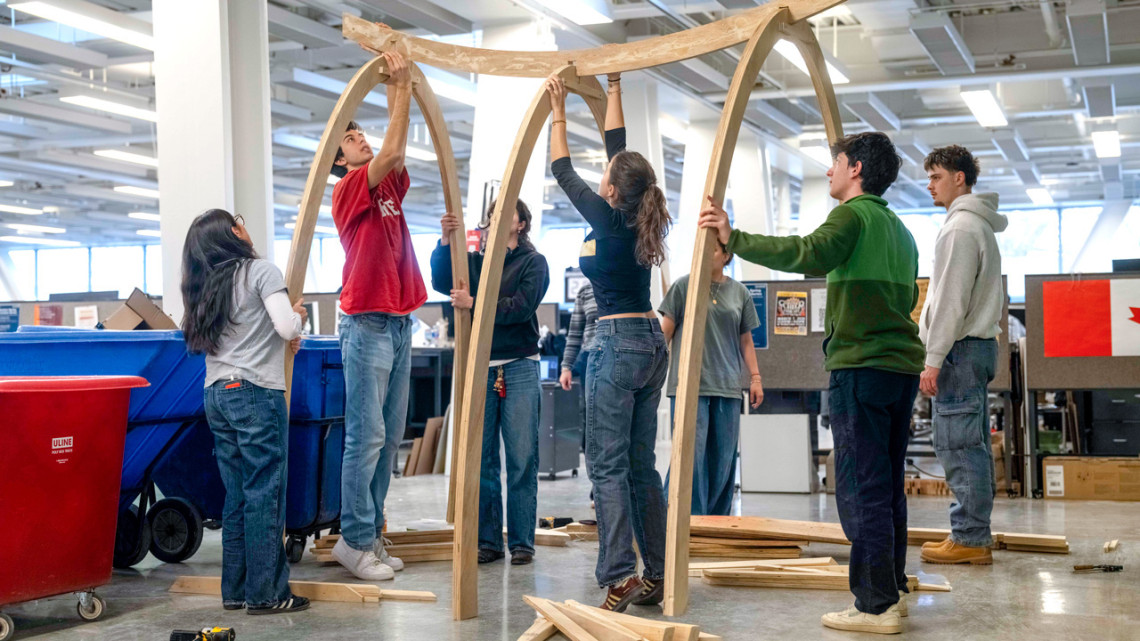
Class of ’30 B.Arch. students building a section of the dragon they’ll unveil March 27 on Dragon Day, carrying on a tradition whose precursor dates to 1901.
“It brings the project one step closer to real architecture, where people can enter the dragon and experience the space it creates inside,” said Adam Sheena, B.Arch. ’30, a Dragon Day co-leader with Abraham Woolner, B.Arch. ’30. “It’s exciting, and it aligns with what we’re doing in school.”
Starting at 1 p.m., the parade will depart Rand Hall, snake across Feeney Way, down Campus Road and then through Ho Plaza before entering the Arts Quad. The costumed students’ trademark call-and-response chant – “Dragon! Dragon! Dragon! Oi! Oi! Oi!” – will resound throughout, possibly complemented by other performers.
The students’ theme this year, “Veiled,” features scales of tensile (stretched) fabric that will partially conceal the dragon’s skeleton of two-by-fours and precision-cut plywood. Layered tiles of the semitransparent fabric will form surprising shapes and patterns that shift depending on one’s point of view, the designers said.
“We’re creating moving architecture with this dragon,” Woolner said. “The fabric will be draped over this frame and pulled apart to create tension. That will create interesting undulations, but also show the structure seeping through.”
The students drew inspiration from their “Structural Systems” class, which introduced the work of German architect and structural engineer Frei Otto, known as a pioneer in developing lightweight tensile and membrane structures. Examples of the concept in everyday life, the students said, include an umbrella, or Bedouin-style tents that are easily disassembled, moved and reassembled.
Dragon Day’s historical record is incomplete, but its precursor, the brainchild of Willard Straight 1901, is believed to have started on St. Patrick’s Day in 1901 with festive banners hung outside Lincoln Hall, where the architecture college was located. A serpent appears to have been introduced by 1911, but the name “Dragon Day” was not used in print until the ’80s, preceded in the ’70s by a “Green Dragon Parade,” according to Cornell historian Corey Earle ’07, visiting lecturer in American Studies in the College of Arts and Sciences. There have been many years without a celebration – most recently, the pandemic scuttled parades in 2020 and 2021 – but this year may credibly be called the 125th anniversary, Earle said.
The Class of ’30 students said they’re honored to join such a venerable – and fun – tradition.
“Dragon Day is probably the one opportunity our entire class gets to collaborate and build something that represents us,” Sheena said.
Even late-20th century dragon designers might marvel at today’s process. The structure unveiled March 27 will have been designed digitally and prototyped before being assembled with the help of high-tech shop tools like a computer numerical control router, which can rapidly carve precise, programmable shapes. But final construction still relies on tools Straight might have used: nails, screws, staples and glue. (See the students’ Instagram feed for a sneak peek at their work.)

Dragon Day showcases first-year architecture students' creativity and construction chops. Starting at 1 p.m. on March 27, they'll parade the dragon they've designed around and into the Arts Quad.
Besides encouraging class bonding and a festive start to spring break, Dragon Day loads the first-year architects with real-world responsibilities. Roughly 80 classmates must translate their ideas into a coherent theme in a matter of weeks, with no help from faculty. Elected teams lead construction, budgeting, marketing and fundraising for the event, which is financed entirely through T-shirt sales and donations. Coordination with university officials and police ensures the event is properly permitted and meets public safety requirements.
“We’re doing this project independently, so it’s a great exercise in learning what we can do on our own,” Sheena said. “Every one of us really has a voice.”
As recently as 2009, the event culminated in burning dragons or related structures, such dragon eggs, on the Arts Quad, a practice that environmental regulations rendered obsolete. Students since have emphasized sustainability, including reusing two-by-fours and designing lasting secondary structures from the materials, like benches – and the dragon now has a flame-retardant coating. This year’s finale promises fellow students and members of the public an insider’s view of the dragon and its design process, as they are welcomed to walk through the structure’s interior prior to its disassembly.
“For the 125th anniversary,” Woolner said, “we wanted to create an opportunity for community involvement, where people could come together.”
Media Contact
Get Cornell news delivered right to your inbox.
Subscribe