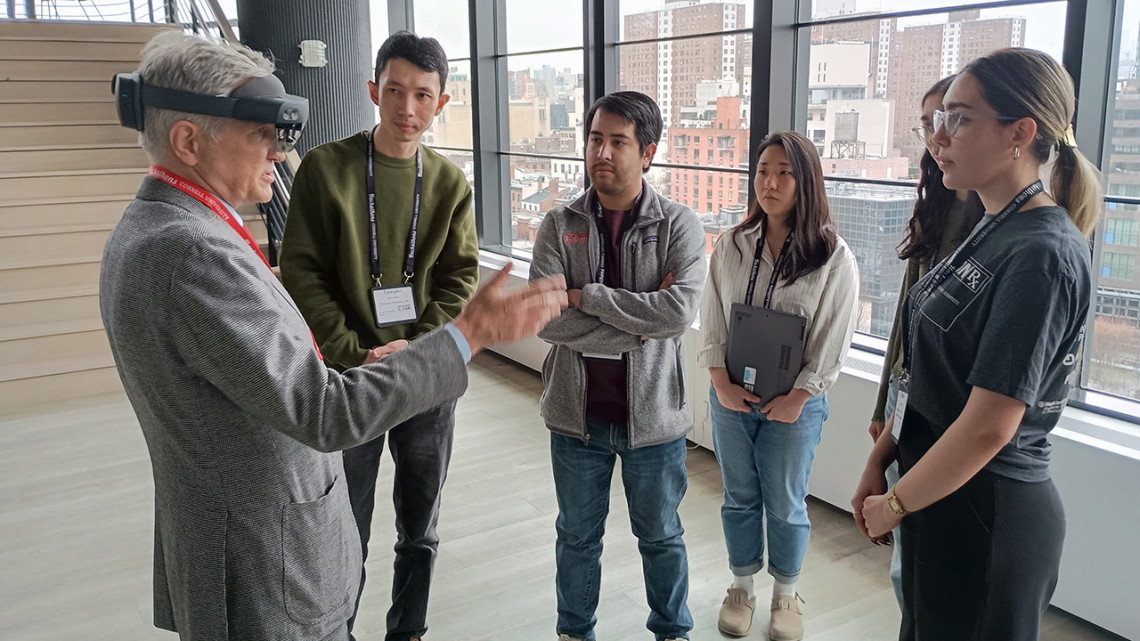
Team Spiny Senses works with Weill Cornell Medicine neurosurgeon Dr. Roger Härtl, left, to develop a system designed to modernize scoliosis screening during the Cornell health AI Hackathon. The team won the hackathon’s grand prize.
Students pitch AI-inspired solutions at Cornell Health Hackathon
By Carla Cantor
Many of health care’s toughest challenges – from delayed diagnoses to inefficient clinical workflows – are waiting for creative solutions. At the Cornell Health AI Hackathon, student teams spent an intense weekend racing to build some of them.
More than 100 students from across Cornell campuses and 17 other universities gathered March 6-8 in New York City for the hackathon. Organized by Entrepreneurship at Cornell with partners including Weill Cornell Medicine’s Englander Institute for Precision Medicine, and the Clinical and Translational Science Center (CTSC), along with Cornell Tech, the event brought together interdisciplinary teams from medicine, engineering, computer science and business.
Over 36 hours, participants developed and pitched prototype technologies aimed at improving health care delivery.
“Artificial intelligence has dramatically changed what students can accomplish in a short period of time,” said Ami Stuart, who has organized Cornell hackathons for more than a decade through Entrepreneurship at Cornell. “What once required weeks of coding can now be done in hours. That allows students to focus more on solving real problems.”
Teams of four to six participants – bringing together undergraduate and graduate students, medical trainees and researchers – formed around health challenges they set out to tackle. Some connected during online sessions organized ahead of the event, while others finalized their teams when the hackathon began.
Mentors from medicine, engineering, data science and industry circulated throughout the weekend, offering guidance as teams refined their ideas.
The event also featured a pop-up maker space from Cornell Tech, equipped with 3D printers and other tools to help teams prototype hardware and test concepts. Sponsors included Johnson & Johnson, NewYork-Presbyterian and NextJump, the New York technology company that hosted the hackathon at its Chelsea headquarters.
Andrea Sboner, director of informatics and computational biology at the Englander Institute and one of the judges, said the quality of the projects was impressive given the limited time teams had to develop them.
“With the help of AI tools, students can build functional prototypes much faster than in traditional coding hackathons,” said Sboner, who is also an associate professor of pathology and laboratory medicine at Weill Cornell Medicine. “That allows them to focus on the problem itself and explore solutions that might have taken much longer to develop in the past.”
Eight of 21 teams were selected to present their solutions to peers, mentors and sponsors in a competitive round. Each team delivered a four-minute presentation followed by a question-and-answer session with judges.
Olivier Elemento, director of the Englander Institute and associate program director of the CTSC, served as a judge alongside Sboner and Alexandros Sigaras, assistant professor of research in systems and computational biomedicine and director of the AI-XR Lab at the institute. The three helped coordinate 17 Weill Cornell Medicine faculty mentors who advised teams throughout the weekend.
Data-driven care
Academic medical centers now have access to enormous amounts of clinical data that could help improve patient care if researchers develop tools to analyze it, Elemento said.
“The idea of a learning health system is that hospitals learn from patient data to continuously improve care,” he said. “But for that to happen, clinicians and researchers need to understand AI well enough to build and use these systems effectively. Events like this hackathon help make that possible.”
After two days of intensive development, the student teams presented their solutions to a panel of judges. Each team had just four minutes to explain its idea and demonstrate its potential impact.
The $2,000 grand prize went to Team Spiny Senses, which developed SpineSight XR, a system designed to modernize scoliosis screening, a condition that affects an estimated 2% to 3% of the U.S. population. Using extended-reality (XR) imaging and AI-assisted measurement, the system helps clinicians detect spinal curvature more precisely during routine screenings. Early detection is critical because spinal curves can worsen rapidly during adolescence.
Spinesight XR team member Remi Ladia ’28 said her interest in the project was personal. She was diagnosed with scoliosis as a child and was initially told the condition was not serious, but by adolescence she needed to wear a brace.
“Typically, scoliosis screening in schools relies on a visual check while a student bends forward,” Ladia said. “With SpineSight XR, we’re moving screening from guesswork to precision, bringing earlier detection and better outcomes to children everywhere.”
The $1,000 Greatest Impact prize went to Scrub XR, an AI-powered system designed to improve operating-room safety and efficiency by tracking surgical instruments in real time.
During surgery, instruments such as scalpels, clamps and scissors are still counted manually to ensure none is left behind. Scrub XR uses computer vision and extended-reality glasses to identify instruments as they are passed between clinicians, automatically updating counts and reducing the risk of errors.
The $1,000 Best Use of Hardware award went to the team that developed a wearable device designed to help patients and clinicians monitor conditions and communicate more effectively in the ER. The system includes a multilingual voice-first waiting-room interface that captures symptoms in a patient’s native language, provides wait-time updates, passively monitors physical distress through a wristband and allows patients to indicate pain when words fail.
Sigaras stressed the importance of giving students the opportunity to turn concepts into reality.
“These tools are making it possible for students to move very quickly from an idea to something tangible,” Sigaras said. “Instead of spending most of their time building infrastructure, they can focus on the clinical problem they’re trying to solve.”
Stuart said at least a dozen companies have emerged from Cornell hackathons over the past decade, often with support from mentors or university entrepreneurship programs.
“You’re not building a million-dollar product in a weekend,” Stuart said. “What judges look for is proof of concept – technical feasibility, a viable idea and some indication there’s a market for it.”
Carla Cantor is a freelance writer for Weill Cornell Medicine.
Media Contact
Corinne Esposito
Get Cornell news delivered right to your inbox.
Subscribe