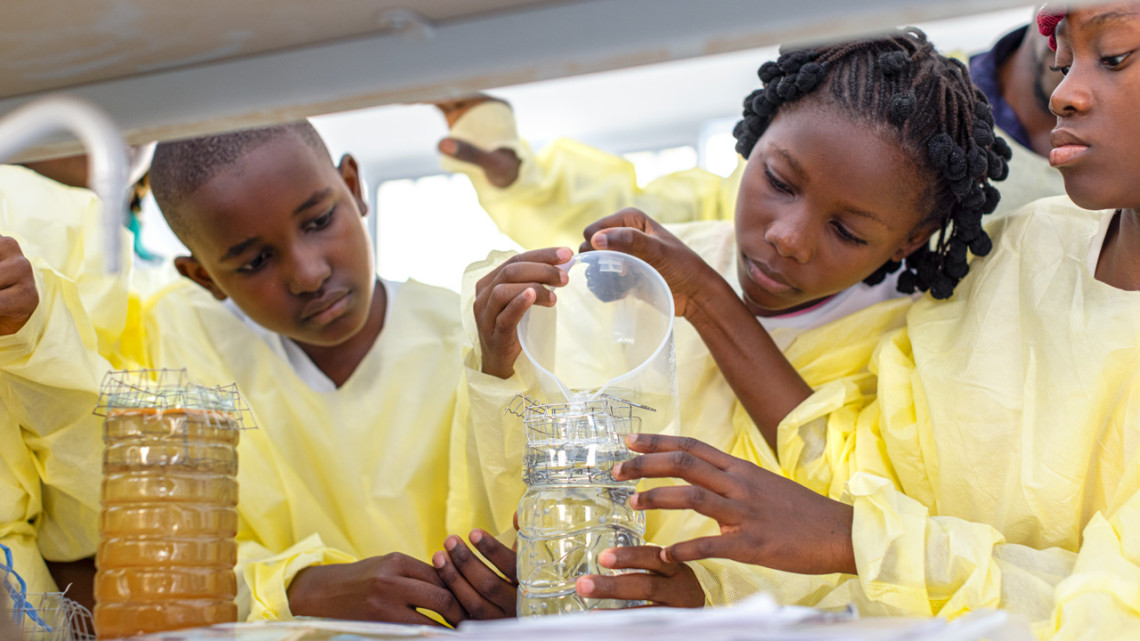
Students perform a wet aggregate stability experiment as part of STEAMpact’s Comunidade Ubunye project in Angola.
Grad student ignites a passion for science in Angolan youth
By Holly Hartigan, Cornell Chronicle
Hours after Cátia Dombaxe was born, robbers shot her 13-year-old brother Lulu in their home in Sambizanga, Angola. A bullet pierced his lungs while he shielded her with his body. She was unharmed.
“I never met him because I was a couple of hours old, but I’ve always felt connected to him,” said Dombaxe, a doctoral candidate in the field of biomedical engineering. “His dream was simple: to care for his people and lift our family and community out of poverty.”
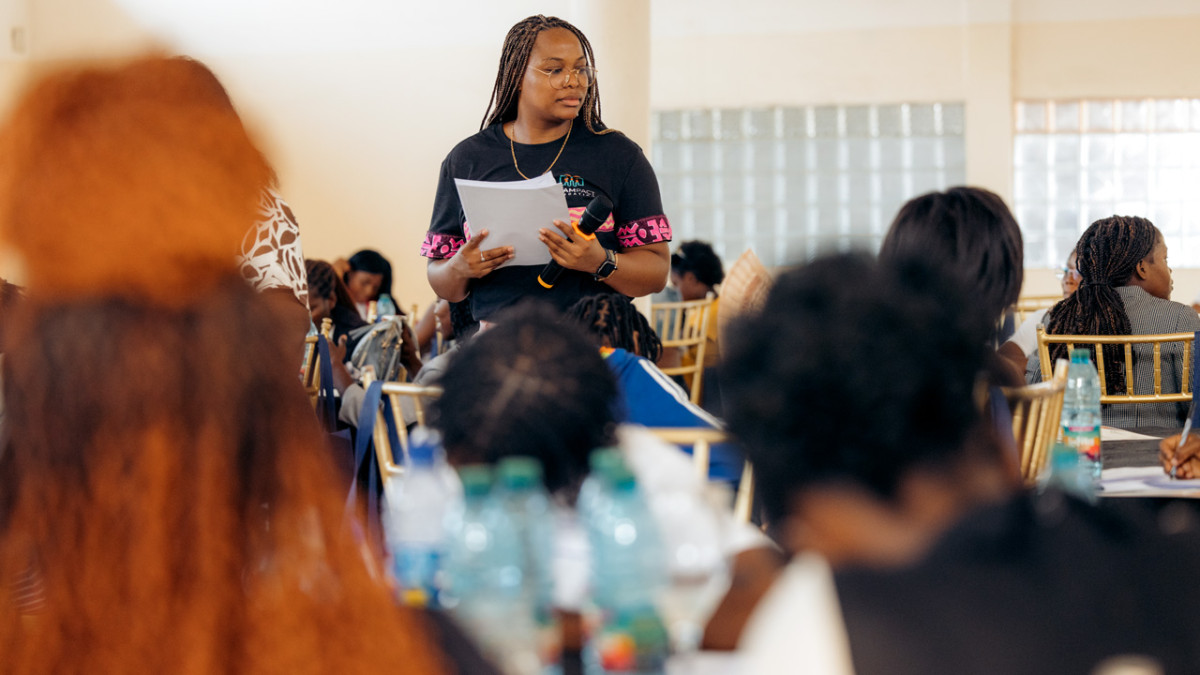
Doctoral student Cátia Dombaxe facilitates an EducateHer workshop in Angola, where STEAMpact delivered training on women’s health, reproductive health and financial literacy.
Today, she is bringing badly needed practical science education to impoverished areas of Angola through the STEAMpact Foundation, a nonprofit she founded in 2024.
So far STEAMpact has attracted a $8,625 leadership grant from the President’s Council of Cornell Women and a NatGeo Explorer grant from National Geographic. Entrepreneurship at Cornell named STEAMpact its 2025 Student Business of the Year in April 2025.
“I was born in one of the most dangerous neighborhoods in Luanda,” she said, “and my family was very, very poor. We didn’t have much, but my parents always believed in education.”
Growing up, Dombaxe was a good student, but a failed experiment trying to make an egg bounce fired up her curiosity about science.
“This sense of wanting to know more is why I’m a scientist today, not because I always dreamed of being a scientist,” she said.
Now at Cornell pursuing her Ph.D., Dombaxe is attempting to create a therapy that could help neurons regenerate after spinal cord injuries. Outside the lab, she is committed to helping young people connect to science, technology, engineering and math (STEM) education.
In May 2024, STEAMpact launched a 1.5-year pilot project called Comunidade Ubunye to connect 10- to 18-year-old students with science at one school in Angola.

Facilitators of the Comunidade Ubunye project measure the height of maize plants grown during a hands-on STEM agriculture experiment. The corn produced through this experiment was later used to prepare meals for girls at a nearby orphanage.
“Due to the lack of hands-on experiences in schools, most of the children, they’re not interested in science,” Dombaxe said. “They’re not curious about science because science is very abstract, unless they get to touch it and see it.”
She and her collaborators designed 10 STEM experiment kits, choosing concepts that have practical applications for the students. One experiment shows the impact of fertilizer rates on plants. Another demonstrates how water purification works.
“I wanted to teach science that was not only tangible but was something that they saw every day,” Dombaxe said.
First, the STEAMpact facilitators trained 51 teachers how to use active learning principles to better engage students in the classroom. Then they selected 10 of those teachers to learn how to use the kits and implement them in the classroom.
In total, these teachers reached 1,278 students in the 2024-25 school year. The STEAMpact team collected surveys after the program, finding significant increases in problem-solving confidence and their familiarity with STEM.
The group realized, though, that they needed buy-in from the students’ parents and broader community for the program to flourish.
“We have the philosophy that you need a village to educate a child,” said Nelma Trindade, STEAMpact’s vice president, who oversees the organization’s operations in Angola. “We decided we needed to help not only the students, but we needed to help the community embrace the difference and think outside of the box.”
They created a series of workshops: EducateHer connected women with experts in financial literacy and women’s health and hygiene; EmpowerHer trained female farmers in leadership and sustainable agriculture; and ImpactHere facilitated direct interactions with a diverse network of professionals drawn from varying fields in Angola.

The EmpowerHer initiative trained 50 women in leadership and sustainable agriculture.
“If you really want to bring holistic impact to people, you cannot just come and bring education,” Dombaxe said. “You’re going to have to come and help them with health. You’re going to have to convince the parents to have the children come. You have to be able to create this umbrella where you’re doing a little bit of everything to have it come together.”
The program ended with a science competition, where groups of five students created their own STEM experiments, kits and lesson plans. The winning team invented and tested an insecticide made from a native plant.
“They actually went within their own environment to look for things that they could show were scientific,” Dombaxe said. “To me, that was the most powerful thing that I could have done with those children.”
She hopes to scale the organization to more schools and more countries.
The teachers in the pilot project are still using the experiment kits and the skills they learned and have the resources to continue using the kits for three years.
Meanwhile, the students are seeing science everywhere. Trindade said one student has helped his uncle identify the best soil on his farm. Others have shared water purification practices with their neighbors.
“They’re literally applying what they learned to the community,” she said, “and they’re helping their families with science from the knowledge that they got from experiments. It’s beautiful to see.”
Media Contact
Get Cornell news delivered right to your inbox.
Subscribe