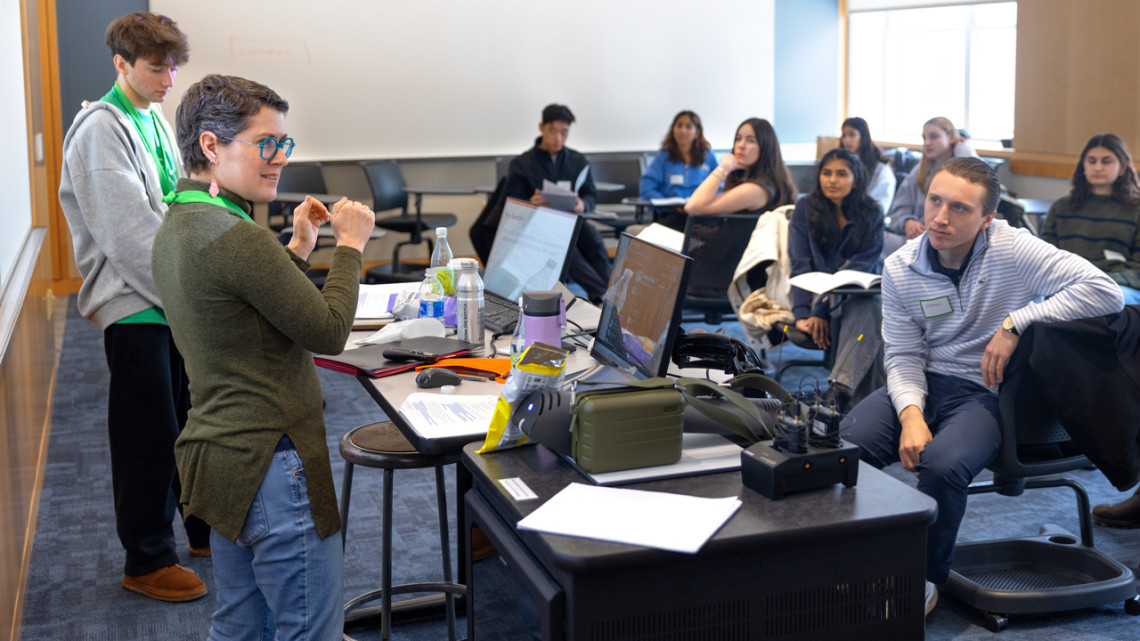
Hadas Kress-Gazit, the Geoffrey S.M. Hedrick Senior Professor in the Sibley School of Mechanical and Aerospace Engineering, part of the Cornell David A. Duffield College of Engineering, leads students through a breakout discussion during the new course Pathways to Purpose – Civic Leadership in Law, Health, Tech and Business.
Civic leadership class asks students to consider their purpose
By Holly Hartigan, Cornell Chronicle
On a Saturday morning in February – the coldest day yet of a cold winter – more than 350 students trekked to Statler Hall to learn about civics.
The students, from every undergraduate college, were taking a new one-credit course, Pathways to Purpose – Civic Leadership in Law, Health, Tech and Business – the product of a collaboration including the Cornell Jeb E. Brooks School of Public Policy, the College of Human Ecology, the Center on Global Democracy and the Center for Dialogue & Pluralism.
The course instructors had hoped to attract a handful of students for the intensive weekend program, with university leaders, faculty, staff and alumni guiding students through conversations about the role of purpose, civic engagement and democracy in their personal, academic and professional lives.
Throughout the weekend, facilitators from the Center for Dialogue & Pluralism (CDP) modeled civil discourse in small seminar groups focused on real-world challenges and the purpose of a Cornell education. Their aim was to equip students with the skills to support resilient democracies and work with people of different backgrounds and perspectives.

As part of the new course, students broke out into small groups to discuss big questions relating to law, health, technology and business.
“The fact that so many students wanted to be part of it was so exciting and gratifying,” said co-instructor Rachel Dunifon, the Rebecca Q. and James C. Morgan Dean of the College of Human Ecology. “It’s a really different model for Cornell.”
The class asked students to step back from their other assignments and distractions to think about what it means to lead a life of impact and purpose. They considered what and how they could contribute to the Cornell community and beyond.
“It’s so good for our brains and our bodies and our whole being to be able to have those conversations,” Dunifon said. “I think this just shows that our students are hungry for these opportunities.”
Co-instructor Colleen Barry, dean of the Cornell Brooks School of Public Policy, said it can be challenging to view democratic deliberation as an avenue for change in this moment of extreme political polarization, where it is hard to pass laws and enact policy, given the partisan divide. But learning how to bridge this gap through informed discourse across difference and effective collaboration is essential.
“I think courses like this can work against apathy,” she said, “by giving students concrete tools and approaches to contribute to solving real world problems in our country and around the globe.”
The weekend kicked off with a panel of faculty and academic leaders discussing what Cornell owes democracy, followed by a panel of alumni on advancing the public good. Afterward, students broke into seminar groups led by faculty experts and CDP peer facilitators focusing on challenges in health, law, business or technology.
“Students had an opportunity to feel real community connection and individual empowerment,” said Rachel Beatty Riedl, the Peggy J. Koenig ’78 Director of the Brooks Center on Global Democracy and professor in the Brooks School and the College of Arts and Sciences.
As a peer facilitator, Gianna Leon ’27, a biology major in the College of Agriculture and Life Sciences, taught dialogue skills for moving conversations forward even in the face of disagreement. She said the class created forums for open dialogue where students and faculty wrestled with big topics, all bringing their individual expertise and experiences to the conversations.
“Each unique perspective gives us another way to tackle these larger problems,” she said. “In these conversations, hearing all of the different ideas surface and come together to create a bigger picture is really beautiful.”

Lisa Nishii, (from left) senior vice provost for enrollment management and undergraduate education; Rachel Dunifon, the Rebecca Q. and James C. Morgan Dean of the College of Human Ecology; and Colleen Barry, dean of the Cornell Jeb E. Brooks School of Public Policy, look on during panel presentations during the one-weekend intensive course.
Ethan Entenberg ’28, a hotel administration major in the Cornell Peter and Stephanie Nolan School of Hotel Administration, part of the Cornell SC Johnson College of Business, participated in the class as a student. His group grappled with the ethics of replacing human labor with artificial intelligence and robotics. Generally, he thinks innovation is important and wants to embrace it, but he’s not sure how to do that while protecting jobs and without exacerbating inequality.
“I couldn't figure out for me what would benefit society, and then what changes we can make to have innovation, but also not create these large wealth gaps,” he said.
His uncertainty was part of the point. “These questions didn’t have to be answered during that discussion,” he said, “but it’s important to think about them and realize that it’s an issue and that we need to see it in society, work at it and pay attention to it.”
Learning to connect and communicate across differences is crucial for students as our next generation of leaders, said co-instructor Adi Grabiner-Keinan, associate vice provost for undergraduate education and director of the Center for Dialogue & Pluralism.
“The course’s goal was not to walk out of the weekend with a clear life trajectory or a plan for fixing society,” she said. “Instead, we asked students to consider how to use the knowledge and experiences they gain at Cornell to live more purposefully and to influence their communities. We encouraged a habit of reflection and a willingness to act on what matters to us.”
On Sunday, facilitators asked students what they owe democracy and how they can support it right now. Entenberg said he didn’t hear anyone say they were going to walk away.
“We know we owe something,” he said, “and we’re ready to do the work.”
Media Contact
Get Cornell news delivered right to your inbox.
Subscribe