MirrorBot: fostering human connection
By Tom Fleischman, Cornell Chronicle
While technology has made the world “smaller,” it has also pulled individuals apart, thanks to mobile phones and other devices that command our attention.
Cornell researchers wanted to see if they could employ technology, in the form of a mirror-equipped robot, to help bring people back together.
Members of the Architectural Robotics Lab, led by Keith Evan Green, professor in both the Department of Human Centered Design (College of Human Ecology) and the Sibley School of Mechanical and Aerospace Engineering (Cornell Duffield Engineering), built a 4-foot-tall robot – dubbed MirrorBot – with dual mirrors that, when placed in front of a pair of strangers, lets each participant see themself in one mirror and the other person in the other.
In a study involving 16 pairs of participants in a waiting-room setting, MirrorBot spurred conversations, playful exchanges and other interactions between strangers. The findings suggest that robots can act not only as conversational partners, but also as spatial mediators.
“We weren’t just trying to trigger conversations, but to support the very first moment of social connection, which is the eye contact,” said Serena Guo, M.S. ’24, Ph.D. ’25, lead author of “Robot-Mediated Mutual Gaze: How a Mobile Robot with Actuated Mirrors Facilitates Encounters between Strangers,” which was named best paper in the Design Track category at the ACM/IEEE International Conference on Human-Robot Interaction, held March 16-19 in Edinburgh, Scotland.
Other co-authors were Gilly Leshed, Ph.D. ’09, teaching professor in the Department of Information Science, in the Cornell Ann S. Bowers College of Computing and Information Science; Guy Hoffman, associate professor in the Sibley School of Mechanical and Aerospace Engineering (MSE), in Cornell Duffield College of Engineering; Jenny Yu ’25; Wenqian Niu ’25; and MSE master’s student Yifei Gao.
“What have the most popular forms of computing done? Mostly pulled people apart, through social media, and contributed to a lot of mental health issues,” Green said. “And so we thought, maybe we can use computational things to bring people together.”
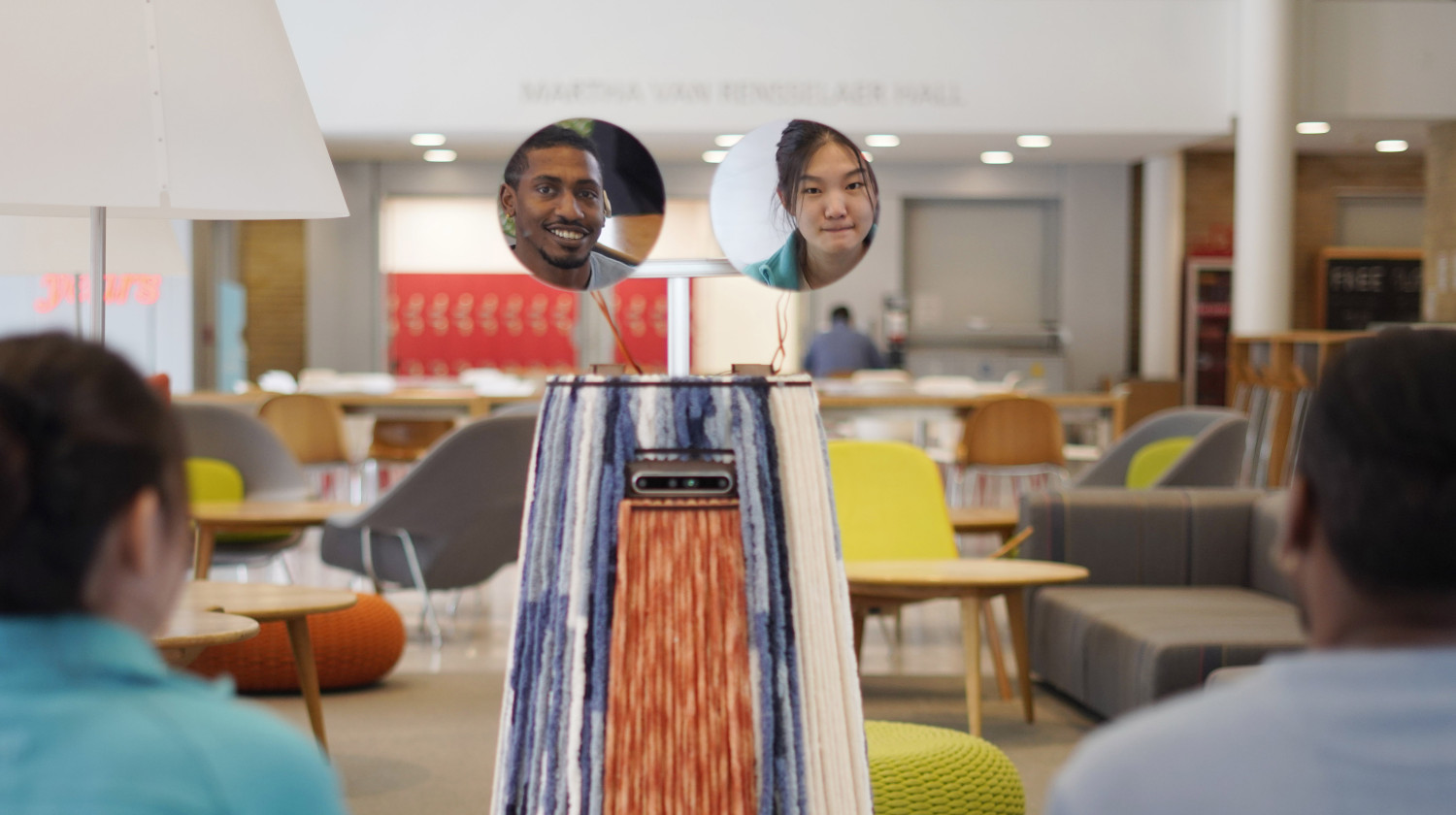
Two students shown to each other using MirrorBot
“I became interested in our everyday environments – everyday moments between strangers – when people are physically close but socially disconnected,” said Guo, now a postdoctoral researcher and lecturer at the University of Wisconsin, Madison. “We saw a lot of the scenarios in waiting rooms, in public parks and other shared environments, where everyone is on their phone. People may be physically together, but socially apart.”
For their experiment, Guo and the research team recruited 32 individuals, ages 18 to 50, and told them they were participants in an experiment involving a short-term memory task (they were later told the true nature of the experiment). Pairs were ushered into a waiting room, with three chairs along one wall of the approximately 12-by-12-foot space.
After a few moments, MirrorBot appeared from behind a screen, teleoperated by Guo, who controlled the robot’s movement and selected from pre-programmed mirror positions until each participant could see reflections of both themself and the other person.
MirrorBot – purposefully small and covered in soft material, so as not to intimidate – elicited a range of behaviors, with 12 of the 16 groups reporting that the first meaningful contact with the other person was through the mirrors and not face-to-face. Some pairs tried to mutually make sense of the robot, others engaged with it, and some used the mirrors as a way to cautiously gauge the receptiveness of the other person.
Not everyone enjoyed the exercise, Guo said.
“A few participants felt uncomfortable,” she said. “We saw them turn away from the robot and frown, which created an awkward moment between the two participants. One participant actually said it felt like ‘an overenthusiastic friend,’ pushing two reluctant people to talk.
“It suggests social technology should not only know how to initiate interaction, but also know when to step back.”
Guo said that for a related paper, she and her collaborators tested other devices – a robot without mirrors, a wall-mounted mirror, and no device at all – to see how interpersonal connections might develop. With a larger participant pool (40 pairs of individuals), they found that MirrorBot was most effective because of the eye contact it facilitated.
They also wondered if any object could serve as an icebreaker.
“Unusual or novel objects can make people talk,” Guo said, “but people often end up talking about the object itself, rather than becoming curious about each other. We feel MirrorBot is different, because the focus is not on the robot – it’s on the other human.”
Green, Guo and the team will present the related paper at the Association for Computing Machinery Conference on Human Factors in Computing Systems (CHI ’26), April 13-17 in Barcelona, Spain.
Media Contact
Get Cornell news delivered right to your inbox.
Subscribe