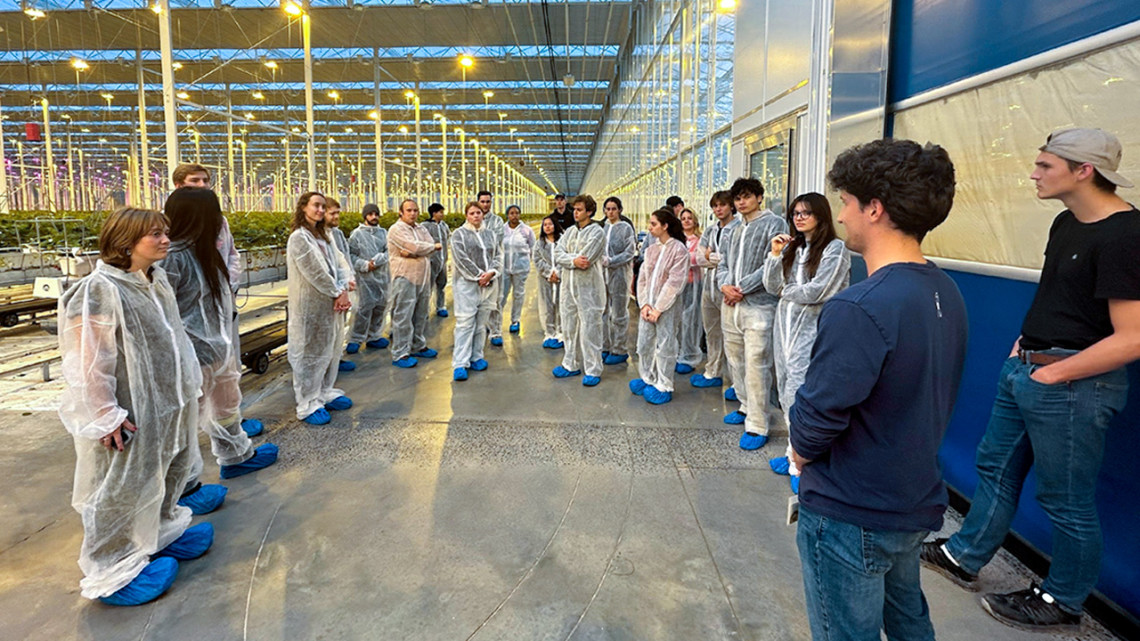
Students in Marvin Pritts’ Berry Crops: Production and Management course visit Green Empire Farms’ 32-acre strawberry greenhouse operation in Oneida, NY. Their protective suits prevent pests and bacteria from entering from the outside.
Creative Teaching Awards celebrate experiential learning, community connections
By Carolyn Keller
Beebe Lake at dawn. Central New York berry farms. A local middle school. An art museum in Queens. The Cornell Teaching Dairy Barn.
These are just a few of the places this year’s Creative Teaching Awards faculty recipients have taken students for hands-on, local learning experiences well beyond the classroom walls.
Now in their third year, the Creative Teaching Awards are sponsored by the Vice Provost for Academic Innovation and the Center for Teaching Innovation. Their goal is to recognize and share innovative teaching strategies that Cornell faculty have implemented into their courses.

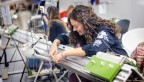
Students in Kathryn Fiorella’s Food Systems & Health course visit Cornell’s aquaponics facility at the Agricultural Experiment Station to learn about controlled-environment agriculture.
The 2026 theme, “Local learning experiences outside the classroom,” aims to highlight human-centered, community-focused approaches to teaching and learning around campus, in the Ithaca community and in New York state.
The winners:
- Misha Ailsworth, assistant professor of psychology in the College of Human Ecology (CHE).
- Kathryn Fiorella, associate professor in the Department of Public and Ecosystem Health in the College of Veterinary Medicine.
- Peggy Leung, assistant professor of medicine, and Andrea Card, assistant professor of clinical medicine, at Weill Cornell Medicine.
- Anthony Ong, professor of psychology in CHE.
- Marvin Pritts, professor of horticulture in the School of Integrative Plant Science, in the College of Agriculture and Life Sciences.
The faculty presented their approaches at CTI’s annual Provost’s Teaching Innovation Showcase, held April 8. They also collaborated with CTI on its Creative Teaching Case Studies, which document their approaches for inspiration and potential adaptation by other faculty.
“Students often benefit from stepping outside the four walls of a classroom to meet people from a nearby community, or into nature. But such experiences must be artfully planned – and successful educational outings sometimes represent semesters, if not years, of finesse,” said Rob Vanderlan, executive director of the Center for Teaching Innovation. “It’s nice to be reminded – and inspired – by the amazing ways faculty find to connect classroom learning with experiences in the wider world.”
Winning approaches emphasized direct connection with community partners, empathetic shifts in perspective or an emphasis on well-being.
From the faculty’s winning case studies:
Ong has been teaching “The Science of Well-Being” for more than 20 years. What originated as a traditional lecture course now leans into experiential learning and Ithaca’s natural surroundings, sending students on “awe walks” and “sensory savoring routes,” “flow mapping experiences” and “community connection hours,” all tied to scientific research on well-being.
Leung and Card incorporate “social prescribing” into Weill Cornell’s internal medicine residency training program. The approach is a holistic community-focused means of addressing psychosocial stressors such as social isolation, financial burdens or intrapersonal conflict, which often impact patient health. Since 2017, they’ve paired residents-in-training with patients for guided museum tours at the Noguchi Museum in Long Island City in Queens – providing time and space to see each other not as doctor and patient, but as human beings and collaborators in care.
For the past two years, Ailsworth has collaborated with English language arts teachers at DeWitt Middle School in the Ithaca City School District. The Cornell advanced undergraduate and graduate students met with the eighth grade students to develop reading discussion guides for young adult books with Black girl protagonists. The goal is to take a closer look at the impact of history, culture and power on the contexts that influence Black girls’ lives – and to encourage the Cornell and DeWitt students to learn from each other.
In coordination with colleagues at Cornell Cooperative Extension, Pritts connects his students with novice berry farmers throughout New York to help diagnose production issues. Each semester, his class pairs with a partner grower. Students visit local farms, consider plant biology, climate science, agricultural economics and more, and develop and pitch plans to help their partner grower build and expand their farm.
In Fiorella’s Food Systems and Health course, students visited Cornell agricultural production facilities, including the Teaching Dairy Barn and aquaponics facility; shopped for groceries using a USDA Healthy Food Basket weekly budget allocation; and helped to prepare meals at the Loaves and Fishes community kitchen. The experience helped them to understand otherwise abstract concepts of food production, food system value chains, and food equity and insecurity in concrete terms, with real impacts on public health.
Carolyn Keller is a communications strategist at the Center for Teaching Innovation.
Media Contact
Get Cornell news delivered right to your inbox.
Subscribe