New instrument will map the formation of early galaxies
By Kate Blackwood
Cornell astronomers are deploying a new instrument that grants them, for the first time, a better view of the universe’s earliest galaxies, which can’t be observed individually with traditional ground- or space-based telescopes.
“Instead of trying to isolate every tiny galaxy, it measures the combined glow from enormous numbers of galaxies all at once,” said Selina F. Yang, doctoral student in the field of physics. She compared the approach to observing a city’s lights from a great distance: “It is less like counting individual streetlights and more like measuring the overall brightness of an entire city from space.”
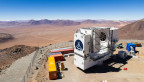
In a study published May 12 in the Astrophysical Journal, Yang and other Cornell researchers report on the first observations with the Tomographic Ionized-carbon Mapping Experiment (TIME), which focused on Sagittarius A, a well-known region at the center of the Milky Way galaxy. The observations were made during the 2021-22 season at the Arizona Radio Observatory (ARO) 12-meter telescope at Kitt Peak, and they confirm that TIME is ready for mapping future targets at the facility.
The study also validates a technique, called line-intensity mapping, that will be used for new instruments on other telescopes, including the Cornell-led Fred Young Submillimeter Telescope.
“With TIME, we are trying to probe cosmic history over a range of times,” said Abigail Crites, assistant professor of physics and Fred Young Faculty Fellow in the College of Arts and Sciences (A&S) and principal investigator of the project, supported by the National Science Foundation. She has been developing the instrument for ten years and is one of the first scientists to use line-intensity mapping to explore the early universe.
The earliest galaxies are so far away and faint that they can’t be viewed individually with traditional telescopes. Rather than focusing on specific targets like those telescopes do, TIME gathers light from a large portion of the sky. Then its spectrometer measures the specific frequencies and patterns in the light emitted by molecules or atoms from the faint galaxies throughout that area.
“With a regular telescope, you know where an object is or at most you survey a tiny patch of sky and you see some very bright galaxies. But with TIME, we know the galaxies should be there, and we know they should have some brightness,” Crites said. “You just see a fuzzy patch, but that’s kind of cool because you’re getting all those photons even if you’re not identifying them as this galaxy or that galaxy.”
Those photons communicate identities that are unique to every molecule, like a barcode, said Yang, the paper’s first author.
“Even if line-intensity mapping is collecting blended light from millions of distant galaxies at once, we can still look at the spectrum of that light, identify these distinctive barcodes and translate them into an estimation on how much each molecule or atom is there and where it is concentrated across the universe,” Yang said. “This becomes important for studying early star formation because some of these molecules are closely connected to the environments where stars are born.”
The researchers are looking for signals to probe two different eras of cosmic history, Yang said. Emissions from ionized carbon can be used to study galaxies during the epoch of reionization, when the first stars and galaxies were beginning to form and light up the universe one billion years after the Big Bang. Emissions from carbon monoxide give insight into the era several billion years later, when galaxies across the universe were forming stars at their highest rate.
To prove TIME is ready for such distant objects, the researchers tested it on a target closer to home.
“With Sagittarius A, we are pointing the instrument at the center of our galaxy,” said co-author Dongwoo Chung, assistant professor of astronomy (A&S). “To make sure we can understand observations of molecular gas at redshift two [light that started traveling toward Earth 2.5 billion years ago], we need to make sure we can measure molecular gas at redshift zero correctly.”
Sagittarius A is also rich in the frequency bands the TIME researchers were looking for, Yang said, allowing them to verify their frequency-resolving capabilities and calibration techniques.
Cosmologists are always looking for new ways to probe how galaxies form and how matter and structure evolve across the universe, Chung said. Line-intensity mapping was a fringe idea when Crites first started working on it, but it is growing more popular, the researchers said.
“A lot of the processes we would probe with these experiments would also have significant implications for cosmology,” they said. “By tracing the population of galaxies, you’re tracing cosmological structure.”
This year, the researchers returned to the Arizona Radio Observatory and focused on the targets TIME is built for: sources with emissions much fainter than Sagittarius A, including the COSMOS field, a much-studied part of the sky that contains galaxies at many different distances from Earth.
Cornell co-authors are: Sophie M. McAtee ’28, (who contributed through the A&S Nexus Scholars Program); doctoral students Benjamin J. Vaughan and Shwetha Prakash; and Victoria L. Butler, visiting scientist at the Cornell Laboratory for Accelerator-based Sciences and Education.
The research was supported by the National Science Foundation.
Kate Blackwood is a writer for the College of Arts and Sciences.
Media Contact
Get Cornell news delivered right to your inbox.
Subscribe