Recycling excreta as fertilizer in Kenya transforms ‘disgusting’ to ‘beautiful’
By Krisy Gashler
One person’s waste is another one’s gold. A Cornell researcher and her African colleagues are collecting human excreta from informal settlements in Kenya, processing it to remove pathogens, and turning it into affordable, high-quality agricultural fertilizer – called KIYA Gold – that is nourishing plants while protecting human health and the environment.
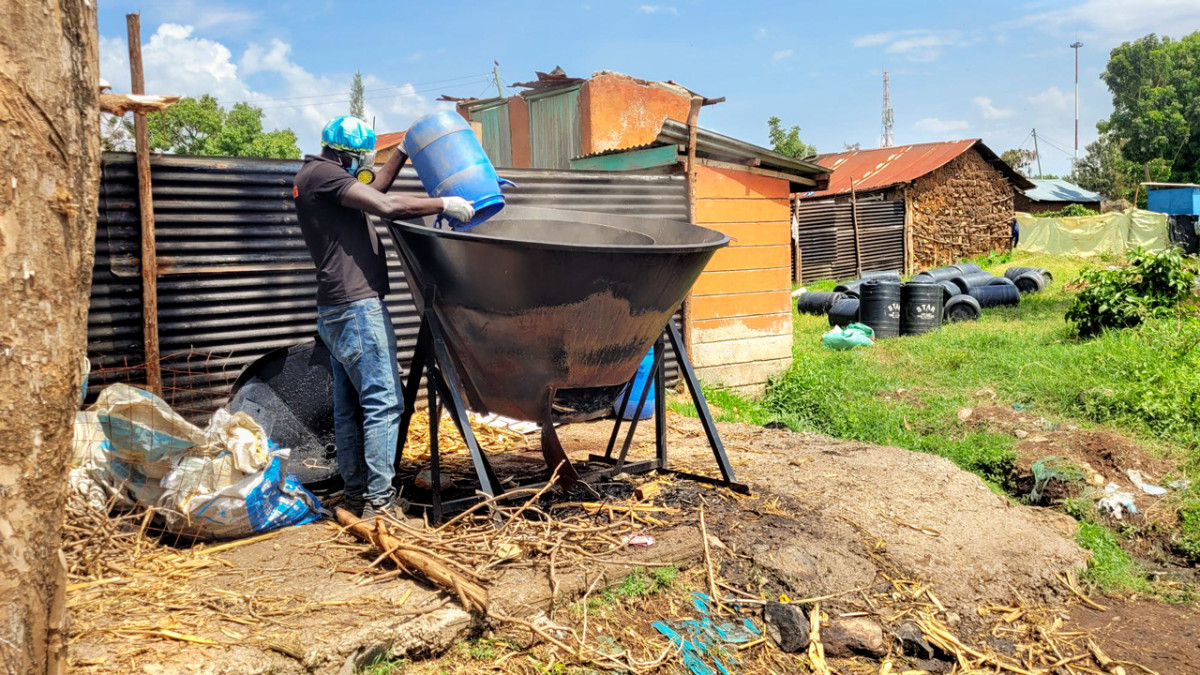
Steven “Governor” Onyango adding dried feces to the Kontiki kiln.
Kisumu, Kenya, a port city on the northeast edge of Lake Victoria, faces multiple challenges. Depleted soils and exorbitant fertilizer costs depress agricultural yields, while inadequate sanitation facilities in informal housing settlements lead to untreated human waste entering the lake, spreading disease and killing fish. These factors create a compounding cascade of poverty, poor health and economic stagnation.
“At some point it occurred to us that there was a positive feedback loop possible here,” said Rebecca Nelson, a professor in the School of Integrative Plant Science and the Ashley School of Global Development and the Environment in the College of Agriculture and Life Sciences (CALS). “If we can use this excreta to make fertilizer, we can expand sanitation, support and improve public health and sanitation in the informal settlements, all while reducing nutrients and pathogens going into the lake.”
Nelson, an agroecologist, and Charles Midega, a professor at Maseno University in Kisumu and executive director of Poverty and Health Integrated Solutions, have collaborated to protect African crops for years. In prior work, Nelson learned that some West African farmers – desperate for both water and nutrients for their crops – use human urine as fertilizer. For the past five years, Nelson and Midega have worked in Ithaca and Africa to study and formalize this practice in support of a circular bionutrient economy, a synergistic system that transforms organic byproducts into valuable fertilizer. The current work, to test, validate and launch KIYA Gold, seeks to transform urine and feces into fertilizer, creating bionutrient cycles at the neighborhood scale.
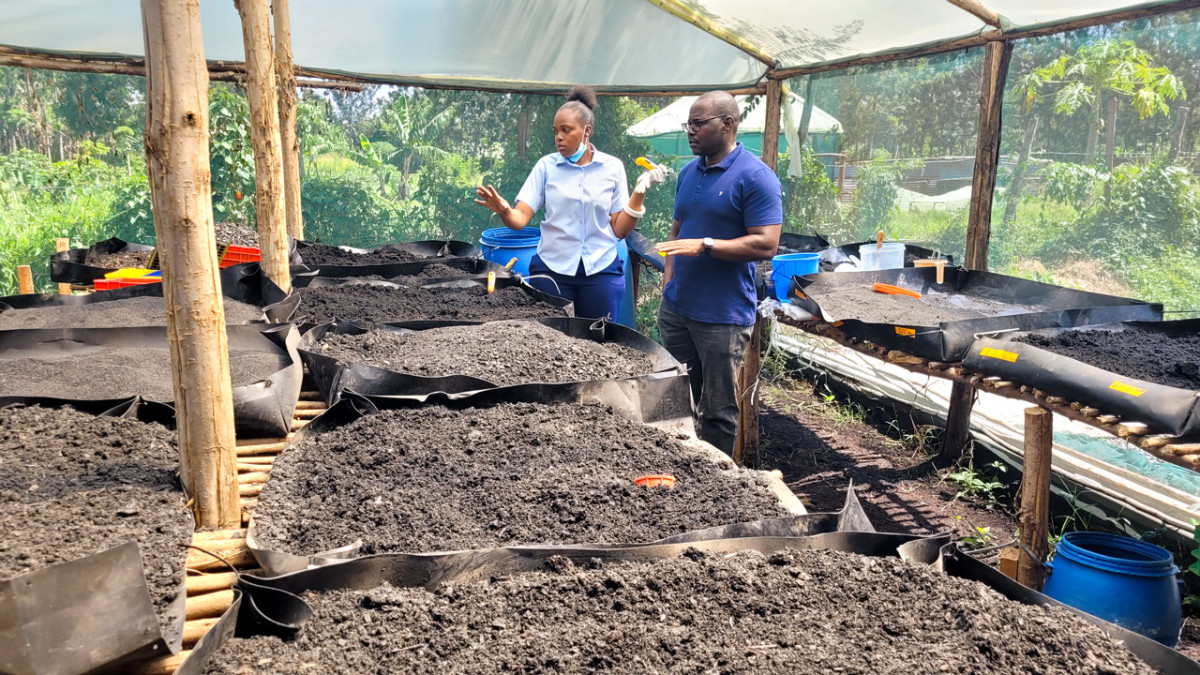
Hope Ochieng and Charles Midega in the drying greenhouse at KIYA.
Three years ago, the pair connected with Roy Odawa, a farmer and director of Kisumu Young Agripreneurs (KIYA – the source of the fertilizer’s name), and with a private waste recovery company, Fresh Life. Fresh Life hosts removable toilet facilities in Kisumu’s informal settlement, Nyalenda. Excreta is brought to the KIYA site where feces are dried and converted to biochar. The pyrolysis process that carbonizes the feces also sterilizes it. The urine is sterilized and stabilized with lime or acid and combined with the biochar. The formula is tweaked as needed to meet soil needs.
“From pretty disgusting inputs, we get a beautiful product that’s completely inoffensive and very beneficial,” Nelson said. The research team has tested KIYA Gold against synthetic fertilizers and found that it increases plant growth as well as conventional fertilizers, and it provides the durable carbon for which biochar is known, improving long-term soil health. They’re working with multiple farmer networks in several counties, including KIYA’s network of 1,000 farmers in the Kisumu area.
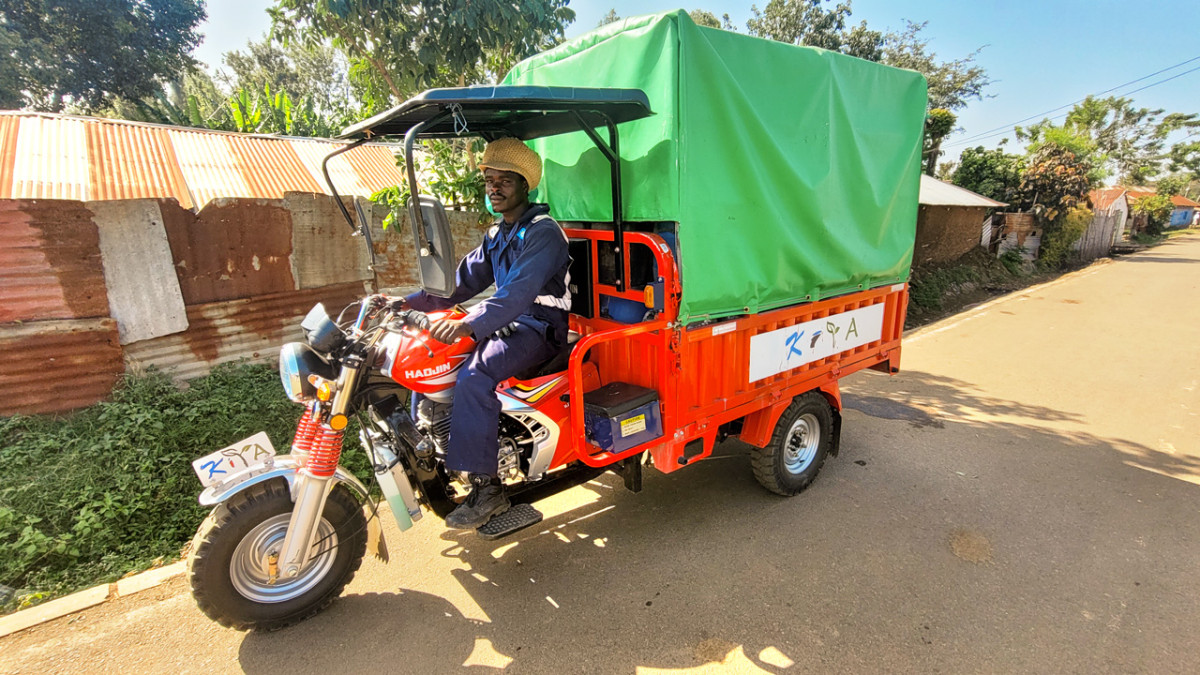
Jeremiah Ochieng doing the rounds, collecting containers of human excreta for processing into fertilizer at KIYA.
Young farmers in Kisumu rarely have enough money to invest in fertilizer, Odawa said.
“Most people cannot afford synthetic fertilizer, so they just do farming without any additives and the soil is not in a good state,” he said. “And here we are coming in with a solution. This can help young farmers to have a good profit margin that enables them to scale up. It’s exciting that we are also protecting our environment and protecting our fish in the lake.”
There are still important unanswered questions, Nelson said. For example, treated municipal wastewater is sometimes used in U.S. agriculture, but concerns have arisen about whether this practice is adding PFAS, pharmaceuticals or microplastics to agricultural fields. The pyrolysis step in the KIYA process heats materials hot enough to destroy pathogens and break down PFAS, Nelson said; her bigger concern is potential buildup of heavy metals and salt, which pyrolysis can’t eliminate. The team’s next steps include doing formal chemical analyses of KIYA Gold for nutrients and contaminants, improving their engineering process efficiency, and obtaining governmental permission to scale up from initial research distribution to formal registration, franchising and marketing.
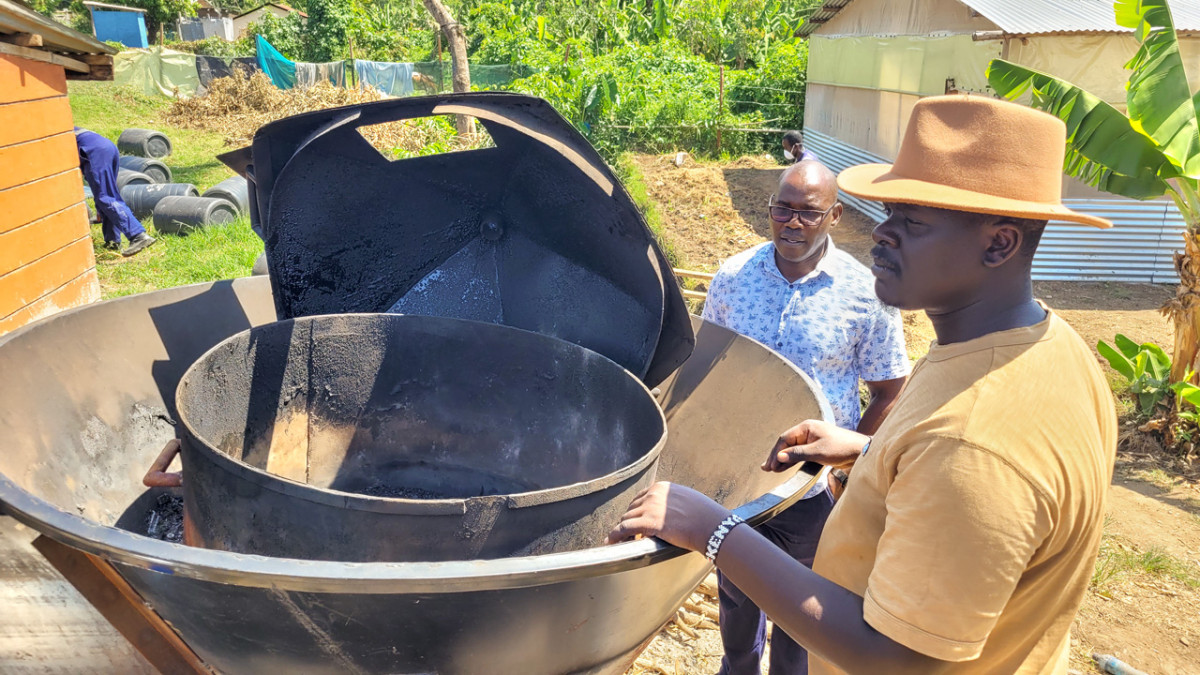
Charles Midega (left) and Roy Odawa display the Kontiki kiln they modified to make biochar from human feces. Credit: Rebecca Nelson
Midega, who is also a Distinguished Africanist Scholar at Cornell, is hopeful about the potential for KIYA Gold to solve multiple challenges with one solution.
“In these informal settlements, poverty is the order of the day. Poor health is the order of the day. And usually, interventions don’t consider that these things are intertwined,” Midega said. “Working together, we are improving human health, improving agriculture and directing pollution out of the environment, all at once.”
This research is supported an Academic Venture Fund grant from the Cornell Atkinson Center for Sustainability and the McKnight Foundation’s Global Collaboration for Resilient Food Systems.
Krisy Gashler is a writer for Cornell Atkinson Center for Sustainability.
Media Contact
Get Cornell news delivered right to your inbox.
Subscribe