Hops and dreams: Cornell helps new varieties go from field to glass
By Laura Reiley, Cornell Chronicle
Nathan Lewis stands in a three-acre yard at Gates East Farm on the Cornell AgriTech campus, plants strung high over his head. He is harvesting flowers, splitting each cone in half and rubbing the two sides together to release their aromas from the sticky, yellow gland in the middle. Is it ready?

Technician Ben Aliperti loads a string of hop vines into the hop harvester to pick off the cones at Cornell AgriTech.
Each of the 61 varieties of hops matures on a particular day; each has a different length of time between its initial flowering and the cone maturity; each cone requires a certain level of dryness.
Lewis is a third-year doctoral student in Larry Smart’s lab in the College of Agriculture and Life Sciences, where researchers aim to take some of risk off of farmers by assessing how hop varieties bred in the Pacific Northwest will fare in New York state.
“It’s very expensive to establish a new variety in their hop yard. To put in 1,000 plants not knowing if any brewer will buy them is a huge risk,” said Smart, professor in the Horticulture Section of the School of Integrative Plant Science. “Part of our mission is to plant those varieties in our hop yard, grow them using industry best practices, get a valid estimate of their yield, their disease resistance, the quality of their cones,” Smart said. “But the quality of the beer is what matters. You’ve got to get them into hands of brewers to evaluate in beer.”
The program also traces hops from field to pilot batch. Nine varieties – seven of which are New York heritage lines rescued from old farms and homesteads – are in brewing trials with breweries across the region.
Lewis and the team started harvesting this year on Aug. 10 and will likely be working through Sept. 25. They are evaluating 38 commercial varieties, seven experimental lines and 16 heritage varieties. And the team is raising its sights, literally: They are erecting six rows of a new 21-foot trellis using concrete Harvest Pillar posts donated by Jensen Precast.
“Our trellis is conventionally 18 feet high,” Smart said. “But what we have found is some of the varieties we’re working with grow taller than that. They hit the top wire and then flop over, so we lose a lot of that material at harvest.”
Smart said Jensen Precast donated enough posts and hardware to put in an acre with a 21-foot-high top wire, a savings of roughly $18,000. Smart’s lab can assess whether the anticipated increased yield is worth the added effort, as right now they are having trouble finding string that’s long enough, and the extra height may be a challenge for their fungicide sprayer.
What it all comes down to: At the middle of a hop cone are the lupulin glands, which produce a sticky, golden powder and resin rich in essential oils and bitter acids that give beer its core bitterness and distinct flavors and aromas. This is the cornerstone of great beer.
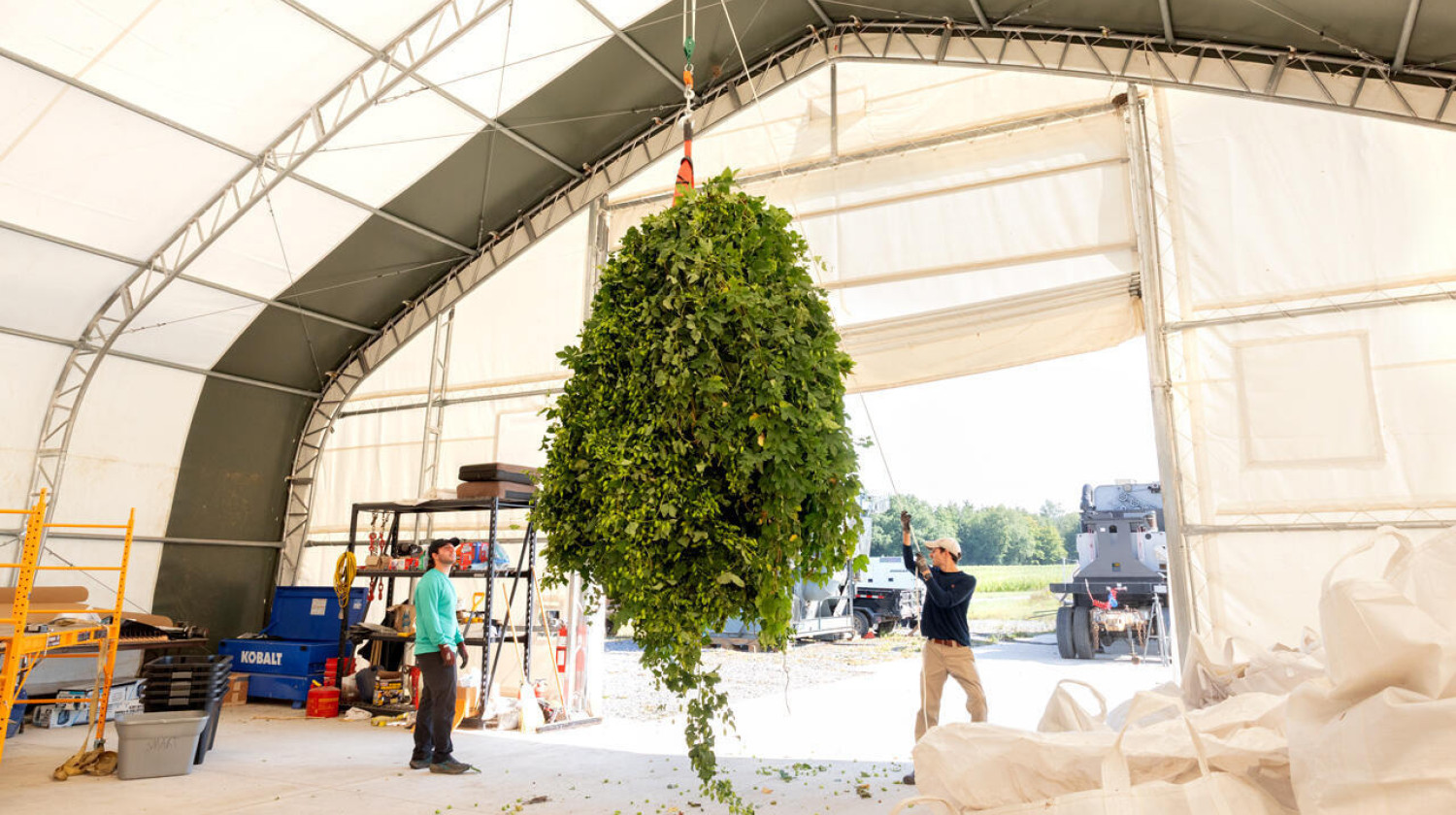
Technician Ben Aliperti and doctoral student Nathan Lewis determine the fresh weight of all of the vines for a hop variety harvested from a research plot before the cones are picked off.
From experimental line to pint glass
The craft beer industry has seen significant contractions in recent years, both in total beer consumption and number of craft brewers. New York state has been slow to see these setbacks, Smart said.
“There’s a strong farm-to-table ethos in New York, an effort to support our local businesses,” he said. “We have 525 craft breweries around the state – they’re in your hometown, owned by local families and couples.”
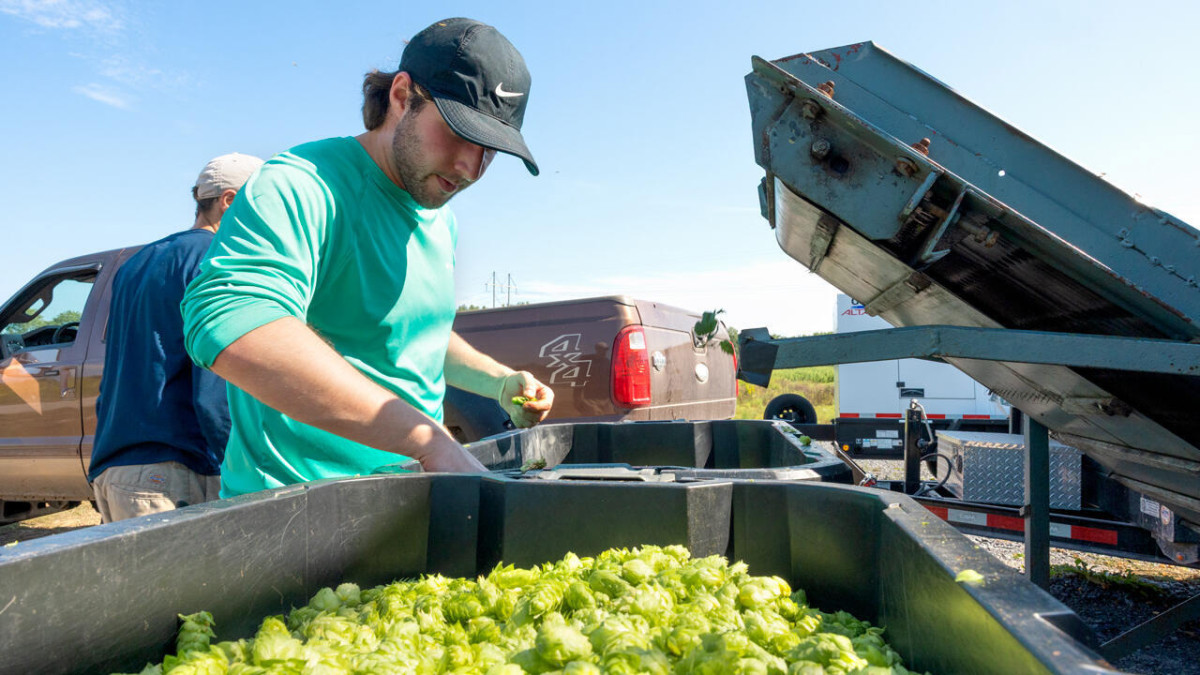
Technician Brian Nardone picks out any stems or leaves of picked hop cones before they are dried and baled for brewing trials.
The Cornell hops that have been incorporated into new brews include: USDA 032, an experimental line with herbal, spicy and stone fruit notes that appeared in beers from Big aLICe, Druthers, Fifth Hammer, Swiftwater and Watershed; Reality, a heritage line of Cluster hops that went into cream ales and pale ales at Gem Creek, Seneca Lake Brewing, Steuben and Watershed; Barryville, a heritage collection found near the town of the same name, that was featured by brewers in a Genesee Brew House pilsner and a Belgian pale ale from Brewery Ardennes and Scale House, and Dwyer 2 that was used in a pilsner by Strong Rope.
Smart’s lab has a list of eight varieties – a mix of new offerings from the USDA and heritage lines – that have made the cutoff in terms of yield and production, and that have qualities Smart thinks brewers are going to like.
The program recently held a Craft Brewer Open House to walk local brewers through this year’s variety showcase, and they are offering hops on a first-come, first-served basis to brewers on the day of harvest. Several breweries with the Seneca Lake Order of Brewers are expected to request wet hops for their annual competition on Oct. 17.
The goal, Smart said, is to continue the program’s push to find New York's signature hop that works for growers and brewers … and beer lovers.
Media Contact
Get Cornell news delivered right to your inbox.
Subscribe
