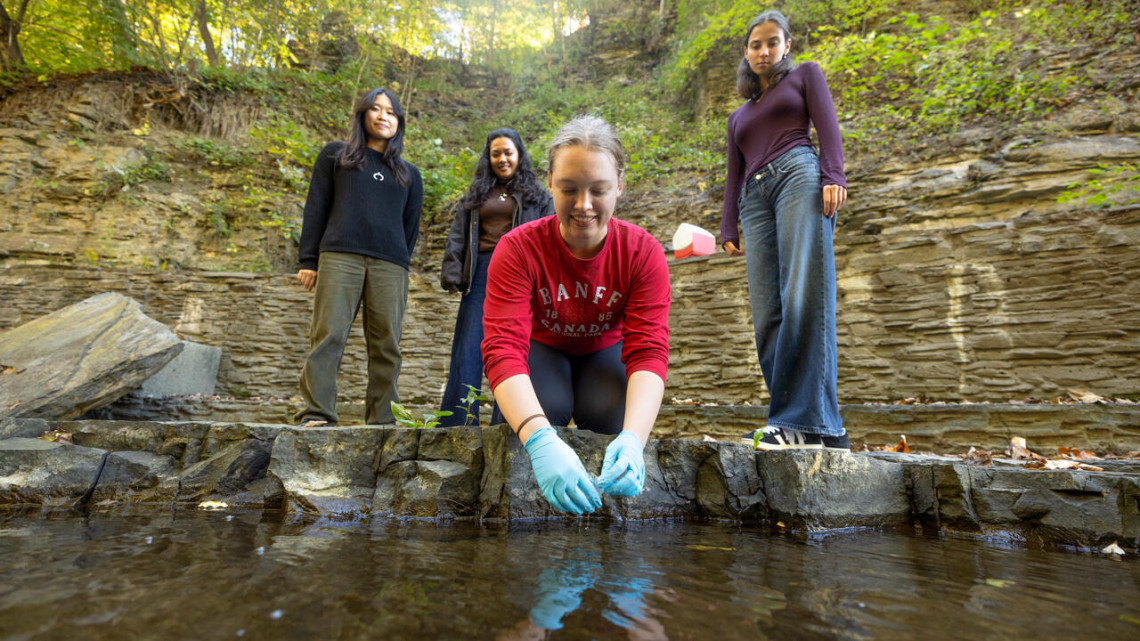
Students in the research group of Damian Helbling, professor in the Cornell Duffield College of Engineering, test for per- and polyfluoroalkyl substances (PFAS) in Cascadilla Gorge on Oct. 6.
Students create first in-depth map of ‘forever chemicals’ in the Finger Lakes
By Caitlin Hayes, Cornell Chronicle
In 2023, Professor Damian Helbling was getting a lot of calls and emails from local residents. The Environmental Protection Agency (EPA) had just announced regulations to limit per- and polyfluoroalkyl substances (PFAS) – some of which have been linked to cancers and other negative health effects – in drinking water. Ithacans and others in the region wanted to know about levels in the ponds, lakes, streams and creeks in their proverbial backyards.
“Anybody in the public could just search online for ‘PFAS’ and ‘Cornell,’ and they would find me,” said Helbling, professor of civil and environmental engineering in the Cornell Duffield College of Engineering. “But I had no idea how to answer their questions. There were no data locally.”

Madeline Adams ’27 said she has been motivated by the project’s local impact.
A group of undergraduates in Helbling’s research group has since filled the gap, taking more than 500 samples across 300 bodies of water, including all 11 Finger Lakes and many tributaries, ponds and even puddles that persistently pool after rain. They’ve screened the samples for 24 common PFAS and added the data to an interactive map. The map shows PFAS hot spots but also relieves some fears: Overall the concentrations of PFAS in the Finger Lakes are relatively low.
“There was definitely relief knowing that generally we’re not seeing elevated levels across the region,” said Alex Van Den Hende ’25, M.Eng. ’25, who first created the map’s infrastructure with Helbling’s mentorship. “We saw that relief in the public’s response but also concern that there is in fact contamination – that maybe you’re not immediately affected, but there’s potential for more significant impacts in the future.”
PFAS don’t break down easily, accumulate in the environment and the body, and have been linked with lower fertility, hormone disruption and certain cancers; the Centers for Disease Control and Prevention has found PFAS in the blood of 97% of Americans surveyed. But regional data on PFAS contamination in water often consists of a small number of samples taken at long intervals. Helbling said the students’ Finger Lakes dataset is unique in its breadth of sites and samples taken over time.
The students found that the amount of surface water in the Finger Lakes region seems to effectively dilute PFAS, so that overall levels remain low. The hot spots – where levels did exceed guidance values for safety set by New York state – are largely in places the group expected: in standing bodies of water near airports and fire training stations. At these sites, de-icing fluids for planes and fire-extinguishing foams, known sources of PFAS, appear to spike the levels, which then decline over time. Those hot spots are not sources of drinking water and are often isolated from other waterways, limiting their impact.
“But these elevated sites might tell us how we can better monitor and do source control,” said Gregory Pepin ’27, a civil engineering major in Cornell Duffield Engineering. “It might also help educate people and make people think about new infrastructure projects that reduce the risk of PFAS exposure.”
Helbling said the data provide a baseline to track changes, especially as new industries establish themselves in the region.
“We’re getting a snapshot of water quality today that will be useful to compare with data from water samples collected after certain industries arrive,” he said.
The student team, now in its second generation after the projects’ initial members graduated, also hope to influence the state’s monitoring of PFAS and plan to use the accumulated data to identify high-priority areas in other regions of New York.
“When we started sampling over time, the motivation was to have all of this spatial data,” said current team member Madeline Adams ’27, a chemical engineering major in Cornell Duffield Engineering. “But now we’re asking what more we can say and figure out.”
Research with purpose
Fulfilling an immediate need in the community was the primary motivation for students – both Pepin and Adams said that the project has made them want to work closely with and for local communities in their careers.
Van Den Hende, now an environmental engineer with the Federal Energy Regulatory Commission in Washington, D.C., said he had previously been “put off” by how disconnected research could be from its impact.
“I wanted to be close to the impact,” he said. “That was a strong motivator for me in this project – that this was about local people who felt like this mattered and wanted information, who were asking questions and who cared.”
It follows that a key focus for the group has been how to communicate the results to the public. Even before students took the first water sample in 2024, Van Den Hende built the public-facing map, which the team has been honing ever since.
The group has also engaged in extensive outreach. Led initially by Brune Boukobza ’26, and in collaboration with the Cornell-housed New York State Water Resources Institute (NYSWRI), students have presented the work at nearly a dozen conferences and meetings of watershed groups and municipal organizations. Helbling said one of the greatest rewards has been watching the students learn how to communicate complex science to the public.
“It’s also been a pleasure for me to watch them take ownership of the project and really direct its course,” he said.
The undergraduates have been full participants in Helbling’s research group. They meet weekly with him and graduate students whose lab-based research – on “fingerprinting” different PFAS to track their sources, the transformation of PFAS in the environment and the capture and destruction of PFAS – dovetails with their own.
“Taking a project from the sample collected to the analysis to the communication of it – to see the whole pipeline of research – and to try to do it well, has been really inspiring,” Pepin said. “Now we have new members who want to learn, and it’s us as students who are able to teach them, to pass the torch – because there are so many more interesting questions to pursue.”
Funding for the project has come from NYSWRI and the New York State Department of Environmental Conservation.
Media Contact
Get Cornell news delivered right to your inbox.
Subscribe