Transformations ahead for Cornell’s heat and power system
By Caitlin Hayes, Cornell Chronicle
A new energy transition plan will profoundly impact the future of the Ithaca campus – starting with its 110-year-old steam pipes.
The 40-year master plan for Cornell’s utilities, which includes a $1.1 billion capital investment, would transform how the university provides heat and power to more than 150 buildings, with a combination of practical upgrades, leading-edge technologies and energy conservation. The blueprint, called the Utilities Reliability and Energy Transition (UR&ET) Master Plan, aims to electrify heating and fulfill Cornell’s longstanding aspiration to eliminate the use of fossil fuels, while also aligning with future New York state regulations under the Climate Leadership and Community Protection Act (CLCPA). Electrifying heat is also a key strategy in Cornell’s Climate Action Plan to achieve carbon neutrality by 2035.

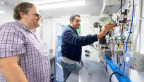
Facilities and Campus Services staff survey the inner workings of the Combined Heat and Power Plant.
The project team, led by Cole Tucker, associate vice president of Energy and Sustainability in Facilities and Campus Services (FCS), found that operating the current system and executing only necessary maintenance and upgrades over the next 40 years would still amount to about 90% of the new plan’s cost. Staying the course would also leave the university out of compliance with the CLCPA and make minimal progress toward reducing emissions, a central driver of the master planning process.
“Business as usual is not a zero-cost option,” said Tucker, who led a large team across units to develop the recommendations. “We’ve got aging infrastructure and demand growth that we have to stay after.”
A sense of stewardship informed the plan’s development, Tucker said. “Some of the utility systems we operate today have served Cornell for more than a century,” he said. “We have created a vision for an equally impressive system that will serve our successors into the future.”
The plan begins with a $93 million investment over the next five years that will include the expansion of cooling capacity for campus; optimizations to building efficiency; and the continuation of a steam-to-hot-water heat conversion which involves the replacement of those 110-year-old pipes.
The university will also pilot a Borehole Thermal Energy System (BTES), which includes drilling boreholes, up to 850 feet deep, to store waste heat in the summer for redistribution to buildings in the winter; eventually, the system could comprise 1,800 boreholes across campus. Paired with heat pumps and solar thermal, BTES would take the place of the Combined Heat and Power Plant, which now heats and powers campus efficiently but is fueled by natural gas with fuel oil as a backup.
The transition plan, years in the making, is phased and adaptable – so the university will frequently assess goals, new technologies, funding opportunities and shifts in the regulatory landscape. Electrification will keep pace with the availability of renewable energy; ending routine use of the power plant will depend on New York state’s progress towards its goal of a zero-emissions grid, as moving too quickly risks shifting emissions from campus to less efficient power plants elsewhere in the state.
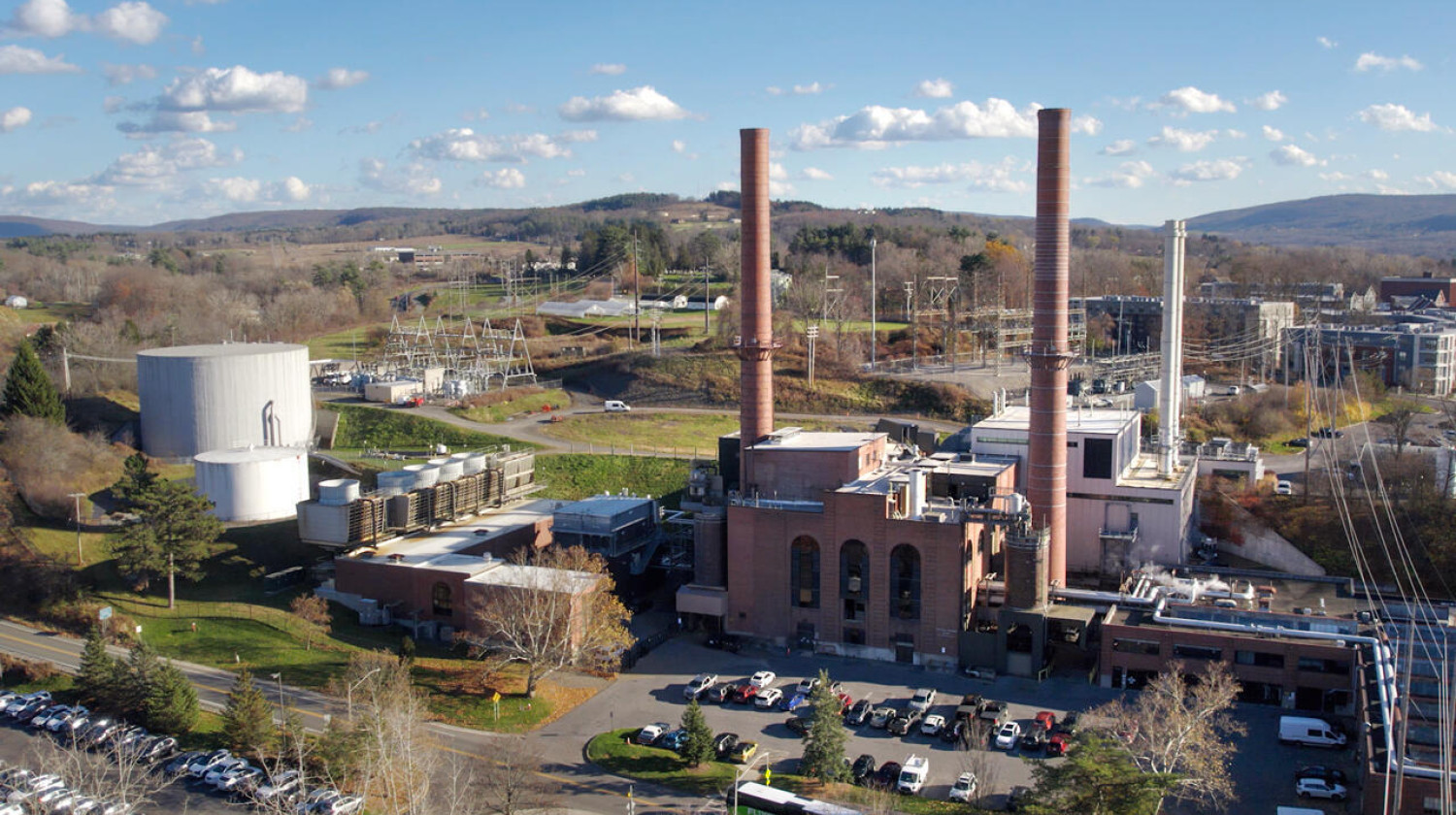
The 40-year master plan takes steps to end routine use of Cornell's Combined Heat and Power Plant, which is fueled by natural gas with fuel oil as a backup.
The plan sidelines the still promising Earth Source Heat geothermal project, an unproven technology which requires much deeper and more complex drilling than BTES. While engineers found temperatures at the Cornell University Borehole Observatory (CUBO) to be hot enough, more drilling is needed to determine viability – but the master plan keeps the technology open as a future option.
“The plan is very grounded in reality, but it’s so flexible,” said Stacey Edwards, the UR&ET program manager in FCS. “It takes advantage of the latest technology but leaves room for others that might come along. It’s really going to serve us into the future.”
‘Not a trivial exercise ahead’
BTES is an enhancement of commercially available technology used at other universities, but it’s so far untested in New York state.
“We think it’s cool, our state partners think it’s cool, because after being proven here on campus, it could be scaled as a common solution for everybody in heating-dominated climates,” Tucker said. “As the state’s land-grant university, our solution should be something that benefits the whole.”
The BTES pilot is expected to begin in spring 2027 with the drilling of up to five test bores, to create a “baby” BTES that will collect data and test critical assumptions. Those lessons will be incorporated into the first fully functional BTES on East Campus, which will initially store summer waste heat from the Combined Heat and Power Plant. That heat will then be extracted in winter and delivered to the College of Veterinary Medicine.
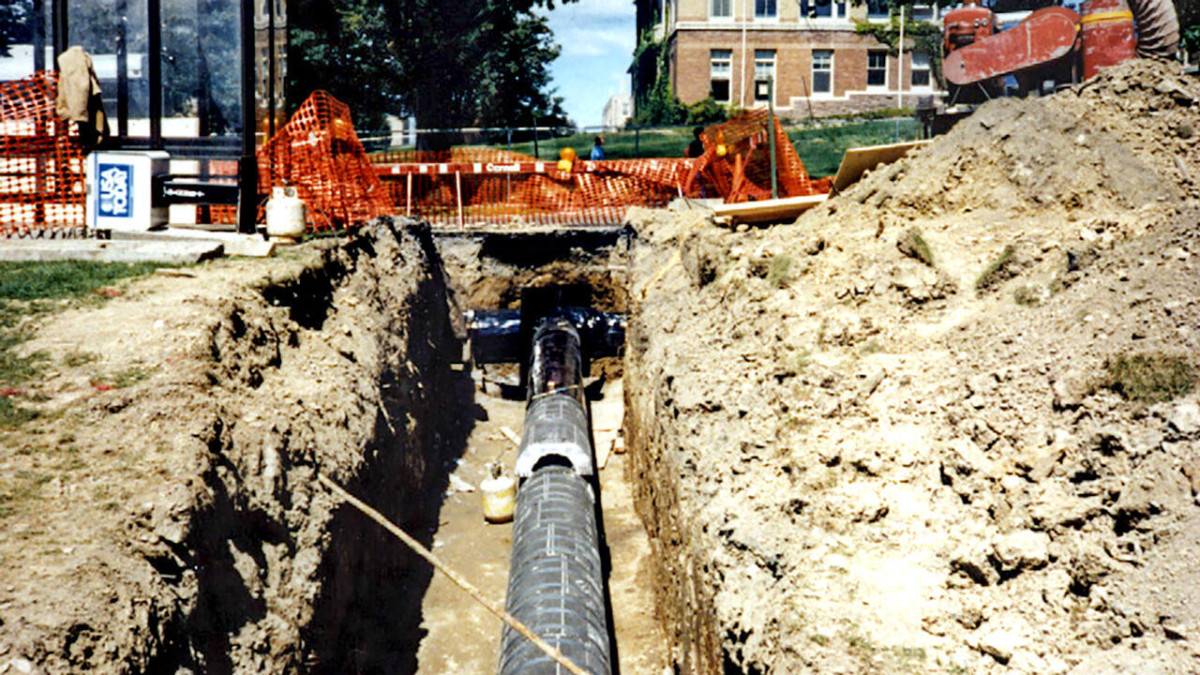
The new plan will accelerate a conversion from steam to hot water heat, which will require replacing 110-year-old steam pipes.
“We want to get enough data to build a model and tune it, so we can refine our design and operation before we scale up,” Edwards said. “There are some pretty exciting, interesting steps along the way.”
Eventually the boreholes will be in clusters of 150 to 200, underground across campus, and will be largely inconspicuous and unobtrusive. Still, Edwards said at a pace of one hole a day, Cornell could be drilling for four straight years.
“This is not a trivial exercise ahead,” Tucker added.
The FCS team is working with faculty and students in the master of engineering programs, and others, to explore how they can incorporate the BTES installation into coursework and the work of student groups.
“That’s going to bear fruit right away in both students’ opportunity to work with seasoned professionals in a real-world application but also giving us more information and learning about the product,” Edwards said.
Full system renewal
Utilities at Cornell have a long history of innovation and improvement, Tucker said. Lake Source Cooling was the first system of its kind in the U.S. in 2000, saving enough electricity to power 2,500 households each year. Since then Cornell has continually reduced its energy load through ongoing conservation and management strategies, despite growth in the campus footprint and student population.
Aging infrastructure and New York state’s climate law have made a long-term plan imperative; the CLCPA in its current form will outlaw the Combined Heat and Power Plant’s production of electricity by 2040 and most likely its production of heat by 2050.
To find the best solutions, Tucker’s team researched and modeled more than a dozen scenarios. Stakeholders across the campus community, the Ithaca community, peer institutions, industry partners and state agencies were engaged in the plan development and had the opportunity to weigh in on the scenarios’ potential impacts. The team retained consultants from Jacobs Engineering with hands-on experience in construction and implementation and ran multiple feasibility studies.
“We couldn’t risk having the consultants give us a bright and shiny plan that actually didn’t work for us, that didn’t take into account Cornell’s nuances, so it was a highly collaborative, iterative process between our Cornell experts and the consultants with worldwide experience,” Edwards said.
Incorporating geothermal technologies, the new plan maximizes efficiency and lowers emissions. The changes also minimize the strain and reliance on the New York state grid compared to other options the team considered, like using electric boilers for heat.
“We’ll also get a full system renewal with this plan. Everything on the heating side will be renewed to brand new conditions,” Tucker said. “And this scenario is really the only one that would be eligible for potential state and federal research grants, because it’s more leading edge.”
The Cornell Board of Trustees Buildings and Properties and Finance Committees voted unanimously in support of the plan on Oct. 15.
“This was the highest performing team that I’ve ever been on in my life,” Tucker said. “It was thoughtful, it was logical, and it was a whole lot of fun. We challenged each other and built relationships, and we created something amazing that we hope will last another 100 years.”
Media Contact
Get Cornell news delivered right to your inbox.
Subscribe