Loom seamlessly combines weaving, knitting and braiding
By Patricia Waldron
Cornell researchers have developed a loom that seamlessly incorporates weaving, braiding and knitting-like techniques to create new kinds of textiles.
A team led by François Guimbretière, professor of information science in the Cornell Ann S. Bowers College of Computing and Information Science, developed the prototype, named Kneadix. By re-envisioning these techniques as a series of yarn twisting processes, they built a machine that can switch between them, and even create novel shapes.
The technology may one day enable designers to create clothing that easily combine these styles to enhance their fashion or functionality.
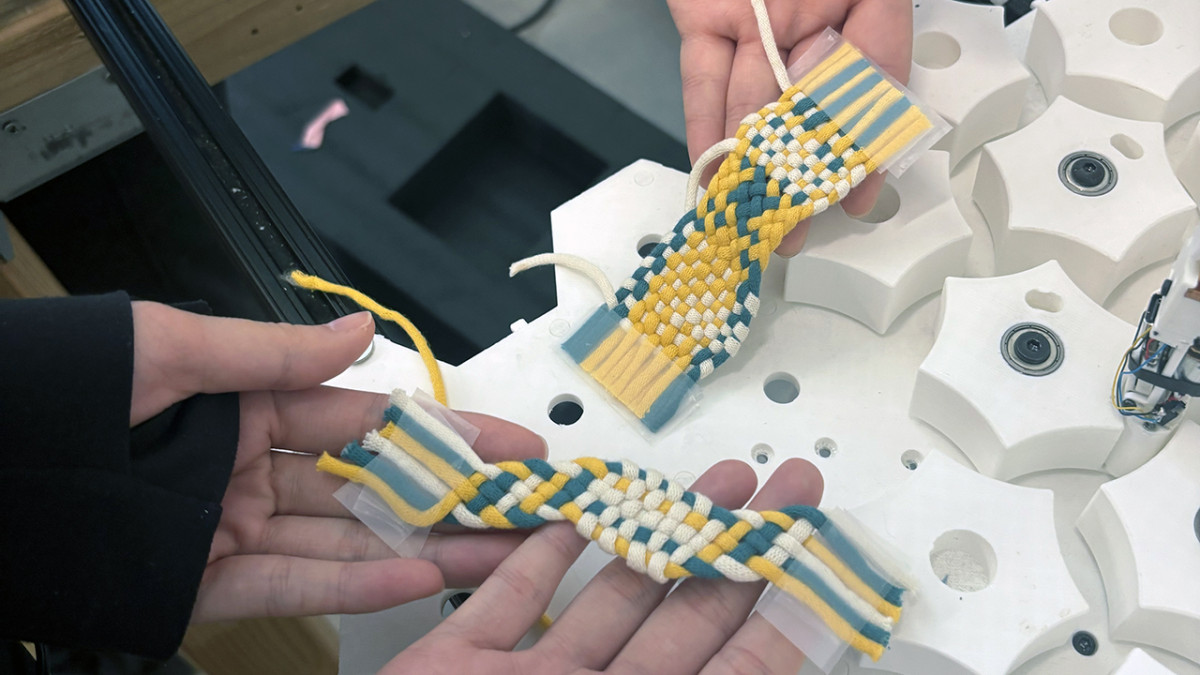
Kneadix can switch seamlessly between weaving, braiding and knit-like patterns.
“Different techniques can provide different properties,” said Shuhong Wang, a doctoral student in the field of information science and lead researcher on the project. “Weaving is stable, knits stretch and braids contour easily. And sometimes people want a product with more than one textile technique.”
Wang presented the paper, “Kneadix: A Multi-Process Loom with Dynamic Warp-Weft Role Assignment,” at the Association for Computing Machinery Symposium on User Interface Software and Technology (UIST) in Detroit, Nov. 4, where it received a Best Paper Award.
On a traditional loom, a part called the heddle holds the warp, or vertical threads, separate from the weft, the horizontal thread that is passed back and forth across them. For Kneadix, the researchers instead used a bed of rotating hexagonal gears, called horn gears, borrowed from braiding machines. The horn gears pass the yarn carriers around so any yarn can switch roles between warp and weft mid-fabric, enabling users to shift between techniques and create curved edges.
Instead of a traditional comb, which weavers use to beat the weft thread into place after each pass, researchers designed a retractable comb, which moves out of the way after beating and has teeth with adjustable spacing.
The team also developed a custom tensioner system for the yarn carriers. Each tensioner has a sensor to determine the thread’s tension – too slack and it might get caught up in the machine, but too tight and it could warp the pattern – and a motor that adjusts the tension by winding or unwinding the yarn around the bobbin.
“Tension is very important because the combination of tension and friction between the yarns basically maintains the form that you are building,” Guimbretière said.
Kneadix requires programming, which the researchers admit is a challenging task, especially for complicated shapes. They built a library of modules in Python, a popular programming language, but users must track each yarn by hand. Next, they plan to automate the yarn tracking and eventually add a more user-friendly interface.
They also aim to improve the machine’s stability and make it compatible with more types of yarn.
From a commercial standpoint, this type of loom could one day create high-performance items, such as a glove with flexible knit joints, a tough woven palm and a braided cuff that keeps the glove in place, researchers said. For smart clothing applications, manufacturers could weave in electrical wires along specific paths during fabrication, instead of sewing them into the garment after construction.
Once the technology is ready for wider use, the team plans to provide it as a kit with 3D printing instructions, so that makers can print their own Kneadix looms and designers can experiment with new textiles more affordably.
“This is something really revolutionary, not only for mass manufacturing, but also for artists in their personal studios,” said Shengyuehui (Lily) Li, M.P.S. ’26, a research assistant and co-author of the paper.
Li and Wang both came to this project through a personal interest in crafting. Li creates felted designs, while Wang has done knitting and embroidery since she was a child. As creators themselves, Li and Wang are excited to help others add to their tool kit and expand on their craft.
“That’s very exciting to me, because previously I just followed others’ instructions and did their patterns,” Wang said, “but now we can innovate new fabric structures ourselves.”
Co-authors on the paper include Xiaoman Yang, M.S. ’26; Vivien Chen ’28; Yoobin Lee ’27 and Brianna Cheng ’27.
The research received support from the National Science Foundation, the Cornell Bowers Undergraduate Research Experience and a seed grant from the Department of Design Tech at Cornell University.
Patricia Waldron is a writer for the Cornell Ann S. Bowers College of Computing and Information Science.
Media Contact
Get Cornell news delivered right to your inbox.
Subscribe