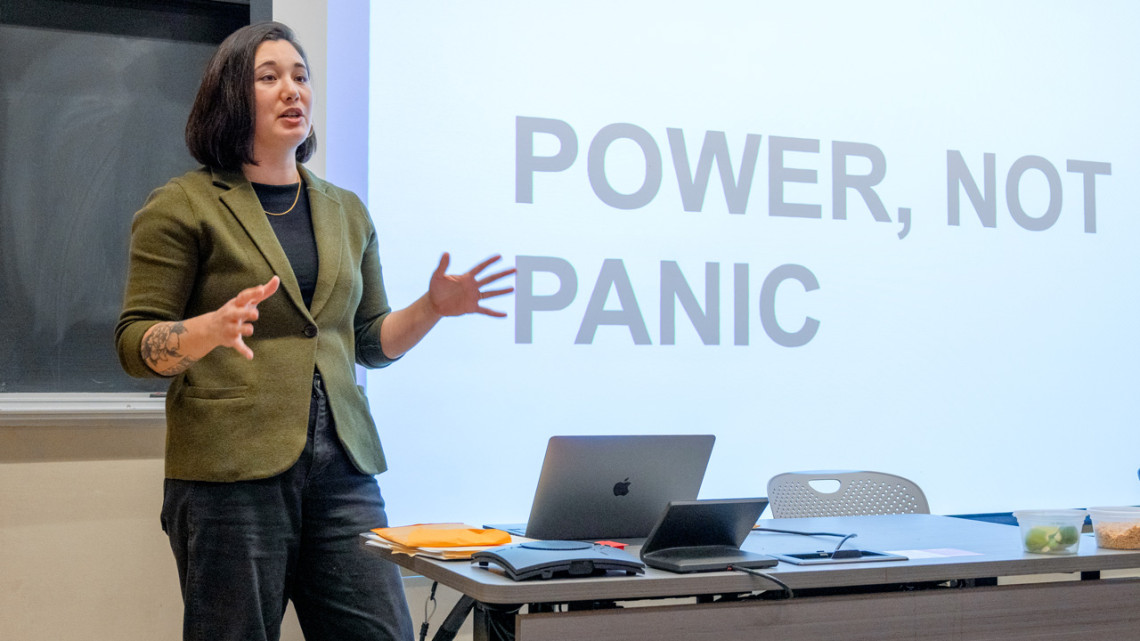
Julia Mizutani, law research, instruction, and liaison librarian for Cornell University Library and an adjunct professor at the Cornell Law School. conducted a Know Your Rights session for Cornell students in December.
Law project raises awareness of constitutional rights
By Jose Beduya
When law student Sahil Venkatesan ’24 first attended a Know Your Rights session, focused on immigration and law enforcement, he found it “sobering and inspiring.”
“There were neverending questions from people who were incredibly afraid, and you could feel the tension in the room with every question a person asked. They were worried for themselves or their loved ones,” said Venkatesan, a student in the Immigration Law and Advocacy Clinic taught by Jaclyn Kelley-Widmer, who led the Know Your Rights event.
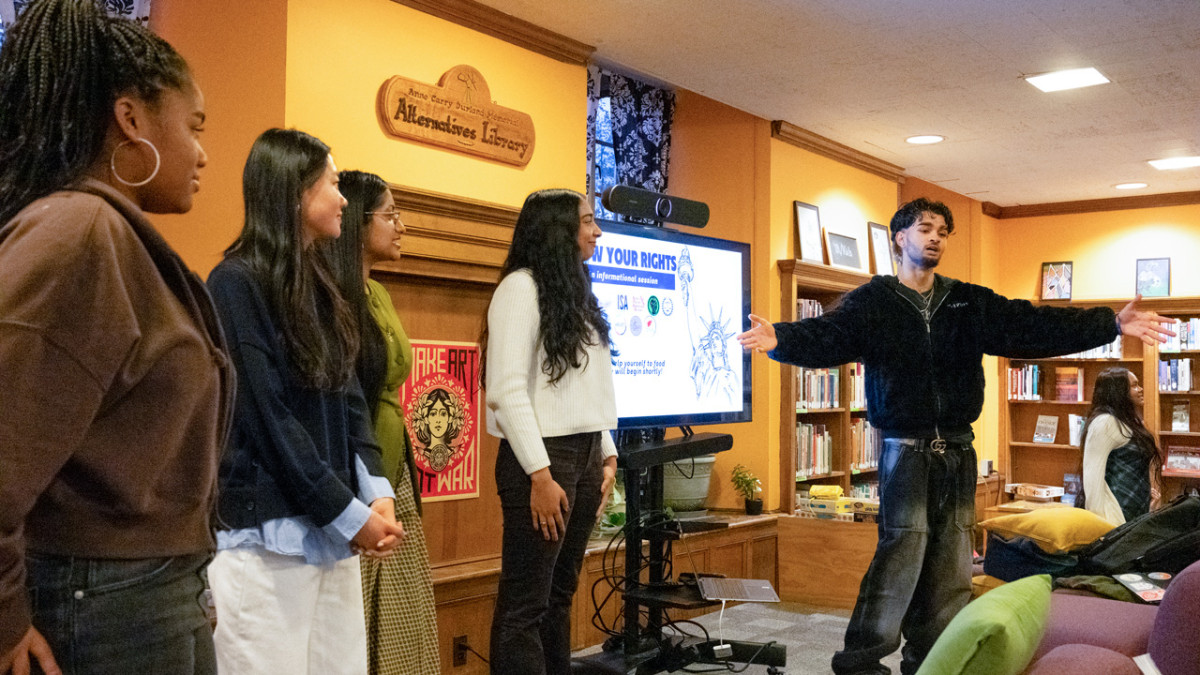
Hasham Ali (right) and other student leaders from the Asian Pacific Americans for Action, Black Students United, the Organization for Afghan Students and the South Asian Council hosting a Know Your Rights presentation at the Durland Alternatives Library in November.
Venkatesan soon after stepped up to become a student lead and coordinator for more Know Your Rights sessions at Cornell and for the Ithaca community. “I tell my friends that my work with the clinic and building a system for Know Your Rights talks is the most good I’ve been able to do at Cornell,” he said.
The Know Your Rights presentations are part of the ongoing Cornell Immigration Legal Information Project, funded with a grant from the Park Foundation and started in January 2025 by Kelley-Widmer, founder and director of the Immigration Law and Advocacy Clinic and clinical professor at the Law School.
The project’s goal is to empower the public with knowledge about immigration law and the basic rights of all individuals in the U.S., regardless of immigration or citizenship status.
“Access to reliable and accurate legal information is far less available than people may think, and a project like this aligns with Cornell’s mission to reach individuals who are in need of information, and that’s across campus and across the community,” Kelley-Widmer said.
Among the specialized faculty and staff lending their skills to the effort is Julia Mizutani, a law research, instruction and liaison librarian for Cornell University Library and an adjunct professor at the Law School.
“We needed a librarian, because librarians have the expertise to find information and to explain the information to lots of different kinds of audiences,” Kelley-Widmer said.
Apart from her library training, Mizutani draws from her experience as a former civil rights attorney with ACLU of Washington in Seattle and as a professor in the Prison Education Practicum at Cornell.
“Information empowerment is legal empowerment,” Mizutani said. “There are certain things that only lawyers can do, but there’s so much that people can do on their own if they just have the right information at the right time.”
To date, the project has held more than 40 sessions for Cornell departments and student groups on the Ithaca campus and at Weill Cornell Medicine, as well as local businesses, churches and organizations. The project team has also presented at higher-education institutions such as Alfred University, Bard College, Ithaca College, and SUNY Delhi and the University at Buffalo. In addition, the project holds legal information sessions for people being held at the Buffalo Federal Detention Center, which Kelley-Widmer and her students visited in July 2025.
To meet the demand for Know Your Rights, Kelley-Widmer leads “train the trainers” sessions for volunteer Ithaca community members and Cornell law and undergraduate students. In its first year, more than 20 law students have led Know Your Rights presentations and more than 100 undergraduates have received training.
“The most rewarding part about getting trained was being able to work with professionals who have years of experience in law and immigration,” said Hasham Ali ’25, a biology and society major from the College of Agriculture and Life Sciences and an outreach chair for Asian Pacific Americans for Action, who partnered with other student leaders on a presentation at the Durland Alternatives Library in November.
“I felt that this session was especially necessary for our international peers,” he said. “Given the current political climate and constant change in policies, I believe that a session centered around fundamental constitutional rights is so important.”
Most recently, in December, Mizutani was invited by the Cornell student group CUACLU to conduct a Know Your Rights session at a workshop event with representatives from the NYCLU, the state affiliate of the ACLU.
“I’m not going to stand here and pretend like knowing your rights will mean that you will be fully protected. It doesn’t mean that law enforcement will respect those rights,” Mizutani said during her talk. “But knowing them at least can give you different options at different stages and help you not panic in the moment.”
Mizutani also spoke about the collective power of community members in safeguarding each other’s basic constitutional rights. “There are a lot of things we can do to protect the people we love,” she said.
The Cornell Immigration Legal Information Project is a collaboration among faculty and students in several Cornell law school clinics, namely the Immigration Law and Advocacy Clinic, Farmworker Legal Assistance Clinic, Asylum and Convention Against Torture Appellate Clinic and the Prison Education Practicum.
Jose Beduya is a staff writer and editor for Cornell University Library.
Media Contact
Get Cornell news delivered right to your inbox.
Subscribe