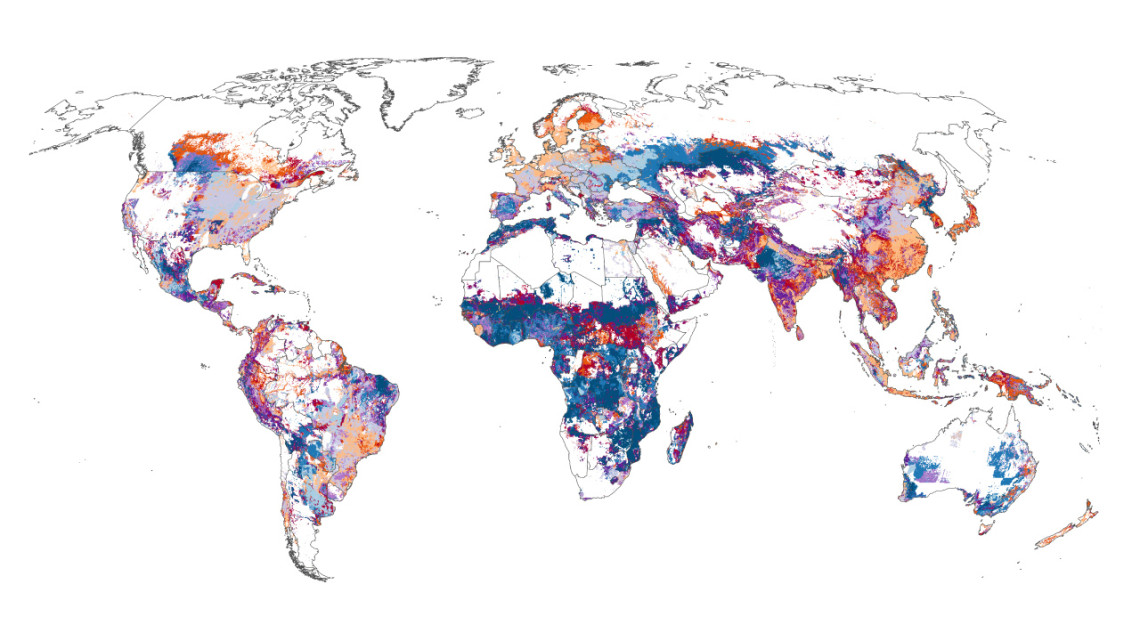
Cornell researchers synthesized data from multiple ground sources and models to map global cropland emissions at high resolution – down to about 10 kilometers.
‘Unprecedented’ emissions maps will hone mitigation
By Caitlin Hayes, Cornell Chronicle
To lower agricultural emissions, policymakers and communities first need to pinpoint the sources. Not just by country but crop by crop, field by field. In other words, they need maps. Detailed maps.
In a study published Feb. 13 in Nature Climate Change, researchers have synthesized data from multiple ground sources and models to map global cropland emissions at high resolution – down to about 10 kilometers – while breaking down emissions by crop and source and identifying regions for more precise mitigation.
“This is an absolute global synthesis of all the information you need, by country, by production system, for calculating greenhouse gas emissions – it’s been a significant undertaking,” said senior author Mario Herrero, the Nancy and Peter Meinig Family Investigator in the Life Sciences and professor in the Ashley School of Global Development and the Environment, part of the College of Agriculture and Life Sciences (CALS). “This enormous update will now be used by all sorts of groups for targeting and understanding much better the emissions sources and developing precision mitigation strategies to address them.”
Croplands constitute 12% of land use globally and account for 25% of greenhouse gas emissions within the agricultural sector. But the last effort to actually map global cropland emissions dates to 2000. Since then, the sector has grown, management practices have changed, and researchers have many more tools to model complex systems.
The new and improved maps incorporate historical data and models, ground and remote sensing, inventory surveys, hydrological information and more. With this integrated data set, the researchers calculated that croplands emitted the greenhouse gas equivalent of 2.5 gigatons of carbon dioxide in 2020, with East Asia and Pacific contributing about half of the total, followed by South Asia, Europe and Central Asia, which collectively contributed 30%.
The data captured emissions across 46 crop classes, but four crops – rice, maize, oil palm and wheat – accounted for nearly three-quarters of cropland emissions, with rice leading at 43%. The source of the emissions differed depending on the crop; the main culprits were drained peatlands for palm oil production (35%), flooded rice paddies (35%) and synthetic fertilizer used in high-production areas (23%).
Greenhouse gas emissions by crop
2020
Skip over chart
Researchers quantified emissions across 46 crop classes and found that four crops - rice, maize, oil palm and wheat - accounted for nearly three-quarters of total cropland emissions.
The researchers said the data highlights the need to tailor mitigation strategies depending on the crop and emissions source, writing that controlled rewetting of peatlands, shifts in the management of flooded rice paddies and optimized fertilizer use could significantly reduce emissions in their respective regions and contexts.
And the biggest hotspots are in Asia, Herrero said.
“It’s all about rice. That’s where the biggest sources and the biggest opportunities are,” said Herrero, also a senior faculty fellow and scholar with the Cornell Atkinson Center for Sustainability. “Some of the more nutritious foods, fruits and vegetables, have way lower footprints. I was surprised by the importance of peatland areas, too, which was much larger than expected.”
The data underscored a correlation between high food production and emissions: Regions that produce a lot of food were often high emitters, and the authors argue that mitigation planning should take productivity into account.
“A lot of studies find the regional hotspot and then say that we need to target this region for mitigation, but we think that may be unfair without considering the production side,” said first author and postdoctoral researcher Peiyu Cao. “One of the innovations of this paper is that we link the food production to the emissions to show how efficient the production system is.”
Greenhouse gas emissions by region
2020
Skip over chart
The East Asia and Pacific region contributed about half of total emissions from croplands in 2020, followed by South Asia, and Europe and Central Asia, which collectively contributed 30%.
The data points to regions that could improve efficiency, even if they have low emissions: Some regions in Africa, for example, have low emissions but also low food production.
“We should be applying different strategies – for African countries, we may ask them to improve their productivity while keeping their emissions low,” Cao said. “In Asia, we may want them to keep their high productivity but focus on emission reduction.”
Cao said the strategies for improving efficiency already exist: Many developed countries succeed in keeping emissions low and productivity high. “The challenge is to overcome the barriers for adopting these techniques in regions with low efficiency,” he said.
Herrero said the maps will ultimately allow countries and communities to address emissions at a hyper-local level.
“It’s really local people who have to act,” he said. “What’s unprecedented here is that these maps provide really a crucial subnational analysis on where you have mitigation opportunities, which is important: Funds for mitigation are scarce, and we need to prioritize.”
Co-authors of the study include postdoctoral researcher Franco Bilotto and research associate Carlos Gonzalez Fischer; Nathaniel Mueller and Avery Driscoll of Colorado State University; Kimberly Carlson of New York University; James Gerber and Paul West of the University of Minnesota and Project Drawdown; Pete Smith of the University of Aberdeen; Francesco Tubiello of the Food and Agriculture Organization of the United Nations; and Liangzhi You of the International Food Policy Research Institute and Huazhong Agricultural University.
The study was funded by Cornell Atkinson and the Land & Carbon Lab, a collaboration led by World Resources Institute and Bezos Earth Fund.
Media Contact
Adam Allington
Get Cornell news delivered right to your inbox.
Subscribe