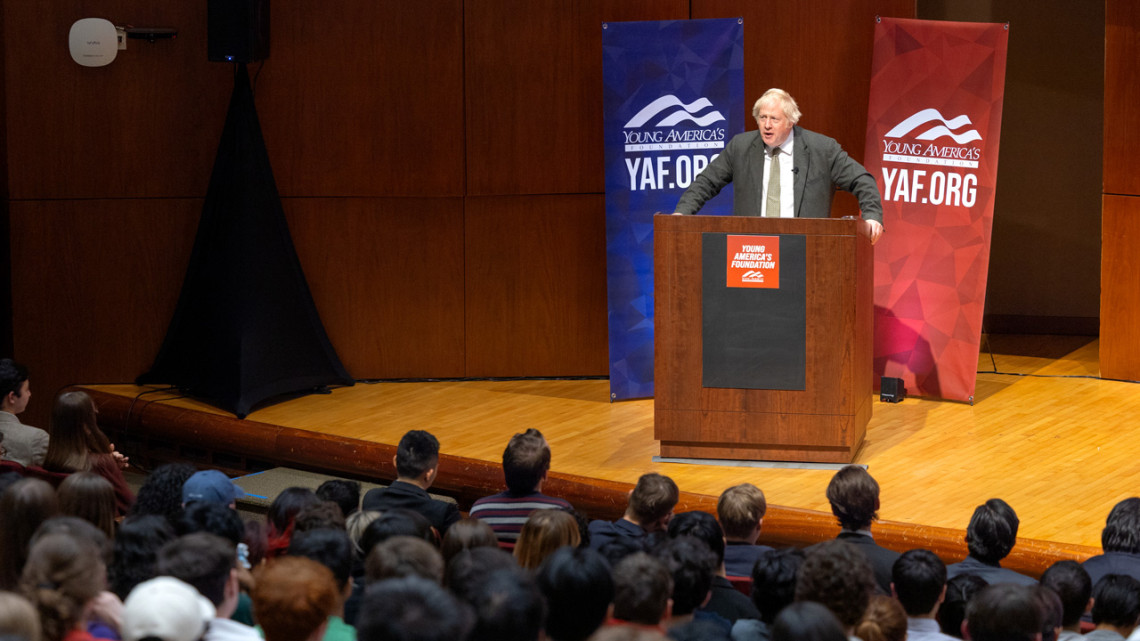
Former British Prime Minister Boris Johnson speaks to an audience gathered April 27 in Call Auditorium.
The West is worth saving, Boris Johnson tells Cornell students
By James Dean, Cornell Chronicle
From the Strait of Hormuz to university campuses, Americans and Europeans must stand together against autocratic regimes seeking to suppress freedom and prosperity, former British Prime Minister Boris Johnson told a Cornell audience on April 27.
“Things are bumpier and more difficult when we are divided and when we squabble, as we have done so often in the past – often far more acrimoniously than today,” Johnson said in Call Auditorium. “But when we stand together and when we unite, and when we correctly identify our foes and the foes of freedom, I promise you, there is absolutely no power on Earth that can prevail against us.”
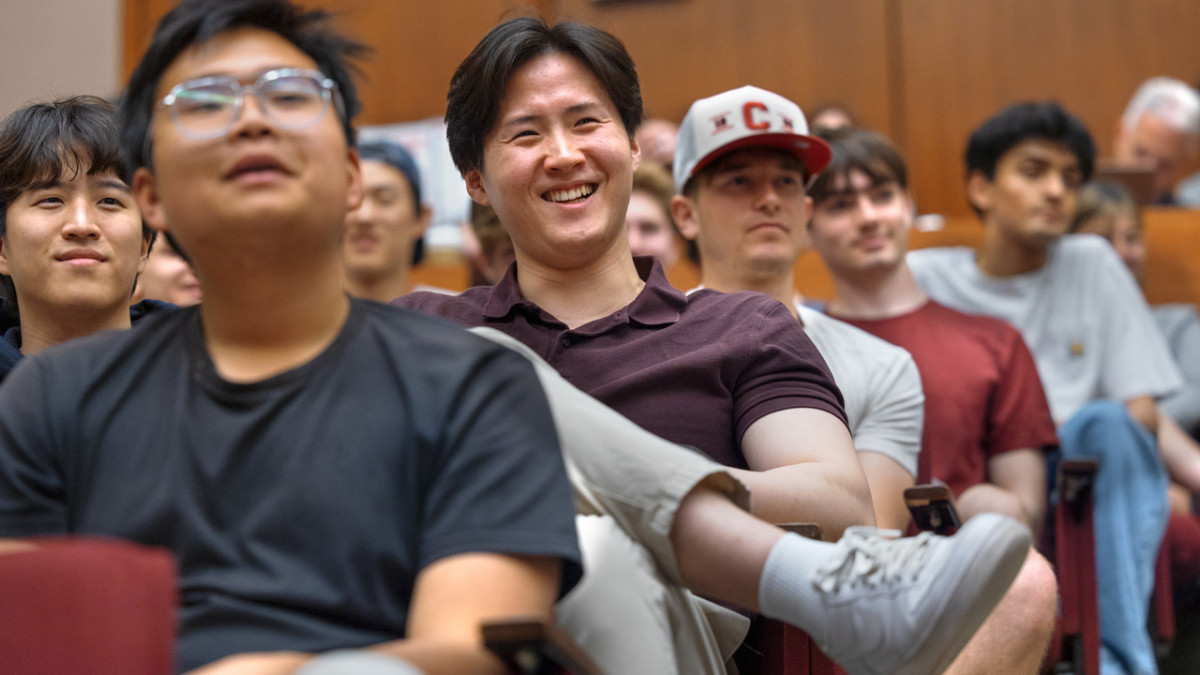
The audience enjoys Johnson’s comments.
Johnson’s talk, “The West is Worth Saving,” was sponsored by Cornell Republicans in partnership with the Young America’s Foundation. In welcoming remarks, Provost Kavita Bala noted that Johnson’s great-grandfather, paleographer Elias Avery Lowe, graduated from Cornell in 1902, and said Johnson’s visit offered the campus community an opportunity to sharpen its global vision.
“Thinking globally encourages us to pursue our core academic commitment to pluralism as a lived institutional practice,” Bala said. “Pluralism strengthens academic freedom and democratic capacity. It requires us to engage constructively across differences in experiences, worldview and values, and to navigate those differences with respect, an openness to learn, and a community in which all members can express diverse opinions and be heard.”
Johnson – who also served as the United Kingdom’s foreign secretary, a member of Parliament and mayor of London – began by expressing dismay at the recent shooting at the White House Correspondents’ Dinner, but appreciation that King Charles III and Queen Camilla had proceeded with a state visit to the White House as planned on April 27. Johnson said he sought to give a sort of pep talk to counter negative narratives about the state of Western democracies and values and a frayed trans-Atlantic alliance.
“People are saying that NATO is about to collapse, the West is finito,” said Johnson, who as prime minister implemented Britain’s exit from the European Union. “And my message to you tonight is, I think this gloom is exaggerated to the point of being mainly nonsense.”
Featuring the brand of humor that bolstered his rise in politics – at one point breaking into song – Johnson poked fun at the Trump Administration’s stated desire to acquire Greenland, noting that it is twice as close to Scotland as Maine (“It’s in our hemisphere”). Perhaps, he said, the U.S. had failed to anticipate Iran’s closure of the Strait of Hormuz because Middle Eastern experts and maps of the region had been “DOGE’d,” referencing the former Department of Government Efficiency led by Elon Musk.
“But that – and this is the point I make to my fellow Europeans – that is not an excuse for turning our backs on America,” Johnson said. “The fundamental objective here of the United States, to defang Iran, is actually sensible.”
He said the world would be safer without nuclear weapons in Iran, which he described as a state sponsor of terror and member of a global “axis of tyranny” including Russia, China and North Korea, whose leaders “hate and fear the freedoms that our people enjoy.”
Similarly, he said, the West should not retreat from support for Israel or Ukraine. Despite gloomy popular narratives, he said, victories in Iran and Ukraine could this year constitute “two huge blows for freedom.”
Johnson cautioned against “false moral equivalencies” equating shortcomings in the West to repression by autocratic regimes, calling them an insult to journalists targeted in Russia, political prisoners in China and protesters killed in Iran. He said the U.S. needed reminding that support for Ukraine was in its interests, and criticized any protests by European or American students that would lend support to Hamas.
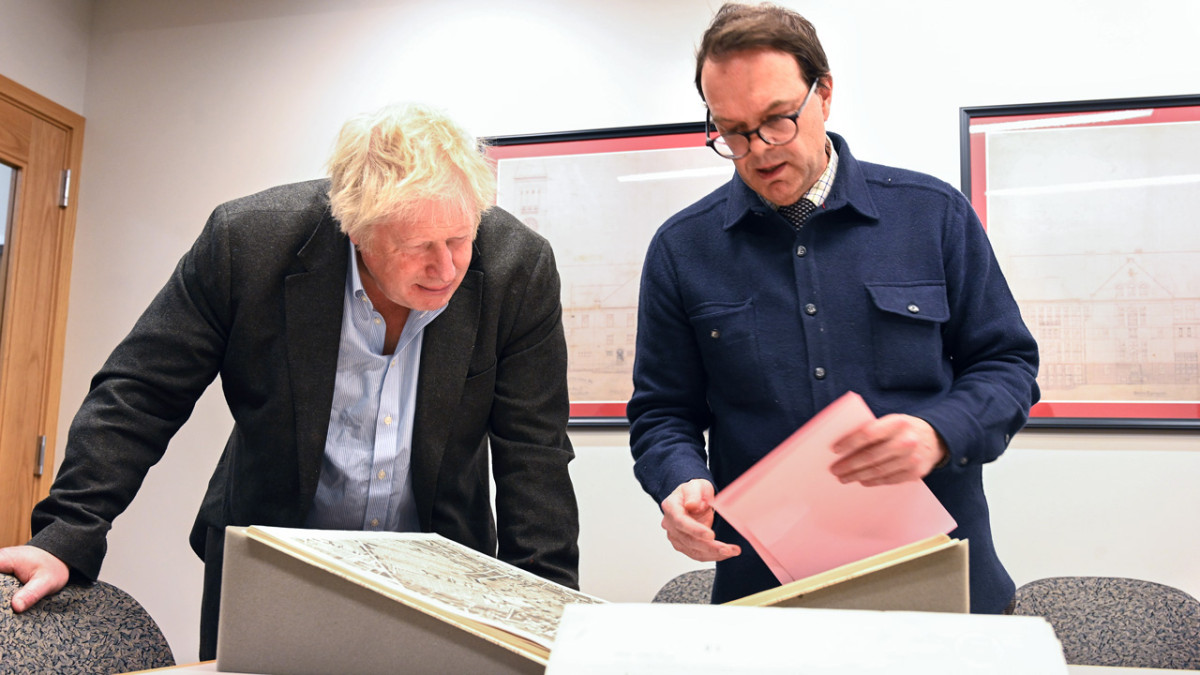
Laurent Ferri (right), curator of pre-1800 collections at Cornell University Library’s Rare and Manuscript Collections, presented Boris Johnson a few invaluable volumes related to Rome, including Giovanni Battista Nolli’s Pianta Grande di Roma, a book of engravings mapping out the city, published in 1748.
Young people in autocratic nations wish they could come here, Johnson said, recognizing that they lack the personal and intellectual freedom essential to economic and spiritual development and to creativity. Consider, he said, the enormous cultural influence of an essential Anglo-American collaboration: rock music. (Johnson sang lines from a French composition that he said was the basis for an Elvis hit.)
Western civilization “is the direct heir and inheritor, the disseminator of the civilization of Greece and Rome, and I would say in its diversity and its creativity, it is the greatest the world has ever seen,” he said. “It is innovative because it is free, and that climate of freedom continues to differentiate the West from the rest.”
Prior to his lecture, Johnson’s visit to Ithaca included a bicycle ride up the Black Diamond Trail to Taughannock Falls and campus stops at the A.D. White House and Cornell University Library’s Division of Rare and Manuscript Collections. There he reviewed two books written by his great-grandfather, whose family emigrated from Russia and whom he remembered meeting as a boy – though he’d been unaware of his Cornell roots. University Archivist Evan Earle ’02, M.S. ’14, also presented Lowe’s class book, academic transcript, correspondence and a memorial service program.
Johnson’s roughly hourlong public talk concluded with a Q&A moderated by Max Whalen ’26, president of Cornell Republicans. What, Whalen asked, is the most compelling reason for optimism about the West?
“I would much rather have a country and a society where people complain about polarization than a country where nobody is allowed to have different reviews,” Johnson said. The U.S. is “going to remain a great, flourishing, troubled, angry, bickering democracy … and you’re lucky to be here. You really are.”
Media Contact
Get Cornell news delivered right to your inbox.
Subscribe