Computer framework generates ‘shadow art’ from scan of an object
By Tom Fleischman, Cornell Chronicle
Some people have a gift for creating beautiful works of art. Others appreciate art but do not have the talent to create it.
Researchers at Cornell Tech and the Cornell Bowers College of Computing and Information Science have created a artificial intelligence framework, ShadowDraw, that can create “shadow art” – partial line drawings that are completed by the shadow cast from an object – by simply scanning the object.
ShadowDraw generates a shadow of the scanned object, then produces a line drawing that is completed with the cast shadow.
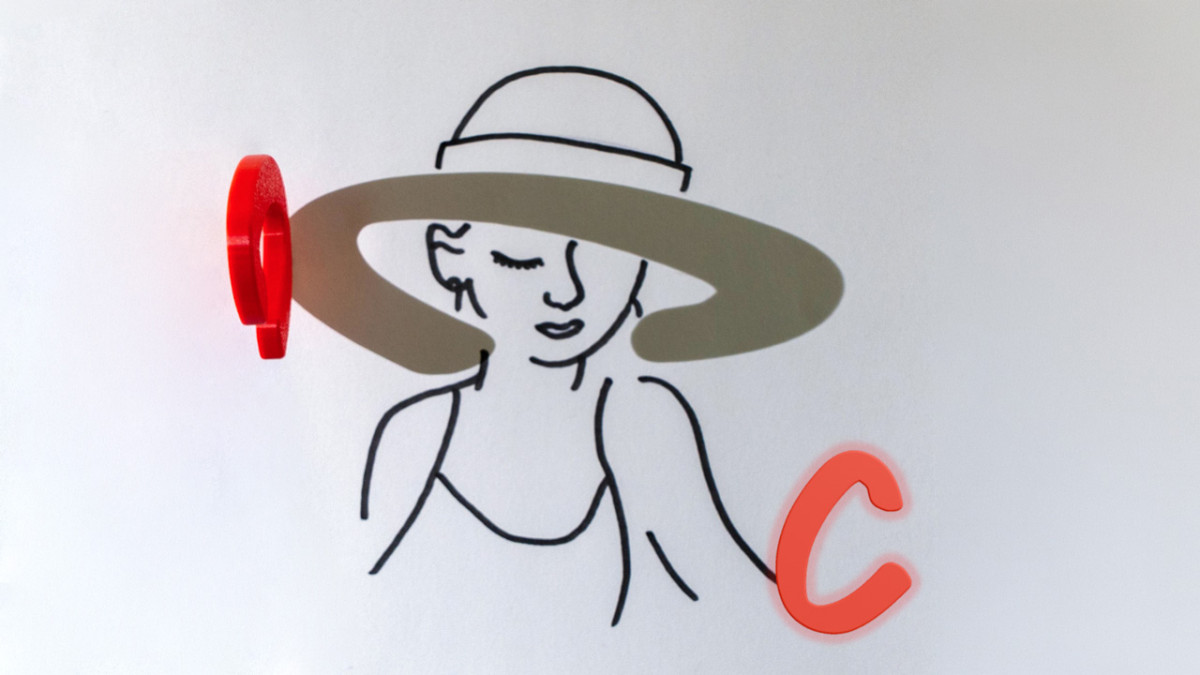
The shadow cast by the letter "C" forms the brim of a hat worn by the woman in this line drawing produced by ShadowDraw, an AI framework developed by researchers at Cornell Tech and Cornell Bowers.
“Shadow art requires iterative trial and error, but with our system, even for people with limited artistic talent, they can take any object from their daily life to create this art,” said Rundong Luo, a doctoral student in the field of computer science. “It takes no trial and error; our system outputs the result in one shot.”
Luo is lead author of “ShadowDraw: From Any Object to Shadow-Drawing Compositional Art,” which he will present June 6 at the Computer Vision Foundation’s Conference on Computer Vision and Pattern Recognition (CVPR ’26), being held June 3-7 in Denver.
Co-authors are Luo’s Ph.D. advisers – Wei-Chiu Ma, assistant professor of computer science (Cornell Bowers); and Noah Snavely, professor of computer science at Cornell Tech.
Luo and the group were inspired by the “Shadowology” art of Belgian filmmaker and visual artist Vincent Bal, known for works that reveal how the cast shadows of everyday objects can seamlessly complete drawn elements.
“Wei-Chiu saw his work on Instagram and found it very cool,” Luo said. “We had done some previous work on art creation, and he sent me the link and asked me whether we could develop some algorithms to automatically create this kind of art.”
Luo had begun by using existing shadow art as training data for his model, but realized that the dataset would be limited. “Artists may produce just one image a day, so it’s only like a few hundred images, not enough for a model to learn on,” he said.
Instead, he used all line drawings they could find online and then taught their computer model to generate line drawings based on the 3D object’s shadow, which serves as a portion of a potential drawn image.
“We use this closed region – the shadow – as a condition to generate a complete sketch,” Luo said. “For this, we have tons of data available – there are tons of sketches online, we can just download them and use them as training data.”
The group tested ShadowDraw using both single and multiple objects, and using animation by rendering five key frames of a scanned object, then overlaying their shadow contours onto a single drawing, using colors to distinguish separate frames. The shadow evolves with the motion of the object, to complete the composition.
“One really nice thing about Rundong’s work,” Ma said, “is that it’s really trying to combine AI, which sort of exists in a 2D space, with those physical objects in our lives. We’re trying to make AI go beyond our screen.”
Ma is adamant that the goal of ShadowDraw is not to replace artists.
“I believe that the reason it’s called ‘art’ is because it’s created by humans,” he said. “We see this more as an opportunity for human-AI collaboration, a way to bootstrap the creativity of humans but by no means replace it.”
The research was supported by Ai2, an NVIDIA Academic Grant and the Defense Advanced Research Projects Agency.
Media Contact
Get Cornell news delivered right to your inbox.
Subscribe