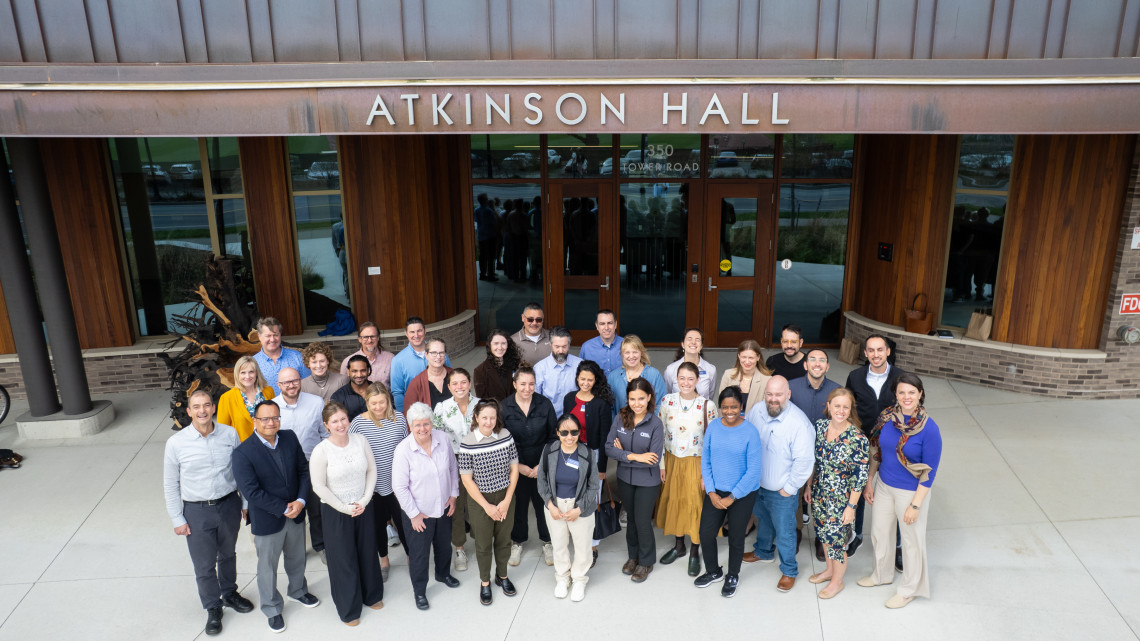
Members of the inaugural Resilient Futures Leadership Program cohort gather at Cornell University in front of Atkinson Hall. The six-month executive education program brought together professionals from across sectors to explore strategies for financing sustainable agriculture.
News directly from Cornell's colleges and centers
Sustainable ag finance leadership training connects industry leaders
By Krisy Gashler
The Cornell Atkinson Center for Sustainability hosted its first-ever executive education program this spring – on financing strategies that support sustainable agriculture – and 93% of participants in an anonymous survey said they would recommend the program to friends or colleagues.
The program was co-created with Field to Market, a Washington, DC-based nonprofit that brings together 200 member organizations across the agriculture value chain. This first session was so successful, Field to Market and Cornell will be co-hosting two more trainings in the next two years, said Miguel Gómez, interim director of the Cornell Atkinson Center for Sustainability.

The program created opportunities for participants to exchange ideas with peers, Cornell Atkinson Faculty Fellows, and industry leaders during sessions and networking events held on Cornell's Ithaca and New York City campuses.
“What was most exciting to me is that participants really valued the chance to step outside their silos and understand the larger food value chain. We had the unique opportunity to have people from financing, sustainable ag, farmer groups, companies that are downstream in the value chain and NGOs all in the same room, talking with one another,” said Gómez, who is also the Robert G. Tobin Professor of Applied Economics and Management in the Dyson School of Applied Economics and Management. “It was great to see the hunger for communication, and for understanding the complexity of the system that is required to finance regenerative and sustainable ag. Participants said they valued the quality of the sessions and the organization, but even more so, they valued being able to talk and share with others across sectors.”
The 2026 cohort included 29 professionals who work at the American Peanut Council, Bayer, Environmental Defense Fund, Farm Credit East, CoBank, the Intertribal Ag Council, and Nutrien (a global supplier of fertilizer, seed and other crop inputs), among others. A graduation ceremony June 3 celebrated the program’s completion.
Anonymous surveys collected from participants after the session documented how important cross-sector communication was in helping students understand how people and systems can function together to support sustainability in agriculture, said Alan Martinez, lead for climate and nature finance on Cornell Atkinson’s Strategic Partnerships team.

Participants explored Cornell's Ithaca and NYC campuses, including visits to the Johnson Museum of Art, creating opportunities to connect with one another while experiencing the broader university community.
“People were speaking different languages… just being in the room together created new strategies,” wrote one participant.
“I don’t know where [else] I would’ve gotten this level of relevant information that so closely impacts what I do for a living,” wrote another.
Program participant Sean McMahon is global sustainability lead at Corvian, a subsidiary of Farmers Edge, Inc., which supplies digital tools and strategic support for organizations across the food and agriculture value chains.
“We’ve learned about sustainable finance for conservation, blended finance, public-private partnerships, philanthropic capital, concessionary capital,” McMahon said. “I think a number of us are going to take some important learnings back from this week to create more effective projects and help us scale more effectively to drive better, more impactful environmental outcomes.”
Carrie Vollmer-Sanders, president of Field to Market, said that the future of agriculture depends on leaders who understand the entire system and can work across traditional boundaries to solve complex challenges.
“Partnering with Cornell Atkinson allowed us to combine Field to Market's cross-sector network with Cornell's academic excellence and deep expertise in sustainability, agriculture, and finance to create a learning experience that challenged participants to think differently, engage with new perspectives, and explore innovative approaches to financing sustainable agriculture,” she said.

Participants engaged with Cornell faculty through lectures, case studies, and discussions focused on sustainable agriculture, agricultural systems, and innovative financing approaches.
The program included three modules: a systematic overview of global, national and farmer perspectives; sustainable ag adoption; and strategies to finance sustainable ag. In addition to components at Cornell’s Ithaca and New York City campuses, participants visited working farms to see first-hand how sustainable practices are being implemented. Faculty from across multiple colleges and industry partners offered lectures and led case studies, including Ben Houlton, Ronald P. Lynch Dean of the College of Agriculture and Life Sciences (CALS), Nish Kumar, head of investor relations at Federal Farm Credit Banks Funding Corporation, and several faculty from the S.C. Johnson College of Business and CALS.
Cornell Atkinson and Field to Market partnered with eCornell, which offers over 200 online certifications for professionals, but this was Cornell Atkinson’s first foray into executive education. Martinez said he is excited to seek out additional partners and expand Cornell Atkinson’s educational programming for professionals, as part of the center’s mission to bridge the gap between research and real-world impact.
“Much of Cornell Atkinson’s resources have been focused on research collaboration, and using research as an avenue to influence impact. But this project really goes much more directly toward shaping, influencing and creating leaders in the sustainability sector,” Martinez said. “This program showed us the potential of bringing researchers, practitioners and emerging leaders together around real-world sustainability challenges. We’re already exploring where similar partnership-based leadership programs could create value in other sectors.”
Krisy Gashler is a writer for the Cornell Atkinson Center for Sustainability.
Media Contact
Get Cornell news delivered right to your inbox.
Subscribe