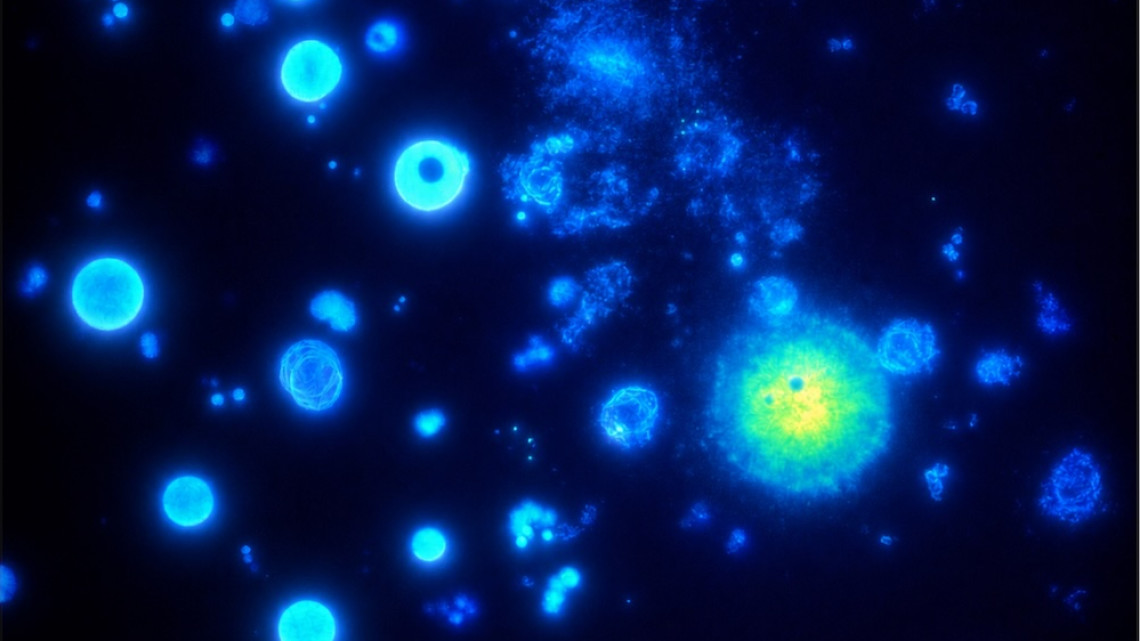
Membraneless organelles known as “condensates” form and disappear every day to help organize the biochemistry in our cells. This image captures in vitro condensates dissolving after a specific chemical is injected from the right. The color represents the concentration of the protein that makes up the condensates.
News directly from Cornell's colleges and centers
Cell biochemistry beyond membranes: The physics of condensates
By Kate Blackwood
Basic biology courses teach that cells contain organelles – such as the nucleus, mitochondria and Golgi apparatus – set apart by lipid membranes to get things done. Recent cell biology research has revealed another organizational principle going on in cells across all orders of biology.
“Proteins and nucleic acids spontaneously organize themselves into blobs called condensates,” said Eric Dufresne, professor of physics in the College of Arts and Sciences and of materials science and engineering at Cornell Duffield College of Engineering, who is working to understand how condensates work.
Droplet-like condensates form and dissolve as cells need them, bringing selected proteins, RNA and other molecules together to coordinate biochemical reactions, said Takumi Matsuzawa, postdoctoral researcher in physics. “Their timely formation and dissolution are essential for normal cellular function, and disruptions to this process have been linked to neurodegenerative diseases,” including Alzheimer’s and Parkinson’s.
Matsuzawa and other researchers in Dufresne's Laboratory of Soft and Living Materials have developed an experimental metric useful for comparing chemical effects across different types of condensates, published July 30 in the Proceedings of the National Academy of Sciences (PNAS); Matsuzawa is first author and Dufresne is corresponding author. With their framework, they’ve uncovered some general rules governing condensates’ responses to chemicals. It’s a tool researchers can use to better understand cellular physiology and identify chemicals that can target disease-related condensates.
Read the full story on the College of Arts and Sciences website.
Media Contact
Get Cornell news delivered right to your inbox.
Subscribe