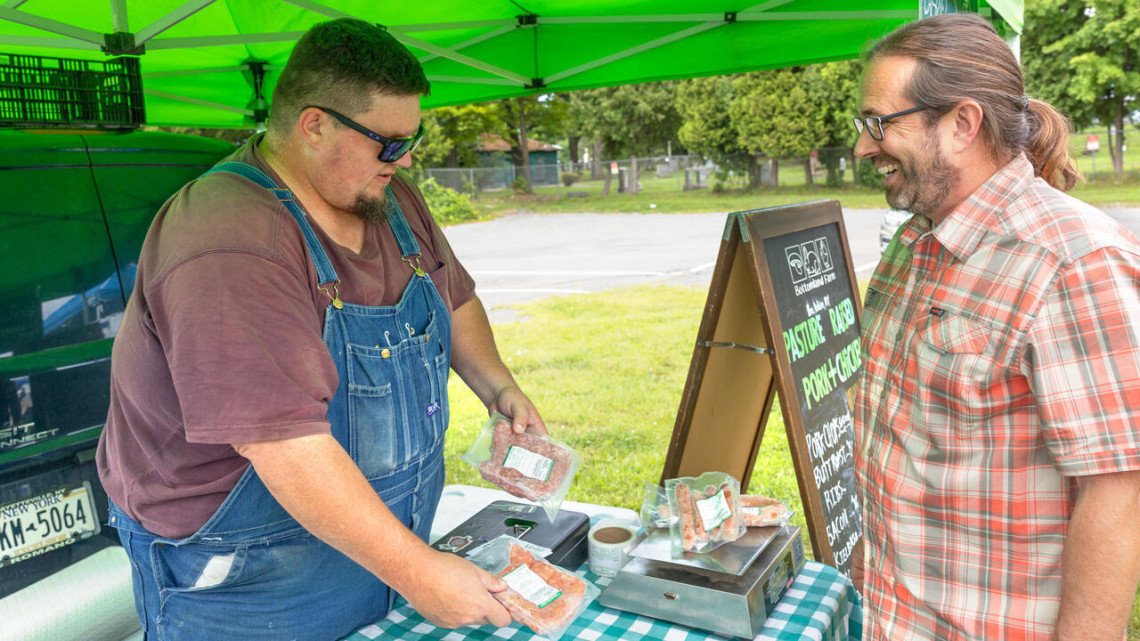
Matthew LeRoux (right), Cornell extension associate and founder of MeatSuite, talks with MeatSuite-user Bill Morse of Bottomland Farm at the East Hill Plaza Farmers’ Market on Aug. 19.
‘Find your farmer, fill your freezer’: Cornell connects meat producers with consumers
By Caitlin Hayes, Cornell Chronicle
Kienan Gridley, owner of Gridley’s Cold Spring Beef in Fayetteville, New York, hears it all the time: People in his area, some of whom live right up the road, have never heard of his beef farm.
“We’re a smaller farm, and we don’t have a big advertising presence,” Gridley said. “And time is so limited. We’re fixing fences, building barns, taking care of cows, harvesting crops and trying to sell products.”
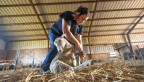
LeRoux's overall research and extension program aims to promote more efficient and profitable markets for farmers.
Gridley has been increasing his farms’ visibility and customer base with a free Cornell website and cache of tools called MeatSuite, which matches customers to local meat producers in New York and North Carolina. Customers can enter their ZIP code and find meat producers in their areas, learn about options for buying local meat in bulk, and access tools – new this year – to determine quantities and savings. The site, used by more than 300 New York state meat producers, had 30,000 visitors from New York in the last year and another 34,000 from North Carolina, doubling previous years’ traffic.
The increase tracks with a growing interest in local food, and in affordability, said Matthew LeRoux, MPS ‘09, founder of MeatSuite and extension associate with the Dyson School of Applied Economics and Management in the Cornell SC Johnson College of Business.
“When the economy is a little worse, I’ve noticed that people often turn to vegetable gardening or buying meat in bulk,” said LeRoux, who has worked in extension since 2009 and directs the Cornell Agricultural Marketing Research Program. “And I think buying in bulk is absolutely brilliant, for both the consumer and the producer.”
A new feature of the site, the Meat Math Wizard, helps customers understand quantities in bulk buying and the cost breakdown, estimating how many servings a quarter of beef will provide, for example (approximately 400). LeRoux said the tool is especially relevant as inflation drives prices up and customers look to lower grocery bills.
“Affordability is top of mind for me as a consumer and in building these tools,” LeRoux said. “And you’re going to get better prices per pound if you buy in bulk from a local producer.”
Gridley, a sixth-generation farmer who works a full-time job on top of farming, said MeatSuite has facilitated deep connections with customers, and along with other Cornell and state programs, makes farming a little easier.
“I don’t think anyone would argue with the idea that farming is hard,” Gridley said. “You don’t get rich and you certainly give your life to it in many ways, so to have the support of Cornell and the state, it just makes the job a little more efficient and hopefully at the end of the day helps to make the farm more profitable and sustainable for the next generation.”
Matchmaking to build resilience
LeRoux started MeatSuite in 2012 when he was an agriculture marketing specialist at Cornell Cooperative Extension Tompkins County. In that role, he surveyed area meat producers and consumers to determine the barriers to selling and buying local meat in bulk: The producers said they couldn’t find customers, and the customers said they couldn’t find producers.
“I saw we simply needed a way to connect them,” LeRoux said. “MeatSuite is a matchmaking site.”
With the motto “Find your farmer, fill your freezer,” LeRoux launched the site in five counties, and it soon grew statewide. In 2020, he partnered with colleagues at North Carolina State University to expand to North Carolina; and with a new influx of funding, they redesigned the site in 2022 and continue to add new tools.
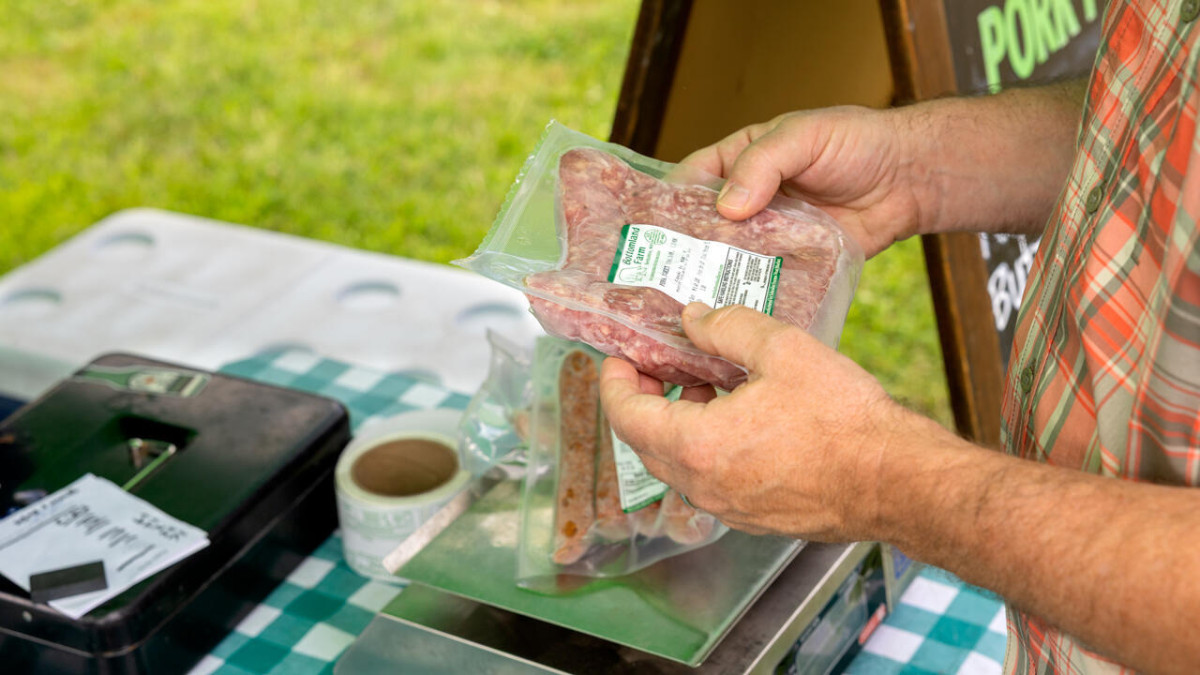
The website serves as a directory of local producers and their products, but it also helps guide consumers through the process of bulk purchasing – such as buying a quarter or half cow – which may be unfamiliar for many. LeRoux said he’s fielded questions about how the cuts of meat are packaged, the storage needed, how long the meat will last, the cost breakdown, as well as production terms like hanging versus take-home weight.
“It’s definitely a different way of shopping that people have to get used to,” said Becca Stern of Kinderhook Farm, a grass-fed meat farm in Ghent, New York that uses MeatSuite. “It can be intimidating to just come into our store and go into the freezer.”
With the Meat Math Wizard, customers can see how far a purchase will go and for how much. For example, the wizard estimates that a typical quarter cow at average price will feed a family of four twice a week for a year for around $18 every week.
Consumers can also compare prices to see their savings; LeRoux and his team collect data on farmers market and grocery store meat prices – with a graduate student canvassing seven local grocery stores every month – and they publish those prices on MeatSuite.
LeRoux said the cost savings aren’t the only benefit. “You’re also going to get this range of cuts in your freezer, from ground beef to ribeyes,” he said. “And it makes meal planning a lot easier, to just be able to grab a cut and build around it.”
For producers, selling in bulk is much more efficient than selling individual cuts in a store or at a farmers’ market, for example, and allows them to package different cuts together.
“It helps us to plan ahead,” Stern said. “And it guarantees that all the parts of that animal are going to the customer and nothing goes to waste.”
Stern said she’s taken advantage of several MeatSuite tools for producers, including marketing guidance, a meat price calculator that takes into account production and marketing costs and a “bundle builder,” where producers can price smaller bundles of bulk meat depending on the variety of cuts.
“I want to use every tool available because they’re all so practical and tangible,” Stern said. “It’s all very straightforward, which lowers barriers.”
Added together, the tools try to make it easier for producers to continue farming, said LeRoux, which is the goal of his overall research and extension program.
“We’re researching and promoting more efficient markets that are profitable to farmers and don’t burn them out,” he said. “Many meat producers are not profit-motivated, they’re lifestyle-motivated, and we try to offer tools to ease the burdens so they can keep farming.”
And more successful farmers and farms mean a more resilient food system, LeRoux added.
“When COVID hit, the shelves were bare, there was no meat, but the local farmers had it,” he said. “A local food system is like a muscle: The more you use it, the stronger it is. And if you want the muscle strong when you need it, you should use it all the time.”
Media Contact
Get Cornell news delivered right to your inbox.
Subscribe