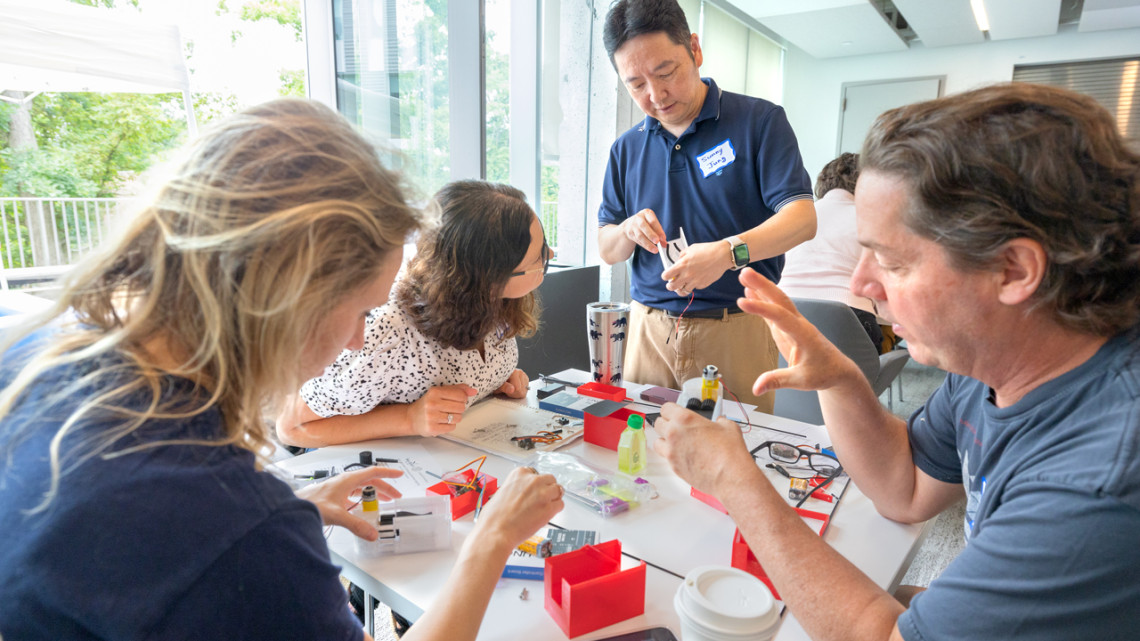
Sunny Jung (standing), professor of biological and environmental engineering in the College of Agriculture and Life Sciences, helps Alisha Stahl, a middle school teacher from Durgee Junior High School in Baldwinsville, New York, at a workshop for teachers on July 29.
NYS teachers take on microplastics with snail-inspired robot
By Caitlin Hayes, Cornell Chronicle
On a rainy morning in late July, Professor Sunny Jung asked a group of New York state schoolteachers to consider the biology of the aquatic snail.
With only one foot, the snail can move and feed, and they do it with an efficient undulating motion that can draw in particles from a distance 10 times greater than their body length.
“They are very efficient at pulling in water from the surface without sucking in the bulk fluid,” said Jung, professor of biological and environmental engineering in the College of Agriculture and Life Sciences, at a workshop for New York state teachers offered by a team of researchers and staff at Cornell, New York Sea Grant (NYSG), Princeton University and the University of Michigan. Now in its second year, the program gives teachers the tools to apply Cornell research in their classrooms, with lesson plans and hands-on materials they can share with their learners.

New York State teachers constructed snail-inspired robots that can pull water in and filter microplastics out.
The workshop’s lessons center on the application of Jung’s research to a problem of increasing concern: the proliferation of microplastics in waterways. Inspired by the undulating movement of the snail, Jung designed a simple robotic system that can pull surface water in and filter microplastics out. With a team of collaborators, the group put the mechanism on a robot they named Mollusca and created both lab-scale prototypes and a build-your-own version for schools.
As Jung presented the research, the wires, circuit boards, motors and many 3D-printed components of the Mollusca robots lay in disassembled piles on a back table. Before day’s end, the teachers would build the robots, test them in a kiddie pool filled with small pieces of plastic called nurdles, and troubleshoot just like students, just like researchers, turning the conference room in Upson Hall into a makeshift robotics lab.
“The Sea Grant trainings are the best I’ve ever done,” said Emily Colletta, head of the gifted and talented program at North Tonawanda Intermediate School in North Tonawanda, New York, who was attending the workshop for the second time. “They’re super interactive, and it’s always local, which makes it easier to integrate and for the kids to benefit. And they always provide us with hands-on materials we can take back to our classrooms. It’s pretty special.”
‘A multiplicative effect’
The research and the workshops come as concerns about microplastics are on the rise, with scientists projecting that the quantity of microplastics in the environment could double by 2040. The particles have been found in at least 1,300 species and throughout the human body, with evidence mounting of harmful health impacts. In April, the Environmental Protection Agency added microplastics to its list of contaminants.
The National Oceanic and Atmospheric Administration’s (NOAA) Marine Debris Program funded development of the Mollusca concept in 2024, and the researchers set about integrating Jung’s mechanism onto a robot. Two years later, three 12-by-12-inch prototypes have now logged 80 hours of swimming in a kiddie pool in the lab of Kirstin Petersen, associate professor of electrical and computer engineering in the Cornell Duffield College of Engineering. She and her students are now investigating how a swarm of the robots could produce flows that increase microplastics collection.
Meanwhile, collaborator Michelle DiBenedetto at Princeton is examining how to optimize the robots under different wave dynamics, and Maha Haji at Michigan is working on designs of larger systems for deployment in the Great Lakes.
“It might not be the right way to get all the microplastics out of the oceans, but you can sample really well,” Petersen said. “Then you can learn more about where microplastics aggregate, which we currently don’t really know. It’s also given us a lot of hands-on knowledge that we need for field robotics on lakes and waters generally – lots of different projects have sprung from this one.”
As the research has progressed, NYSG staff have been translating it into a curriculum that can be adapted for New York state students of any age. The team first shared the lessons at a two-day workshop in July 2025 for 25 teachers and this summer reached 43 more at two all-day sessions, one on Cornell’s campus and one in New York City. In addition to building robots to take home to their students, this year’s cohort learned about microplastics in New York state’s waterways and current collection technologies, as well as the latest Mollusca research developments. They also heard from last year’s teachers on how to implement the project with students.
“It’s super critical that we seed this interdisciplinary approach to complex problems at a really young level,” Petersen said. “And normally, we might reach 20 people at an outreach event that lasts an hour. But here, we’re able to follow the teachers longer and help them seed it in their students – there’s a multiplicative effect.”
Building the skills
For Colletta’s sixth graders, the fact that they could see microplastics in the dust of their classroom, and on the shores of the Niagara River outside their town, made the lessons more real and engaging.
“My students can go to this park by us and find nurdles any time from a nearby plastics factory, so it’s very relevant for them,” Colletta said. “The kids can see the connection to their own community and to themselves.”
Colletta designed an entire three-month unit around the Great Lakes and Mollusca research; students learned about everything from the geography of the lakes to problems that affect them, such as climate change and microplastics. They learned about biomimicry and existing trash capture technology in waterways and brainstormed their own designs for removing the plastics. Then using kits and designs provided by NYSG and with in-person guidance from Jung, they built the same Mollusca robots as the teachers had.
“They tested the robots and made observations and then were able to 3D-print their own modification to improve it,” Colletta said. “They were super engaged.”
Taryn Matteson used the materials with her Advanced Placement Biology students at Tapestry Charter High School in Buffalo. She got “total buy-in,” she said, with some students even using their plastic-capture designs to apply for college scholarships. Matteson and a colleague combined the project with materials from another NYSG workshop on LittaTraps, which collect trash in storm drains.
“The students were able to look at trash collection from the macro- and micro- scale, and then the art class even took the trash and made an art project out of it,” Matteson said. “They really are thinking and building the skills that the new AP standards are looking for.”

Nate Drag, a New York Sea Grant Great Lakes literacy specialist, runs workshops for New York state teachers and is largely responsible for translating the Mollusca research into accessible classroom materials.
Many of the teachers in July’s workshop were repeat participants for NYSG and for Nate Drag, a NYSG Great Lakes literacy specialist, who runs the workshops and is largely responsible for translating the highly technical research into classroom material teachers can use.
“Teachers are fundamentally learners. They’re excited, they’re engaged and asking smart, insightful questions, because that’s what they do with their students,” Drag said. “The hope is that we can keep them connected over the school year, too, and have them working together and sharing resources.”
Drag said the Mollusca project, his first foray into robotics, has added to his skill set and capacity, even as funding cuts have stalled original plans for a third year of workshops.
“It doesn’t end with this project,” he said. “It’s given me a whole new insight into the world of robotics and coding and using new and evolving technologies to solve these really tough problems. Now we can show teachers and students, who will be solving these problems into the future.”
Media Contact
Get Cornell news delivered right to your inbox.
Subscribe