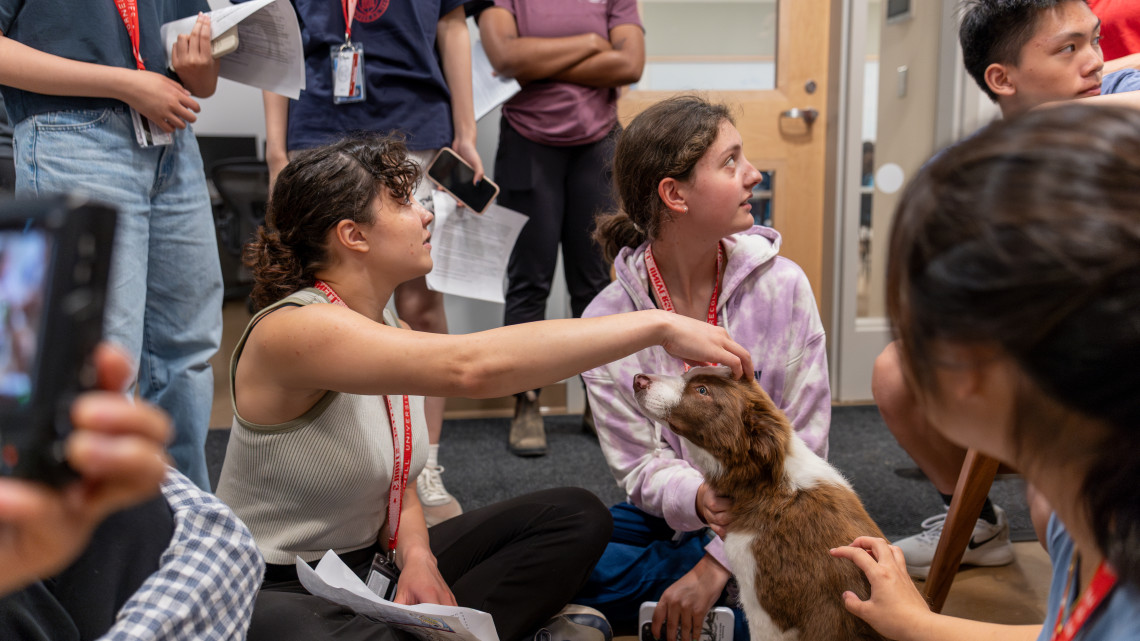
Through a partnership between Cornell’s School of Continuing Education (SCE) and 4‑H, high school students from across New York state can receive scholarships to Cornell’s Precollege Studies program and take courses such as Veterinary Medicine: Science and Practice, pictured here.
News directly from Cornell's colleges and centers
Through an SCE–4 H Partnership, New York Youth Gain Access to College Readiness Experiences at Cornell
By Shelley Preston
When Jecoliah “Cola” Anderson arrived at Cornell for a three‑week veterinary medicine course this summer, she wasn’t sure she belonged in a college classroom or could manage being away from home for the first time. But supported by a Provost Scholarship through Cornell’s School of Continuing Education (SCE), the Harlem high schooler stepped into her first lab, met new friends, and discovered she could thrive in a rigorous academic setting.
Cornell’s Precollege Studies, offered through SCE, gives high school students the opportunity to take real Cornell classes—on campus or online—earn college credit, and learn directly from faculty. The program is designed to help motivated students explore academic fields, build confidence, and experience the expectations of college‑level work.
Many students access Precollege Studies through a statewide partnership between SCE and 4‑H Youth Development, which helps connect New York teens with early college opportunities they may not otherwise encounter.
For Anderson, that opportunity meant immersing herself in veterinary medicine: studying gross anatomy, practicing clinical skills, and working with the school’s beagles during physical exam labs. By the end of the three weeks, she was all smiles in her Ruth Bader Ginsburg Hall dorm. “I learned so many new things I never experienced at my high school,” she said. “It helped me figure out what I want to do in life—I want to be a vet.”
Her experience reflects a growing effort at Cornell to expand access to college‑level learning for New York youth. Through the SCE–4‑H partnership, students come to campus or enroll in Cornell’s online Precollege courses, gaining opportunities to explore academic fields, build confidence, and envision themselves in higher education.
Career Explorations: A statewide entry point
Many 4‑H students first encounter Cornell through Career Explorations, a three‑day residential program that brings more than 200 middle and high school students from across New York State to campus each June. This year’s theme, “Planting the Seeds to Possibilities,” introduced youth to emerging fields including climate‑smart agriculture, artificial intelligence, water resources and dietetics.
Students live in residence halls, eat in dining halls and explore academic fields with Cornell faculty, students and extension professionals. The program includes two tracks: University U, a series of one‑hour workshops across disciplines, and Focus for Teens, a deeper dive into a single topic area.
Alexa Maille, director of New York State 4‑H with Cornell Cooperative Extension, said the goal is to help youth “see possible futures for themselves.”
For Jamila Simon, who leads Cornell’s 4‑H youth development partnerships within the Bronfenbrenner Center for Translational Research, Career Explorations is one place where she can identify students who may thrive in more advanced opportunities, including SCE’s Precollege Studies.
Online Precollege courses expand access statewide
A growing share of 4‑H youth engage with Cornell through its Online Precollege Studies, a vital option for students who may not be able to travel to campus. Each summer, dozens of 4‑H participants across New York State enroll in virtual Cornell courses, studying subjects ranging from veterinary science to computer science from home. For many, the online format offers a first, confidence‑building step into college academics and a chance to earn Cornell credit while balancing family responsibilities, summer jobs or distance from campus.
Simon said SCE’s online courses open doors for youth in every region of the state. “It means a young person in the North Country, the Southern Tier, the Hudson Valley—anywhere—can take a Cornell class,” Simon said. “It’s another doorway into imagining themselves here.”
A statewide commitment to access and opportunity
The momentum behind 4‑H pathways reflects a broader commitment at Cornell to expand educational access for New York youth, especially those who may not initially see themselves on a college campus. “From Career Explorations to Precollege Studies, these programs are designed to meet students where they are and help them take the next step with confidence,” said SCE dean Mary Loeffelholz. “We are committed to bringing even more students to Precollege by working with community organizations such as 4‑H.”
Simon agreed. “We’re building a continuum of opportunity,” she said. “A young person might start with a one‑hour workshop, then try a residential program, then take a college course, and suddenly Cornell feels like a place they can belong.”
As more 4‑H youth arrive on campus each summer—and more earn Cornell credit through residential and online study — the partnership is reshaping who has access to early college experiences. For Anderson, that access changed how she sees her future. For the statewide network of 4-H Educators, it’s changing what’s possible for hundreds of young people each year.
“These students are brilliant,” Simon said. “They just need the door opened. And once it is, they walk through.”
Media Contact
Get Cornell news delivered right to your inbox.
Subscribe