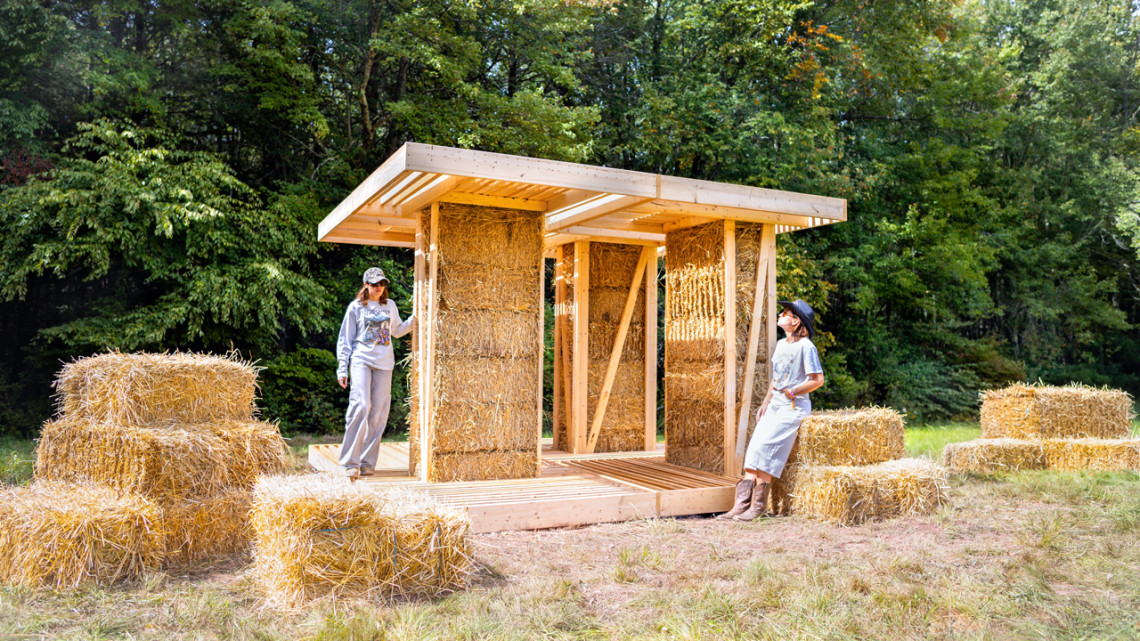
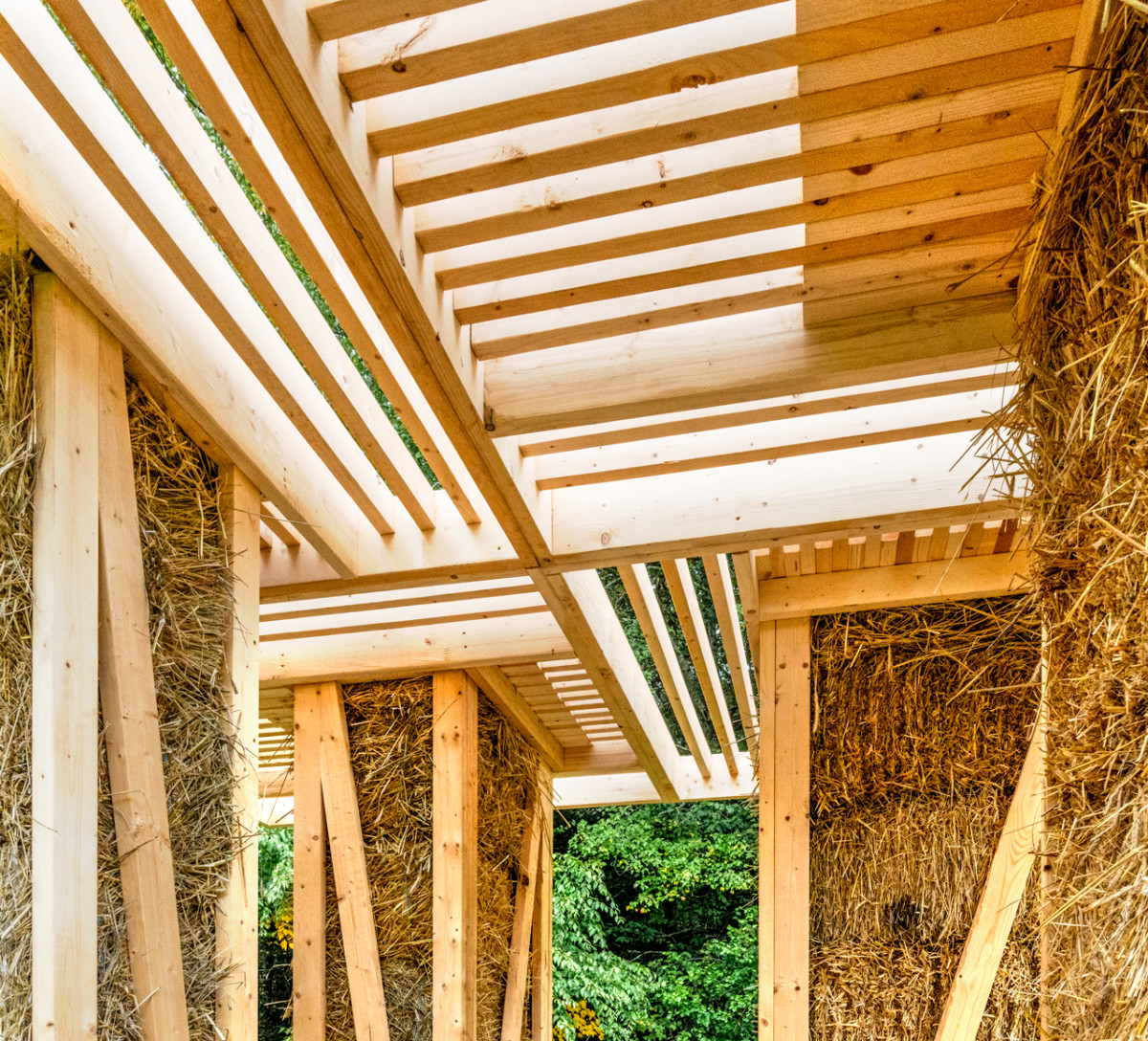
Densely packed straw bales within the interior walls of “BaleWorks,” a design-build installation by Marta Wisniewska constructed recently for BuildFest 2026 in Bethel, New York. As it evolves from a campground stage and shelter to a restroom, weathered straw will be replaced with fresh bales and repurposed for soil remediation.
All-natural materials promote ‘regenerative’ architecture
By James Dean, Cornell Chronicle
Sourced from an upstate New York farm, several dozen straw bales could have ended up like many others this time of year – props in pumpkin patches, fall photo shoots and Halloween décor, before being discarded.
Marta H. Wisniewska, lecturer in the College of Architecture, Art and Planning (AAP) and director of the Regenerative Architecture Lab, prizes them as a more valuable resource: an abundant agricultural byproduct that can be tapped as a sustainable building material.
Built from modular timber frames holding bales of straw, “BaleWorks” explores how straw – typically treated as an agricultural byproduct – can serve as a building material, carbon store and carrier of soil nutrients.
In “BaleWorks,” a design-build installation Wisniewska constructed recently for BuildFest 2026 at the Bethel Woods Center for the Arts in Bethel, New York, densely stacked bales form the interior walls of an open, wood-frame structure whose purpose will evolve over several years. Initially a campground shelter and performance stage, it will transition into a lavatory, while weathered straw is replaced with fresh bales and repurposed for soil remediation.
“At a time when we’re trying to decarbonize the built environment and use less petroleum-based materials, we want to show the potential of natural, renewable and innovative alternatives,” Wisniewska said. “Now may be the perfect time to rethink how we build and help people feel more confident using these materials in their own buildings.”
The project is Wisniewska’s latest exploring how natural and living building materials – also including mycelium, hemp and dirt – can create healthier spaces and mitigate the construction industry’s substantial environmental impact. Buildings over their lifecycles are responsible for nearly 40% of global greenhouse gas emissions, and construction and demolition debris is a major contributor to landfills.
“Addressing this challenge requires a fundamental shift from a ‘take-make-dispose’ economy,” Wisniewska said, “toward a paradigm that integrates biological processes and minimizes waste.”
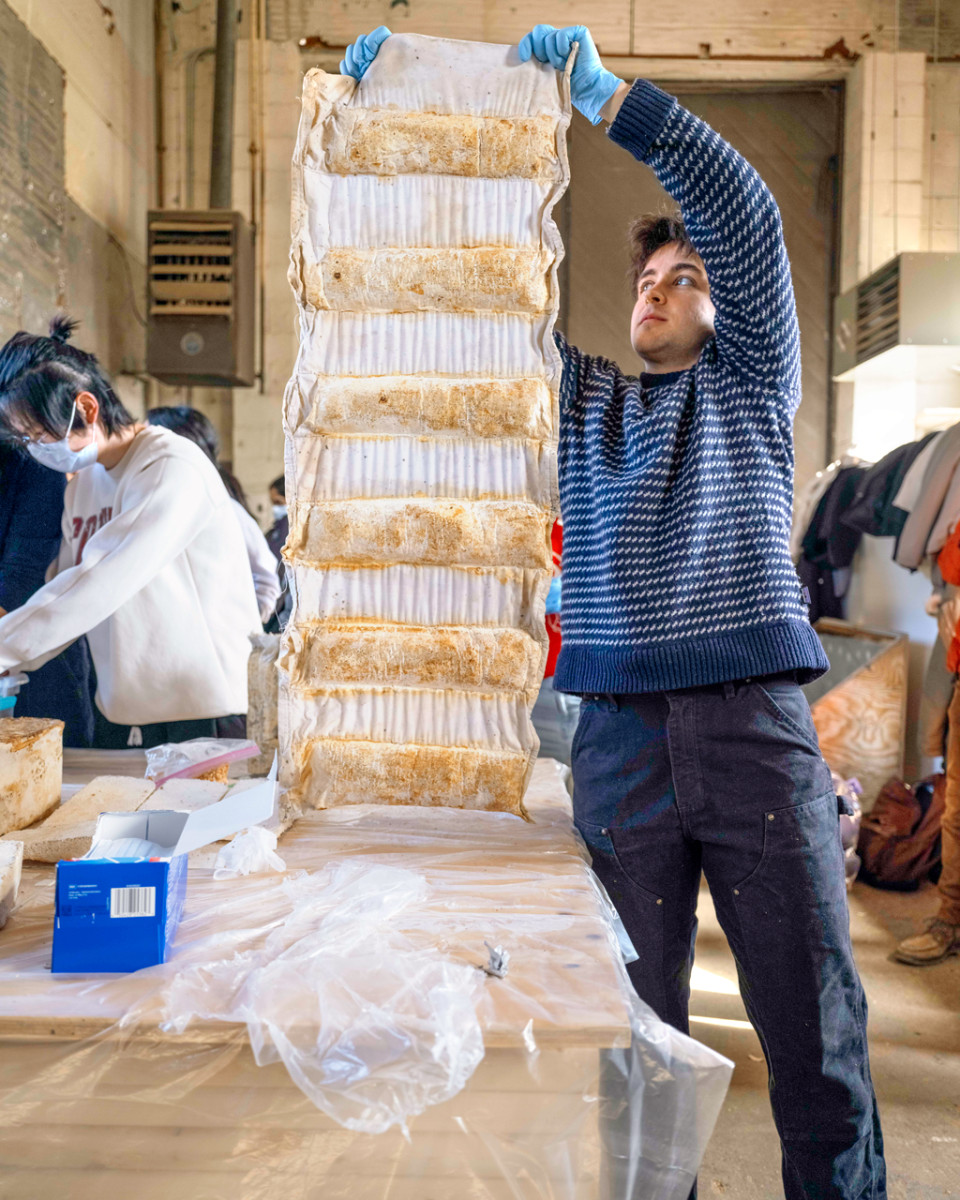
In Home:Grown, Marta Wisniewska’s Spring 2026 seminar exploring bio-based building materials, Sionainn Rudek, M.R.P. ’27, shows off an insulative curtain crafted from mycelium-based composites.
Her contribution involves researching bio-based materials’ capabilities with experts across the fields of plant and fiber science, landscape architecture and engineering; educating students, practitioners and policymakers; and advocating for material consideration before designs dictate more conventional approaches.
“Material decisions are never without costs,” she said. “Each material has social, health and environmental consequences related to their extraction, production and disposal.”
Growing numbers of designers, builders and planners share those concerns. In May, Wisniewska presented her lab’s work to an annual summit of the Bio-Based Materials Collective, a Hudson Valley-based organization with more than 1,000 members, started in 2023 with the goal of rapidly scaling plant-based materials across North America.
“It’s so important that our future designers have tactile experience with natural building materials, and the Regenerative Architecture Lab provides that,” said James Kitchin, a summit organizer and director of the Abundant Futures Design Lab at the nonprofit Model of Architecture Serving Society.
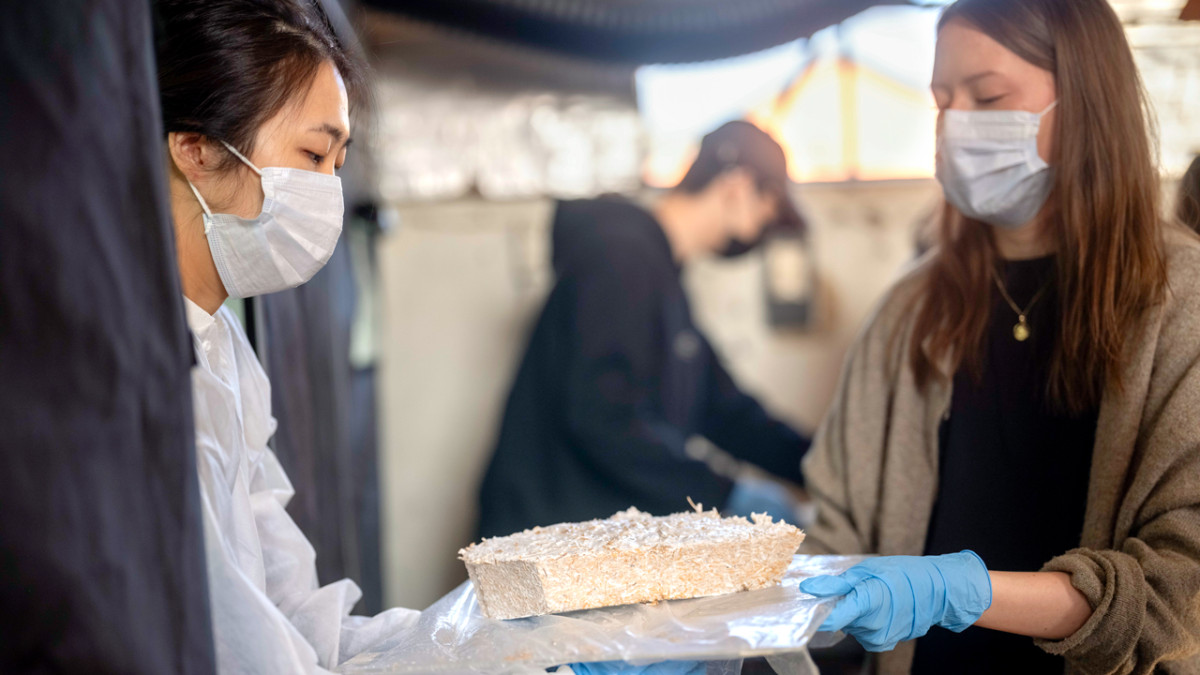
Katie Lee and Sophia Zita, both M.Arch.’27, examine a newly cultivated tile in Home:Grown, a seminar that experimented with mycelium-based composites.
Wisniewska’s recent work also includes:
Home:Grown: In this building technology elective course offered in the spring, students experimented with mycelium-bound composites harnessing the vegetative part of fungi, whose branching, thread-like hyphae act as a naturally growing and biodegradable glue.
The class participants cultivated mycelium-based substrates and stored them in an environmentally controlled chamber to promote further growth. A couple of weeks later, they returned to fill rigid molds and fabric formwork of their own design with fully colonized composites. After several more weeks of mycelium growth, they dried the resulting hardened bricks, panels and tubes in a solar oven. Students proposed applications from interlocking wall elements, roof tiles to insulative curtains, and the incorporation of natural dyes.
The class built on lab studies analyzing the strengths and weaknesses for different applications of roughly 40 strains of mycelium, in collaboration with Kathie Hodge, associate professor of plant science in the College of Agriculture and Life Sciences (CALS) and director of the Cornell Plant Pathology Herbarium, also known on campus as the “mushroom museum.”
Increasing the work’s bio-resilience, Wisniewska and Connor Youngerman, an agroforestry and mushroom specialist with the Cornell Small Farms Program, are partnering with local edible mushroom producers to reuse their substrate – typically a waste product – for MBC production, supported by the Cornell Einhorn Center for Community Engagement.
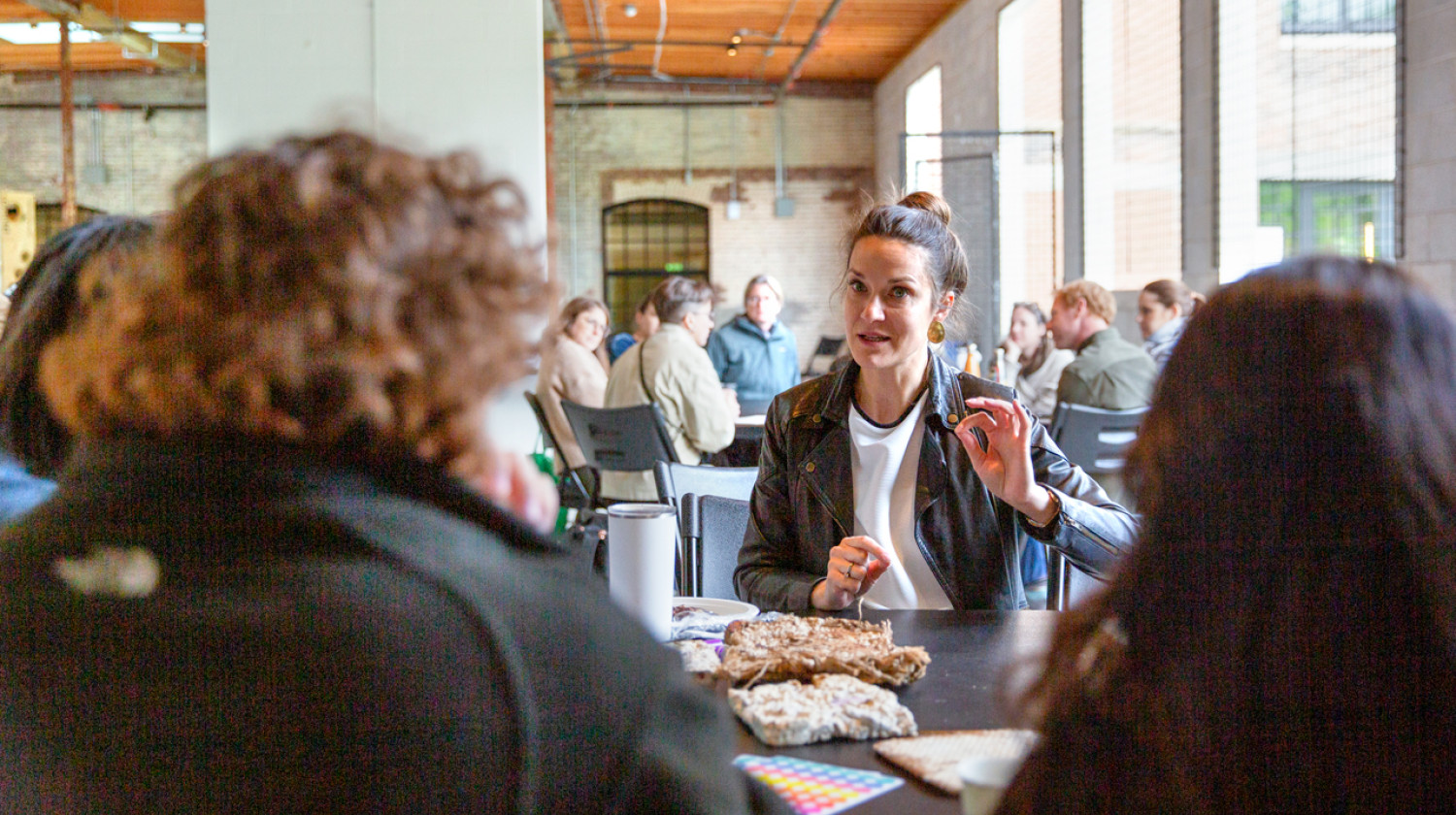
In May 2026, Marta Wisniewska, lecturer in the College of Architecture, Art and Planning and director of the Regenerative Architecture Lab, discussed her research at the Bio-Based Materials Collective’s annual summit in New York’s Hudson Valley.
MycoShell: At BuildFest in 2024, Wisniewska and collaborators designed and built “MycoShell,” a vault of three catenary arches constructed with mycelium-based laminated panels reinforced with natural fabric. The project utilized MycoPly, a product the researchers developed as an alternative to plywood and composite boards. Detailed in a 2025 research paper, MycoPly’s thinner panels are grown separately and then biowelded to increase stiffness and strength, promoting more uniform mycelium growth and improving load-bearing capabilities.

At BuildFest 2024, “MycoShell,” a vault of three catenary arches constructed with mycelium-based laminated panels reinforced with natural fabric. The project incorporated MycoPly, a product the researchers developed as an alternative to plywood and composite boards.
After the arches weathered and eventually collapsed as intended, Wisniewska visited the site recently to collect screws that were the project’s only nonbiological components, leaving no other trace on a forest floor.
“The mycelium’s now being left to decompose and fold back into the landscape,” said Neal Lucas Hitch, M.S. ’24, professor of practice at Carnegie Mellon University and curator of BuildFest. “It’s a little microcosm of how that circular process can work, and we were happy to be the testing ground.”
TerraFirma: NewGrounds: Featuring one of humans’ oldest building materials, a grid of nine columns of compacted dirt rose from the Cornell Duffield College of Engineering quad in June 2023. Measuring 8 feet tall and 18 inches in diameter, each rammed-earth monolith tested a different mix of regional gravel, sand, silt and clay that was pounded into rigid molds during assembly.
Over seven months, architecture and engineering teams monitored weathering, maintenance and structural stability, then measured failure points when the columns were intentionally toppled.
“Soil is often regarded as a waste material, excavated during construction activities and disposed of elsewhere,” Wisniewska and co-authors wrote in a research paper. “However, if structural codification of earthen construction materials are developed, then this so-called waste can be repurposed as a viable construction resource.”

On campus in 2023, architecture and engineering teams collaborated to build and study “TerraFirma,” an installation of nine rammed-earth columns. The project demonstrated the architectural potential of soil often treated as a waste material in construction activities.
Supported by the Cornell Council for the Arts, BaleWorks furthers Wisniewska’s investigation of resource recovery, adaptability and links between construction and agricultural cycles. A proposed next phase anticipates adapting the modular structure into a stalled restroom, in partnership with Rebecca Nelson, professor of plant science and global development (CALS), an expert in “peecyling,” or using human urine as a fertilizer.
Hitch said the project exemplifies the “regenerative” emphasis of Wisniewska’s research-informed teaching.
“It acknowledges that mitigation isn’t necessarily enough, that we’ve crossed a line in terms of the effects humans have had on the environment and we need this reparative action,” Hitch said. “The idea that this structure itself could eventually be used to regenerate the landscape is really compelling.”
Wisniewska hopes her teaching and research help bio-based materials continue to make inroads in a U.S. construction industry that has prioritized speed and efficiency.
“It’s slower architecture and smaller architecture, for now,” she said. “But a big shift is happening; many people are concerned about the way we build. If we can identify opportunities for structures with shorter lifespans or seasonal uses, that can be rebuilt without too much effort and financial burden, I think there’s a lot of interest in this approach.”
Media Contact
Get Cornell news delivered right to your inbox.
Subscribe