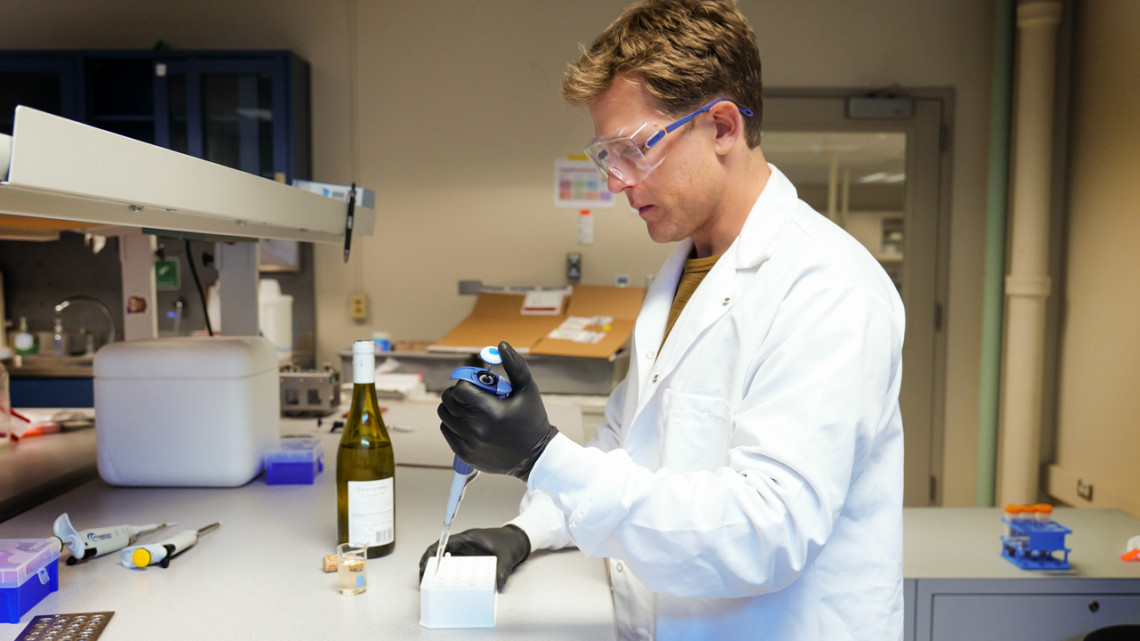
Terry Bates prepares samples in the Quantera lab. The Curio grew out of his doctoral research in Gavin Sacks’s lab at Cornell.
Cornell startup seeks to redefine food, ag, industrial testing
By Laura Reiley, Cornell Chronicle
A single wine grape can announce its readiness through aroma molecules detectable in infinitesimal quantities. Measuring them has long meant working through samples one at a time.
Quantera Analytical, a Cornell spinout based in Ithaca, launched a commercial product it says removes that bottleneck. The launch marks an important step in Quantera’s development, as it has transformed its research into a commercial product that meets a demonstrated market need.
The Curio HS is a cartridge-based extraction platform that prepares dozens of samples at once for testing on instruments laboratories already own. Paired with newer mass spectrometers, the company says, it can cut per-sample cost by up to 80% compared with conventional fiber-based extraction while processing up to 60 times as many samples in the time it used to take.
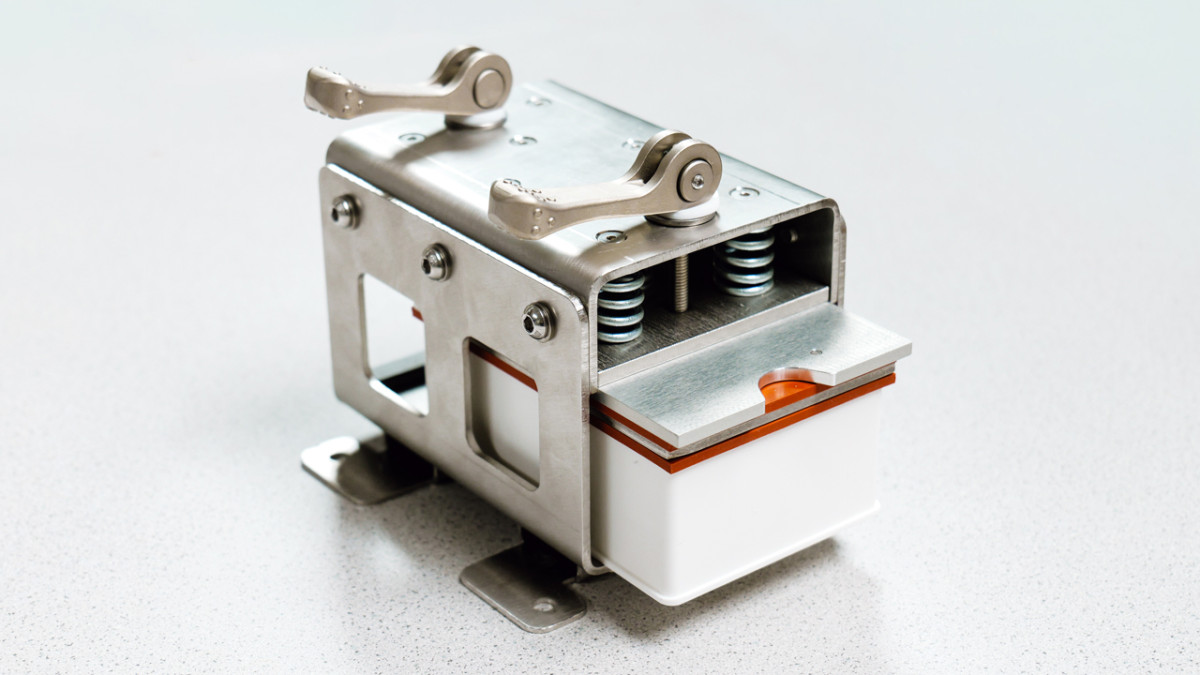
The Curio HS on its dock. The system prepares a full plate of samples at once for analysis.
Quantera is also preparing to deploy the Curio HS this fall in an onsite pilot with E. & J. Gallo Winery at its Modesto, California location and is creating an early-access program for producers and laboratories. Gallo will use it to more effectively test the compounds that matter most for grape quality.
“Curio is the product of nearly a decade of research partnership between Cornell University and E. & J. Gallo Winery,” said Bruce Pan, director of chemistry, research and applications at E. & J. Gallo Winery. “That collaboration was instrumental in launching Quantera and continues to support the advancement and early application of Curio.”
The bottleneck
The new technology aims to improve headspace analysis, which measures the volatile and semivolatile compounds that define the safety and quality of beverages, food or fragrance: the herbaceous notes that tell a winemaker when to pick grapes, an off-flavor in a tank of beer or dairy, residual solvent in packaging film.
“This opens up a new market,” said Terry Bates, M.S. ’19, Ph.D. ’23, Quantera founder and chief executive. “For example, in procurement, when people take in grapes, they’d like to grade them for the aroma compounds that drive consistency, right at intake, but they haven’t been able to. This allows them to do that. In the lab, our goal is to drop this system into workflows that already exist.”
The conventional method uses coated fibers, a technique called solid-phase microextraction, to pull compounds from one sample at a time, followed by analysis with gas chromatography mass spectrometry. Labs have had a limited menu of fiber coatings to choose from.
The Curio HS swaps the fiber for a cartridge. Liquid or solid samples go into a multiwell plate that fits the standard plate footprint, and an array of cartridges seals over it, one above each well. Bates said the Quantera preparation takes under two minutes per sample.
Because the agent that absorbs (called the “sorbent”) lives in a cartridge, labs can choose conventional or advanced materials to match their target compound and their budget. Cartridges can be loaded where the sample is collected and sent to the lab, which spares producers from shipping crates of perishable raw material.
“We can do it both inside and outside a lab. You could be in your field house with your grapes, load the cartridges there, and send them to the lab instead of shipping the fruit,” Bates said.
The technology was developed by Bates as a graduate student in the laboratory of Gavin Sacks, chair and professor of food science in the College of Agriculture and Life Sciences, and has been described in 12 peer-reviewed publications. Quantera holds an exclusive license to the Cornell patent portfolio covering the extraction geometry and workflow and has filed its own patent applications on the Curio platform and cartridge design.
“Turning analytical innovations in the lab into routine applications is as important as the initial discoveries,” Sacks said. “I’m impressed by how Terry and his team at Quantera have transformed his Ph.D. work into a device appropriate for rapid analyses across a range of industries.”
The company was admitted to Cornell’s Praxis Center for Venture Development in 2025. At the time, Bates described accessibility as the company’s top value, saying small growers and labs are often disadvantaged by the cost of testing.
“Since last year, we have completed two pilots with the U.S. Department of Agriculture, for which we are preparing publications,” Bates said. “We have fully engineered the product and are moving into manufacturing and packaging – manufacturing will be done at Elmira Stamp and packaging at Jamestown Packaging – all here in New York state.”
Quantera will compete against 19 other finalists for $3 million in prize money at the Grow-NY Summit, an annual two-day food and agriculture business competition and networking event taking place Nov. 12-13 in Rochester, New York.
Media Contact
Get Cornell news delivered right to your inbox.
Subscribe