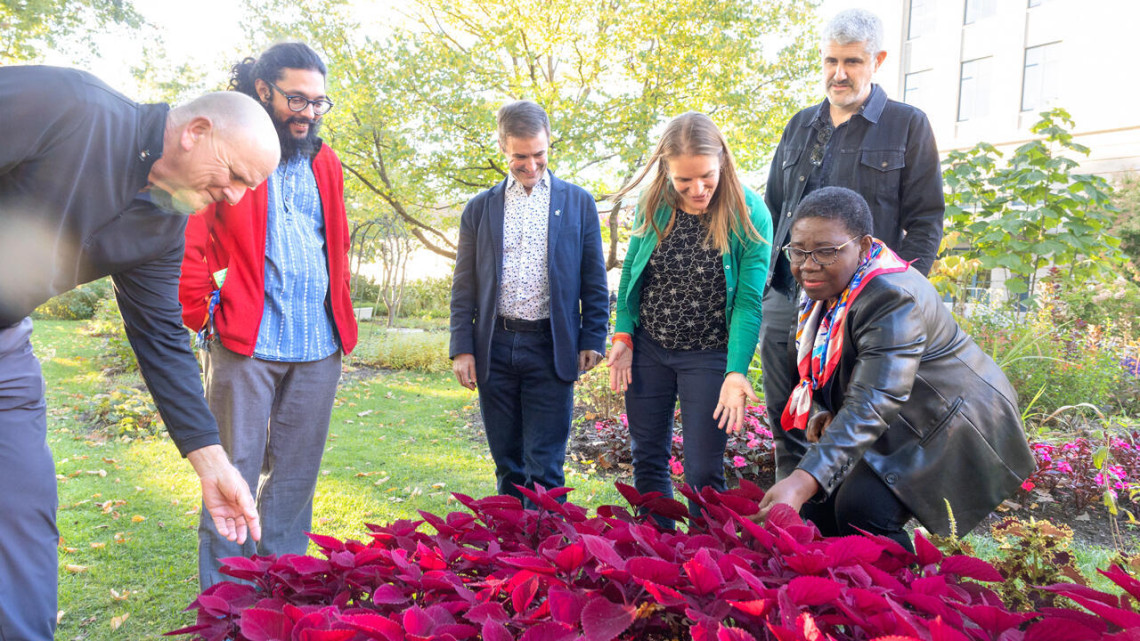
Members of the Center for Research on Programmable Plant Systems meet in Minns Graden. From left: John Reid, Arjun Khakhar, Abe Stroock, Margaret Frank, Jesse Woodson, and Marceline Egnin.
NSF awards $22.5M to continue plant-human communication projects
By Krishna Ramanujan, Cornell Chronicle
Thanks to Cornell-led research, a tomato plant’s leaves turn red when its roots signal that soil nitrogen is low, prompting a farmer to fertilize.
A grower may soon be able to see a weather forecast for a hot dry day and signal her crops to close their leaf pores, called stomates, to preserve water.
And when drought is predicted midway through a summer, a farmer will be able to apply an agrochemical that changes the architecture of his crop’s roots to grow deeper.
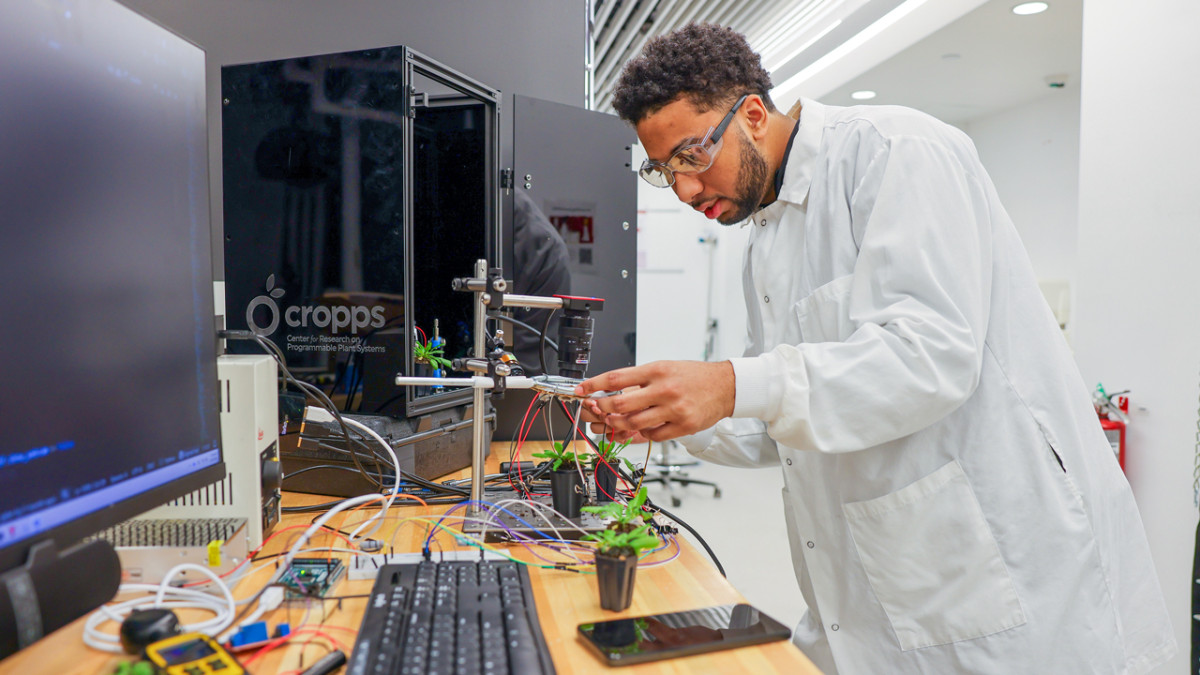
Undergraduate researcher Braddy Maria sets up the mobile demonstration unit “CROPPS in a Box.”
To advance these and other projects that enable direct two-way communication with crop plants’ internal processes, the Cornell-led multi-institutional Center for Research on Programmable Plant Systems (CROPPS) has received a five-year, nearly $22.5 million grant from the National Science Foundation.
The goal of this interdisciplinary work – which combines the expertise of plant scientists, engineersand computer specialists – is to ultimately transform how crops grow, adapt and thrive. The new grant renews a previous $25 million NSF grant awarded to CROPPS in 2021.
“Our definition of programmable plant systems focuses on plant-to-human communication where these communications are from the internal biology of a plant to humans using digital tools, or from a human to a plant’s inner biology,” said Abraham Stroock ’95, the Gordon L. Dibble ’50 Professor in the Cornell Duffield College of Engineering and principal investigator and director of CROPPS.
Aside from Cornell, CROPPS includes five partners: the Boyce Thompson Institute, the University of Illinois Urbana-Champaign, the University of Arizona, Colorado State University and Tuskegee University. At Cornell, researchers from the College of Agriculture and Life Sciences (CALS), Cornell David A. Duffield College of Engineering and the Cornell Ann S. Bowers College of Computing and Information Science are all involved in the center.
The grant will fund several projects that aim to reduce the use of water, fertilizers and other resources, the researchers said.
“Ecologically and economically, agricultural inputs are extremely expensive for us as a society,” saidco-principal investigator (co-PI) Margaret Frank, Ph.D. ’14, associate professor in the School of Integrative Plant Sciences in the Plant Biology Section in CALS.
Half of all nitrogen and vast amounts of water are wasted because they are applied on a schedule and not in relation to the plants’ needs, she said. At the same time, a crop’s real-time requirements are extremely hard to monitor. “It’s vital that we reduce these inputs that have a huge impact on our environment and on the accessibility of affordable food,” Frank said.
To these ends, Frank leads a “root-to-shoot” nitrogen sensing project where tomatoes have beendeveloped with leaves that turn red, alerting farmers when the plants need more nitrogen. The project’s first phase began in the greenhouse with plants embedded in an automated hydroponic system that deliversnitrogen when needed. In 2025, the researchers moved into field trials in two different climates, at Cornell and at the University of Arizona, and have shown that the nitrogen response of these sensor plants can be captured via drone imaging.
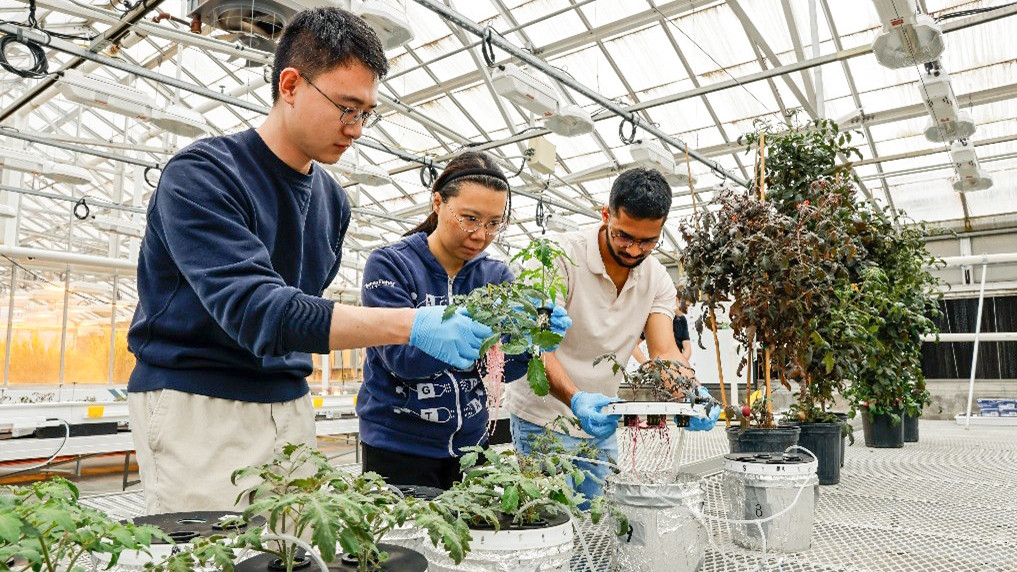
CROPPS trainees Yanlei Zhai, Tian Gong and Sathwik Manjunath transplant RedAlert plants.
“That’s an opportunity that a big center like CROPPS can make possible: We can have common field experiments across very different environments,” Stroock said, referring to access to the diverse climates that partners provide in the Northeast, desert Southwest, the Southeast, the Midwest and in a mountain state.
The grant will fund the continuation of research that has progressed from the initial molecular biology and bioengineering in a crop species to integrating the plants’ growth with automation, drones and computing, and working within environmental, farm and regulatory constraints.
“We are now bringing a new biology in a crop plant all the way to an agronomic context and have demonstrated it in two production environments: a controlled one in the greenhouse and in the field,” Stroock said.
Along with the “root-to-shoot” nitrogen sensing, the group is also developing a plant that senseswater stress in the roots and uses a canopy reporting system in the leaves.
CROPPS members have begun discussions with stakeholders for potentially using “root-to-shoot”tomatoes as sensor plants between their crops, including small production tomato growers who use high tunnels in New York state and large-scale tomato growers in California.
A “fast signals” project, led by co-PI Jesse Woodson, professor of plant sciences at the University of Arizona, and Stroock, focuses on the rapid communication that naturally occurs within plants.
The research, almost entirely in Arabidopsis (a standard model plant widely used in research) to date, aims to develop tools that tap into the plant’s natural, minute-to-minute, or hour-to-hour responses to environmental triggers. For example, plants must make tradeoffs between opening their stomates to take in more carbon for growth and losing water through the pores to the environment. As a result, when conditions are dry, plants close stomates to preserve water. The researchers are developing ways to trackand control such processes, such that if the weather forecast predicts a hot day, farmers might signal their crops to close their pores to save water. Or, when a plant is injured, say from a pest, the damage sets off a series of immediate internal responses that growers can monitor and potentially utilize to manage the pests.The team is also exploring breeding plants and developing tools that work with crops to optimize carbon uptake from the air to maximize growth.
The team has already brought an educational offshoot of this “fast signals” project, called “CROPPS in a Box,” to schools and college classes to demonstrate how physical stresses, such as a wound, can be translated into a phone text message that reads “I’m hurt! Please help!” The system takes advantage of the plant’s natural release of calcium as a stress response. Researchers engineered Arabidopsis plants to fluoresce when they release calcium, which can then be picked up by a microscope, interpreted by a computer and converted into a message.

CROPPS trainees and undergraduate researchers Bobby Henkelmann, Daniel Baldeo-Thorne and Muna Nwaiwu program a closed-loop fertigation system.
“It’s a way we can bring the technology – including biotechnology and image analysis – to other biology labs, classrooms and outreach events,” Stroock said.
A third project, led by Arjun Khakhar, assistant professor of biology at Colorado State University, along with Anthony Studer, associate professor of crop sciences at the University of Illinois Urbana-Champaign, targets plant architecture where researchers could adapt the developmental processes of the root system or the distribution of leaves above ground mid-season based on information from by models or forecasts. For example, if water availability becomes limited during the growing season, root growth can be adjusted, enabling plants to access a limited water supply. Likewise, dynamic changes in a plant’s canopy could allow farmers to suppress weeds with wide leaves early in the season, while optimizing for capturing light through a tapered leaf structure later in the season. CROPPS is also training a cadre of postdoctoral researchers and graduate students who are absorbing the interdisciplinary knowledge needed to develop programmable plant systems.
“I think one of the most valuable outputs of CROPPS is our trainees who are bridging our expertise and helping form these emerging technologies that don’t exist outside of CROPPS,” Frank said.
“They have really driven the discoveries and innovations that underpin the center’s breakthroughs and represent a strong cohort of future leaders in the emerging field of programmable plant systems,” she said.
Media Contact
Get Cornell news delivered right to your inbox.
Subscribe