Data centers need power – lower income, rural residents pay the price
By Caitlin Hayes, Cornell Chronicle
As the engines of artificial intelligence, large data centers can consume as much power as medium-sized cities, straining grids and prompting expensive upgrades to U.S. energy infrastructure. New research finds that residents, and especially lower-income and rural residents, are disproportionately bearing the costs.
In the study, published Nov. 9 in Nature Energy, Cornell researchers analyzed growth in energy demand and infrastructure projects for four major U.S. power grids from 2020 to 2025 and found that data centers have hiked wholesale energy prices and on average paid only 38% of the infrastructure costs linked to their growth – $3.12 billion of an $8.25 billion bill in 2025. The remaining $5.13 billion, or 62%, fell largely on residents, with the lowest income households seeing extra energy costs up to 28% of their incomes.
“We were trying to answer a very simple question: With the booming of data centers, who pays for that expansion and who benefits?” said Fengqi You, the Roxanne E. and Michael J. Zak Professor in Energy Systems Engineering in the Cornell Duffield College of Engineering. “It’s not just a question of generating enough electricity but of whether the rules for paying for the grid are keeping pace with who is driving new demand.”
The research is the first multi-region, long-term assessment of how data center development impacts infrastructure growth and how costs are distributed across communities. It comes amidst a boom in data center construction.
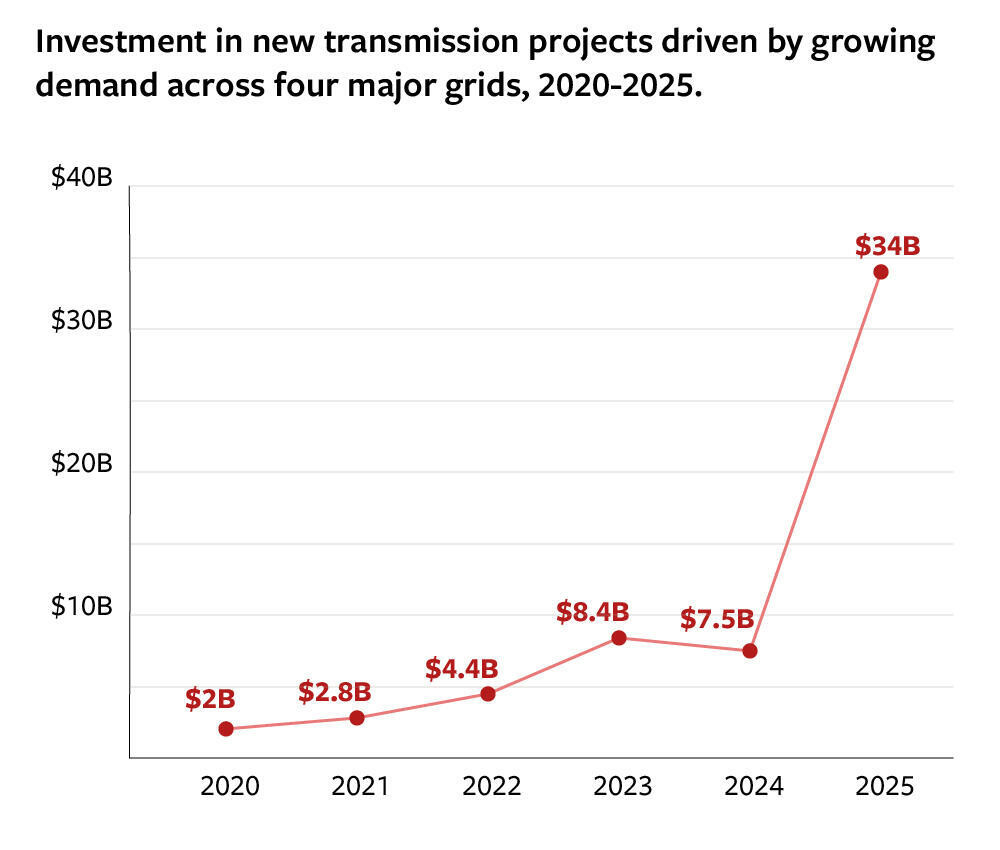
The researchers found that transmission investment in energy infrastructure projects increased from $2 billion in 2020 to $34 billion in 2025, with data centers driving much of that rise. Debates are ongoing – from local communities to state governments to Congress – about who picks up the bill as growth accelerates; data centers are projected to consume between 8% and 17% of U.S. electricity by 2030, with 70% to 80% of that attributed to AI.
With first author and postdoctoral researcher Cheng Feng, You also looked at data centers’ economic benefits, finding that each gigawatt of data center capacity can create 15,000 jobs across the economy, with an average 2,700 jobs directly associated with the data center (although not necessarily all on-site).
“In a lot of discussions right now, people take one side or the other, completely yes on data centers or completely no,” said You, director of the Cornell AI for Sustainability Initiative. “But there are benefits and costs, and the key issue in the end is how to balance the trade-offs.”
Sharing the cost of power infrastructure
The team analyzed data from 4,000 existing and proposed data centers, as well as power-price records, rate filings from utilities, power-line plans, and federal household and job data. The major grids they studied encompass regions with the largest clusters of data centers, including the southern San Francisco Bay area; north Texas around Dallas-Fort Worth; the Midwest; and the mid-Atlantic region, including northern Virginia, where the biggest concentration of data centers has been built to date.
State incentives for data centers have provided returns on the investments, if inconsistently, the researchers found. Some states, such as California, reaped $180 in worker income for every dollar spent, while Virginia increased income $2 for every dollar invested. The researchers determined that the presence of an existing, qualified workforce was a stronger indicator of high returns than the amount of incentive spending.
Data centers also increased wholesale electricity prices, the amounts utilities pay regional power markets before delivering the electricity to homes. In the most-affected hubs, data center growth raised those prices by nearly 10% or more by 2025. In Virginia, the costs jumped 15% and in California’s southern Bay Area, 20%. In contrast, residents in New York and New England, where data center construction has been limited, have not seen clear price increases due to data center expansion, the researchers found.
“I think that means we’re at a good starting point in New York to think about the next steps,” You said. “Economic benefits, job benefits, investment, fairly allocating the costs – these are the dimensions and trade-offs we need to consider.”
A key problem is how the costs of new infrastructure projects are currently shared: The allocation is often based on previous patterns of energy consumption.
“It’s kind of a chicken-and-egg problem,” You said. “Because if you’re going to build a data center, you need to expand this power infrastructure. Otherwise, there’s no electricity for them to run. But before they build, they’re not using energy. So with this model of relying on past consumption, households end up taking on much of the infrastructure costs.”
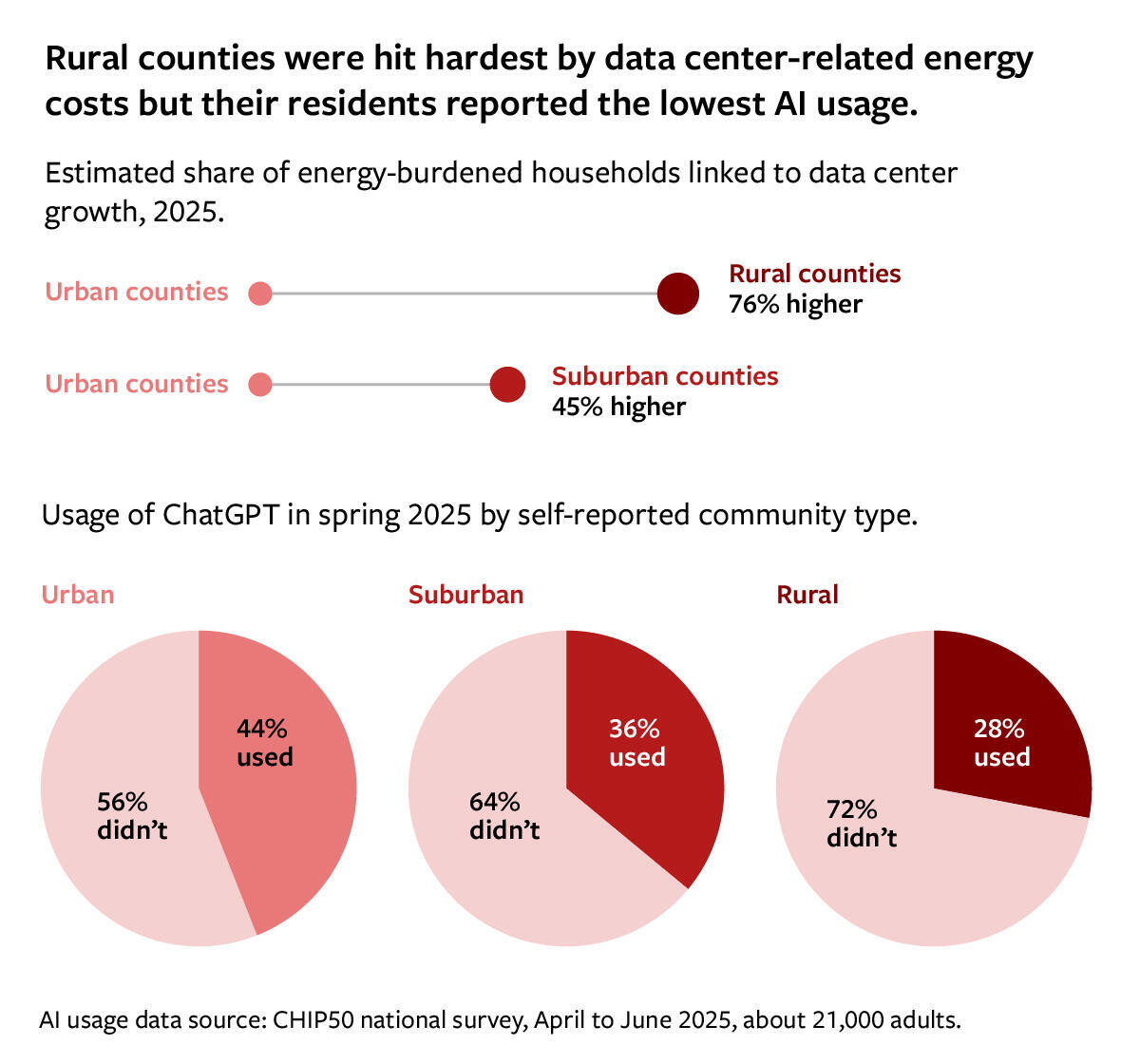
Many more rural and lower-income residents saw proportionally higher bills; the share of rural families shouldering a high energy burden – spending more than 6% of their incomes on energy – rose 76% more than among urban residents. The authors cite a national survey finding that rural residents are also less likely to use AI tools like ChatGPT than urban residents.
The impact on energy bills also has a wide geographical reach. For example, residents in New Jersey, Pennsylvania and Ohio help pay for grid upgrades linked to data center growth in Virginia, the researchers said.
“You do not have to live next to a data center to help pay for its power infrastructure,” You said. “The grid connects communities across states, and cost-sharing rules connect them financially.”

Using insights from the data, You and Feng recommend changes to cost-sharing rules and strategies to lower burdens. In all four regions, they found that, if data centers cut back power use during 22 of the region’s peak demand hours each year, they would relieve strain on the grid and minimize the need to expand. Tech companies, which often own multiple data centers in different states and even countries, could shift operations to another region during the peak demand.
“It’s feasible, and the challenge is more about implementation,” You said. “Coordination is needed, but there’s a clear benefit for better coordination.”
States could also charge data centers directly in line with the new demand they add, or institute programs, like a recent law in Minnesota, to direct funds to low-income households to offset higher energy expenses. Tax incentives could also be tied to job creation and increased wages, so those benefits are more ensured.
You and Feng’s recommendations come as states grapple with how to share costs; six states have recently set special terms for very large energy consumers, and in March, seven major technology companies signed the White House Ratepayer Protection Pledge, a commitment to pay for required grid updates.
“This is an issue that connects directly to debates in many states and in Congress,” You said. “We want to provide science-based evidence and concrete data so that all the stakeholders can better understand the picture and weigh their options.”
Funding for the study came from the Eric and Wendy Schmidt AI in Science Postdoctoral Fellowship.
Media Contact
Adam Allington
Get Cornell news delivered right to your inbox.
Subscribe