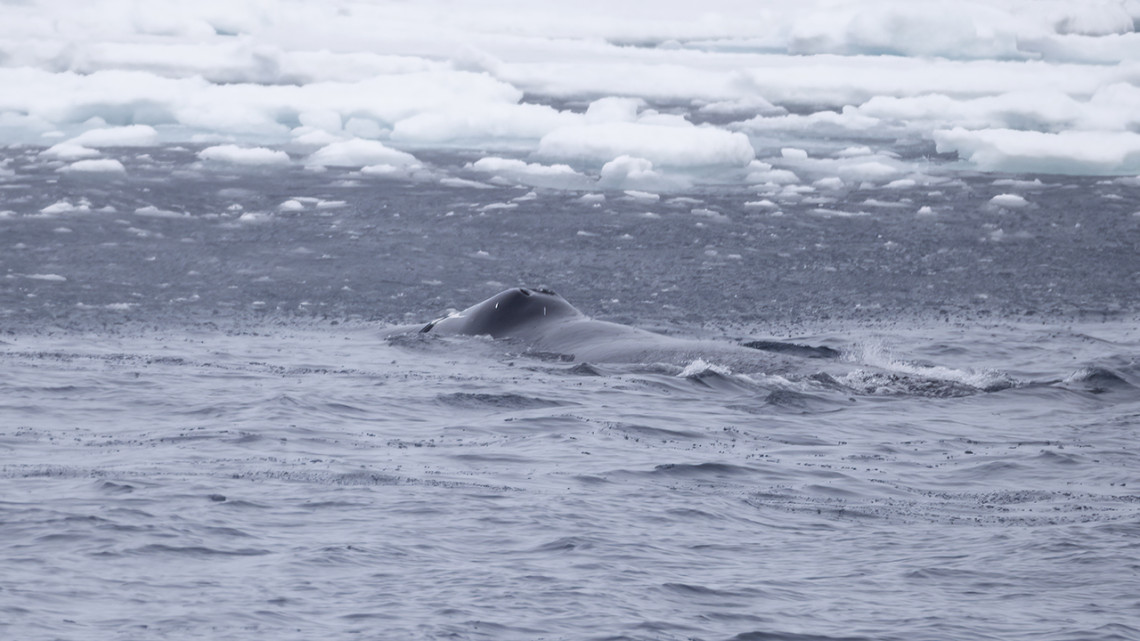
A bowhead whale in Svalbard, Norway.
Repurposing the internet’s backbone to advance whale monitoring
By Kathi Borgmann
Bioacoustics researcher Léa Bouffaut, at the Cornell K. Lisa Yang Center for Conservation Bioacoustics, has spent the past several years eavesdropping on the conversations of whales. But instead of using underwater microphones like other marine scientists, she listens by tapping into fiber-optic cables lying on the ocean floor – a powerful tool to aid in marine mammal conservation.
The cables – originally installed for telecommunications or power transmission – also pick up vibrations from sound waves. The technology, known as distributed acoustic sensing (DAS), works by using special instrumentation, sending laser pulses through fiber-optic cables and measuring tiny changes caused by passing sound waves, including whale sounds. By measuring these disturbances, she can detect sounds along many miles of cable where vocalizing whale species leaves a unique fingerprint.
Distributed acoustic sensing using fiber-optic cables essentially turns long stretches of seafloor into dense networks of virtual acoustic sensors that are critical for monitoring whales – details needed to safeguard declining whale populations.
Bouffaut was the first to document the use of fiber-optic cables to detect blue and fin whales in 2022, but she wondered if fiber‑optic cables could record the signals of all baleen whales, and whether the technology could be implemented more broadly.
Distributed acoustic sensing using telecommunication cables has primarily been proven for the loud, ultra-low-frequency vocalizations of blue and fin whales (< 100 hertz). Bowhead whales and North Atlantic right whales that call at higher frequencies (between roughly 150 and 300 hertz) and at lower intensity, are harder to detect.
To prove the usefulness of the technology for all baleen whales, Bouffaut headed to Utqiaġvik, on Alaska’s North Slope, where Iñupiat whalers have hunted bowhead whales for thousands of years. Bouffaut worked with the Barrow Whaling Captains Association and the North Slope Borough Department of Wildlife Management during the Spring of 2026 to see if she could detect the high-frequency calls of bowhead whales on an existing fiber-optic cable owned by Quintillion. The question was whether the telecommunication cables could pick up their sounds.
After weeks of analyzing terabytes of data, Bouffaut made a breakthrough: the first-ever detections of bowhead whale vocalizations in DAS data.
“Being able to detect bowhead whales on a telecommunication cable is the proof of concept we need to show that DAS can be used to monitor all baleen whales,” Bouffaut said. “This is truly exciting as this technology enables real-time data access, over tens of kilometers and, from land.”
Now that the team has been able to detect the high frequency calls of bowhead whales, Bouffaut said acoustic sensing using underwater cables could open the door to new ways of estimating populations, tracking migration timing and studying how Arctic whales respond to rapid environmental change.
To bring attention to the usefulness of DAS, Bouffaut wrote a review of the rapidly evolving ocean listening technology. Published Nov. 10 in Methods in Ecology and Evolution, by the British Ecological Society, Bouffaut’s review synthesizes the current state of DAS for marine mammal monitoring and offers actionable recommendations to move the technology from proof-of-concept to an operational tool for whale management and conservation.
"The review is also a call to action for scientists, industry partners and regulators to collaborate,” Bouffaut said. “We now have the technical blueprint to turn global undersea infrastructure into a global network for ocean conservation.”
This technology will not replace the traditional underwater microphones used to monitor whales, Bouffaut said, but scientists can use DAS to complement and scale up marine mammal monitoring around the world.
A central focus for Bouffaut is to capitalize on dual-use infrastructure – capturing multiple types of data with one technology. Telecommunication and offshore energy industries already monitor fiber-optic cables for safety and security. Those same data streams, according to Bouffaut, can also be used for environmental compliance and wildlife protection.
Said Bouffaut: “It is critical that we demonstrate the immense conservation and operational value of these cables right now.”
Access to DAS data in Utqiaġvik was provided by Quintillion. Field logistics and access were provided by the Barrow Whaling Captains Association and the North Slope Borough Department of Wildlife Management, working in partnership with the Alaska Eskimo Whaling Commission. Additional funding was provided by the Sound and Marine Life Joint Industry Programme.
Kathi Borgmann is communications manager at the Cornell Lab of Ornithology.
Media Contact
Adam Allington
Get Cornell news delivered right to your inbox.
Subscribe