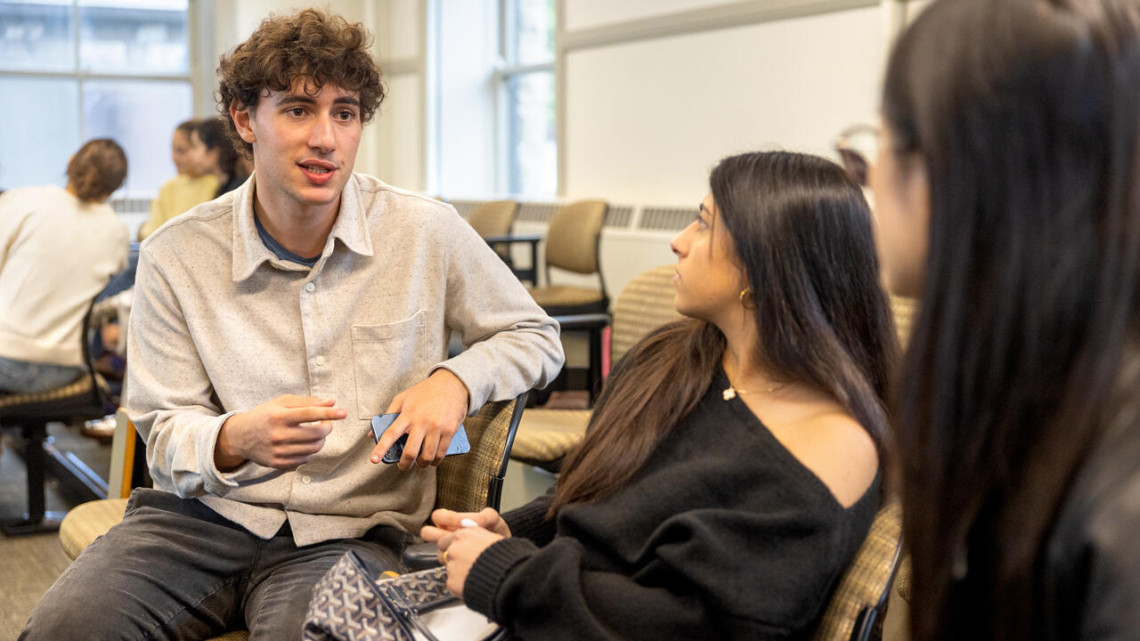
Jaiden Fisher-Dayn ’27, co-president of the Cornell University Parole Initiative Club, speaks with members at a recent club meeting. Since its founding in 2021, CUPI has secured the release of 42 incarcerated people and grown to more than 70 members.
Student club helps incarcerated people earn a second chance
By Holly Hartigan, Cornell Chronicle
After 24 years in prison, Daniel Rodriguez didn’t quite believe he was really getting released until he saw Jaiden Fisher-Dayn ’27 standing outside Fishkill Correctional Facility, ready to take him to breakfast.
“Once I walked over on the other side of the gates, yeah, the tears came down,” Rodriguez said. “I hugged him and I thanked him, and yeah, the tears came out.”
Fisher-Dayn and a small team of undergraduates in the Cornell University Parole Initiative Club (CUPI) had prepared Rodriguez’s parole application and helped him get ready for his parole hearing. The parole board accepted his application and Rodriguez was released July 17, 2025.
“I’m a Puerto Rican guy from the Bronx,” Rodriguez said. “He’s a white kid from Brooklyn. My own family turned their backs on me. My mom is a junkie. My dad stopped calling me his son when I was 12 years old. My whole backstory is a horror flick. I know what it’s like to be homeless at 6 years old.
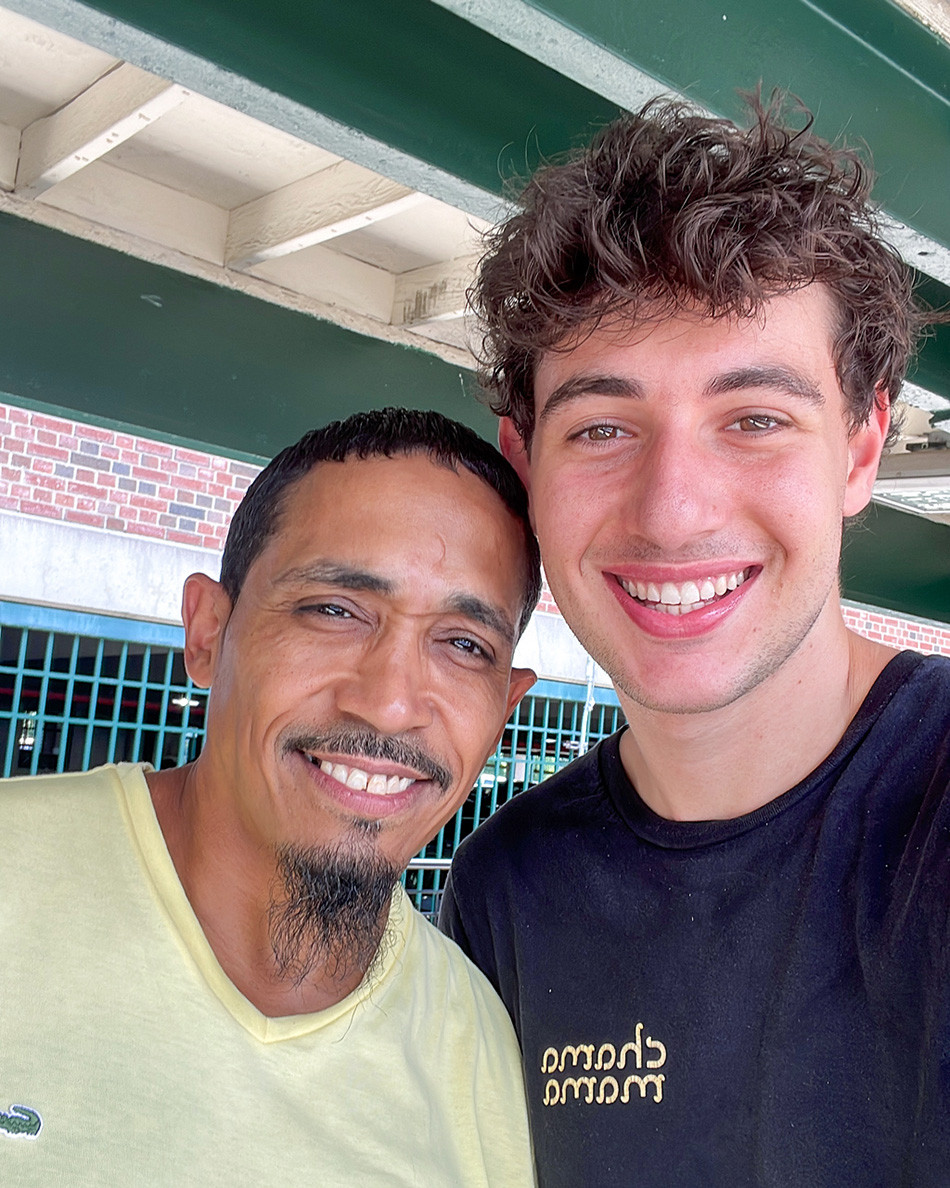
Fisher-Dayn (right) and Daniel Rodriguez on the day Rodriguez got out of prison.
“To have someone extend their hand out to me and help me at the most unbelievable time of my life, where I needed someone the most, he was the only one who stood by me at the end.”
Since its founding in 2021, CUPI has secured the release of 42 people incarcerated at facilities around upstate New York. Most were serving life sentences.
Putting together application packets for incarcerated people going up for parole is more than just paperwork. The months-long process includes helping applicants make plans for housing and employment, conducting mock parole board interviews, requesting records and compiling transcripts of everything the applicant has done to rehabilitate themselves while in prison.
“They are becoming really proficient at developing the life stories, which are essential for transforming the picture that might otherwise be in a parole officer’s head,” said Joseph Margulies, professor of practice in the Department of Government in the College of Arts and Sciences (A&S) and the club’s adviser. “I’m so proud of what the students have done.”
Fisher-Dayn, a public policy major in the Cornell Jeb E. Brooks School of Public Policy, is now co-president along with Alysha Adusei ’27, who is studying government and American studies as part of the Robert S. Harrison College Scholar program in A&S. The club has more than 70 active members.
He and the other club members are passionate about the work, Fisher-Dayn said. “Some want to go to law school, some are just interested in advocacy, but we are determined to make a difference in the carceral system, which we all believe is unjust and unfair.”
Preparing for hearings
Working in teams of three or four, CUPI members navigate the difficulties of getting incarcerated people on the phone, requesting documents from prison case managers and speaking to clients’ family members and outside organizations to line up housing. The parole packets they compile are often more than 100 pages long.
Through a series of conversations and practice interviews, the students also prepare applicants to talk about their crimes before the parole board.
“Getting someone to really tell you about the worst moment of their life and relive those traumatic situations is not an easy ask,” Fisher-Dayn said. “Almost all the cases we work with are murder cases and life sentence cases. To ask someone, ‘How did you feel in that moment when you shot someone in the head?’ is not an easy question to answer, and it’s not an easy question to ask.”
For CUPI client Corey Devon Arthur, who got out of prison on April 7 after serving 29 years in prison for murder, talking about his crime forthrightly was extremely difficult.
“I didn’t know what an apology was,” he said. “When we grow up they teach us to say ‘I’m sorry’ to stop you from hurting me. I never learned to say I was sorry to stop me from hurting you.”
The students pressed him to face details of the crime. At first he resisted going back into that moment, but Fisher-Dayn and the other CUPI members on his team treated him like a person rather than a process or a problem to solve, Arthur said, and they slowly built a relationship.
“We discussed it as people. We unpacked it. I cried. They may have cried,” he said. “I got used to the emotion, and then I learned how to walk with it.”
Arthur said the students he worked with were tenacious in their ability to push through challenges and show him they cared. It inspired him to work harder for his release. Today he is an artist, filmmaker and an advocate for carceral system reform.
Other organizations prepare parole packets, but CUPI’s success rate is so high – 71% – because they don’t force clients into a template or a proscribed process, he said.
“They are not afraid to do the real work, and the real work isn’t a parole packet; it’s actually helping a person,” he said. “That’s what they do.”
Sometimes parole boards deny CUPI clients’ applications, but the work doesn’t end at a “no.” It becomes a building block for their next try.
“Even when the outcome isn’t what we hope for,” Adusei said, “we go back to the drawing board and continue to advocate in preparation for their next hearing.”
Rehabilitation
Almost all applicants face opposition to their release from victims’ families, as well as from representatives of the legal system.
“We don’t do this without the understanding that everyone we work with has done something that has really hurt someone,” Fisher-Dayn said. “The people who know that best are the people we work with, our clients. They know what they’ve done has destroyed families, and part of the healing process is really reflecting on that.”
Adusei said sometimes CUPI students are the only people advocating for their clients, and every case includes letters of opposition to the applicant’s release.
“One of the most difficult things to do is to show society that this person is deserving of another chance,” she said.
CUPI teams help their clients talk about the work they have done to rehabilitate, and the students gather certifications and transcripts as evidence to include in applicants’ parole packets.
During his decades in prison, Rodriguez earned certifications in carpentry, helped Vietnam War veterans access benefits and counseled other incarcerated people through substance abuse, anger, violence and post-traumatic stress disorders. He learned to read and write and cope with dyslexia.
He also made mistakes in prison and got into trouble. “I was scared that the parole board was going to judge me for my slips and falls,” he said.
He said with such a comprehensive parole packet from CUPI, his parole interview mostly covered the good work he had done. He was ready for the tough questions, but the hearing ended up being easy.
Fisher-Dayn was the first person who made him feel like he deserved a shot.
“For a long, long, long time, I didn’t believe that I was worth the time of day,” he said. “This kid helped me open my eyes and realize that there are good people out there.”
Expanding services
The club has also started extending its reach to other underserved populations. In 2025, CUPI raised funds and partnered with other student organizations to assemble 650 personal hygiene care packages for every inmate at Bedford Hill Correctional Facility, the state’s only maximum-security facility for women.
They are repeating that effort this year, hoping to raise $3,000 by Nov. 20 to assemble 850 care packages for incarcerated women at Bedford Hills and the nearby Taconic Correctional Facility. “Through reaching out to incarcerated women to gather testimonials about their experiences accessing basic hygiene products, introducing them to CUPI's work, and organizing our annual hygiene drive,” Adusei said, “we were able to build meaningful relationships that ultimately helped us secure our first two women applicants.”
CUPI has also expanded its services this year to help newly released clients navigate reentry into society.
“Getting 42 people out of prison is great, but if five of them are homeless and five of them are hungry, that’s not satisfying to us,” Fisher-Dayn said. “Reentry is extremely hard. When you get released from prison, you get about $200 cash, and that’s it.”
Most of their clients entered prison before the smart phone was developed. “The world is just a really completely different place,” he said.
The new 14-person reentry division of the club is helping clients create a release plan – find jobs and housing, connecting them with services and advocating on their behalf with parole officers.
“Oftentimes things don’t go exactly how you write them out,” Fisher-Dayn said. “We want to be there to make sure that plan is implemented and to deal with whatever ad hoc things come up that we can help support.”
Since his release, Rodriguez has moved to Philadelphia and has gone into business as a contractor. As that work slows down over the winter, he will start work as a bilingual counselor with the community organization Mothers in Charge, working with people after they are released from prison to teach alternatives to violence.
“If I can help anyone not go down the same path that I went down, then I’m going to,” he said. “Honestly, if I had had someone that I could go to, I don’t think I would have been in the streets the way I was.”
When Rodriguez started working with CUPI, he did not expect the students to work as hard or go as far as Fisher-Dayn did, he said.
“He gave me a second chance at life,” he said, “and I have not squandered it at all.”
Media Contact
Get Cornell news delivered right to your inbox.
Subscribe