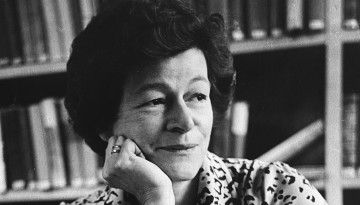
Mary Ann Nevins Radzinowicz, the Jacob Gould Schurman Professor of English Literature Emerita in the College of Arts and Sciences, died March 15 in Ballyvaughan, Ireland. She was 97.
To manage atmospheric carbon dioxide, Cornell scientists have dusted off an archaic – now 120 years old – electrochemical equation. Applying it may thwart the consequences of global warming.
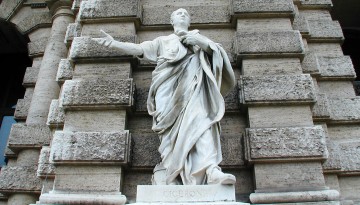
A theory of religion considered “modern” by many scholars was actually described 1,700 years ago, according to new research by Toni Alimi, a Klarman Postdoctoral Fellow in classics and philosophy in the College of Arts and Sciences.
A new book by linguist Michael Weiss provides the first pedagogical grammar ever compiled for an ancient Indo-European language used in parts of what is now western China.
Featuring a unique instrumentation of trumpet, trombone, bass clarinet, and baritone voice, loadbang headlines a week of great musical performances April 11-17.
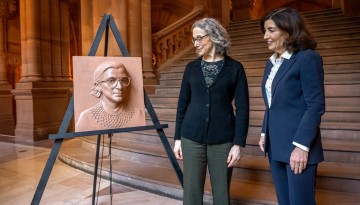
For the first time in 125 years, the face of a celebrated New Yorker – Ruth Bader Ginsburg – will be permanently commemorated at the New York State Capitol’s Great Western Staircase.
Employing AI to write full messages in an arena where personal correspondence is crucial – representative government – appears to be more effective than using AI to generate individual sentences, according to new Cornell research.
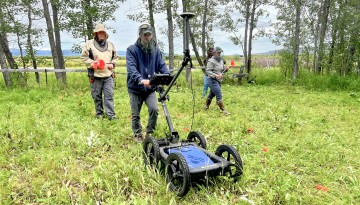
A Cornell research scientist used ground-penetrating radar and AI modeling to locate the communal graves of approximately 93 victims of the Spanish influenza at Pilgrim Hot Springs in Alaska.