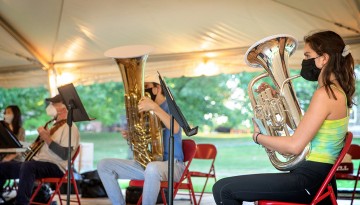
Instrumental music professors have gotten creative during the pandemic, using various approaches to teaching this semester in an effort to give their students the best experience possible.
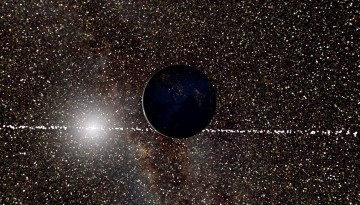
Some exoplanets – planets from beyond our own solar system – have a direct line of sight to observe Earth’s biological qualities from far, far away, according to research led by Lisa Kaltenegger, director of the Carl Sagan Institute.
In surveys of nearly 2,000 American adults, barely half said they would be willing to take a hypothetical vaccine with an efficacy, or effectiveness, of 50% – the U.S. Food and Drug Administration’s minimum threshold for a COVID-19 vaccine.
“Media Objects,” a media studies conference originally scheduled for March 2020 at the Herbert F. Johnson Museum of Art, has been reconfigured into a virtual event, with the first panel scheduled for Oct. 23.
The next installment of the Democracy 20/20 webinar series, scheduled for Oct. 30 at 2 p.m., will tackle polarization and how tensions between the political parties and the social groups they represent are redefining American democracy.
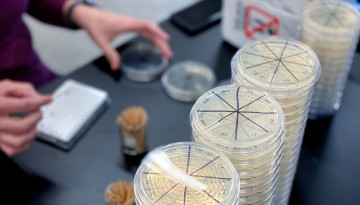
A U.S. Department of Energy agency has awarded $1 million to Cornell researchers, who are using programmed microbes to mine rare-earth minerals used in consumer electronics and advanced renewable energy.
Rather than making people less political, religion shapes people’s political ideas, suppressing important group differences and progressive political positions, according to sociologist Landon Schnabel.
Winner of the Leroy P. Steele Prize for Seminal Contribution to Research for his advances in mathematical logic and model theory, Michael Morley was also a devoted advisor of Cornell students. He died Oct. 11.
Human tracks at White Sands National Park record more than 1.5 kilometers of a journey and form the longest Late Pleistocene-age double human trackway in the world.