For decades, Cornell archaeologists have been excavating at Sardis, Turkey. A new lecture series to spotlight that work launched March 6 with the excavation’s current director, Nicholas D. Cahill, professor of Greek and Roman art at the University of Wisconsin, Madison.
The Office of Faculty Development is using remote conferencing technology sessions to hold faculty workshops during the Coronavirus on topics ranging from what's next in academic book publishing to how to write an op-ed.
To better predict volcanic activity, Cornell geologists have proposed a new system to discern the stages of a volcano’s unrest – as seen from perceptive satellites.
Cornell will have connections to three of this year’s eight winners of 51 Pegasi b Fellowships in Planetary Astronomy. Two are coming to Ithaca for three years of postdoctoral work; another is a recent Cornell graduate.
Cornell astronomers have created five models representing key points from our planet’s evolution to use as spectral templates in the hunt for Earth-like planets.
Students who used immersive virtual reality did not learn significantly better than those who used two more traditional forms of learning, a new Cornell study has found.
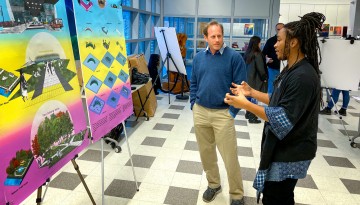
Cornell graduate students studying landscape architecture examined Ossining, New York – a town on the rising Hudson River last fall, and presented ideas for climate-change adaptation.