Cornell researchers have discovered a pathway by which E. coli regulates zinc levels, an insight that could advance the understanding of metal regulation in bacteria and lead to antibacterial applications such as in medical instruments.
A girl who attends a school with classmates whose mothers work is more likely to be in the workforce when she has a child herself than a girl who grows up in local circles where most mothers stay at home, Cornell researchers have found.
The study found that key CD8+ T cells showed signs of constant stimulation that lead to an exhausted state, a condition that is well-studied in cancer.
Olga Verlato's dissertation, “Languages of Power and People: Multilingualism, Politics, and Resistance in Modern Egypt and the Mediterranean,” received the Malcolm H. Kerr Award from the Middle East Studies Association of North America.
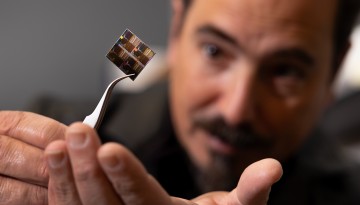
Cornell researchers in physics and engineering have created the smallest walking robot yet. Its mission: to be tiny enough to interact with waves of visible light and still move independently, so that it can maneuver, and take images and measurements.
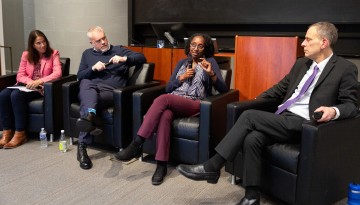
With a panel of Cornell experts, journalist Ann Marimow ’97 discussed the impact of recent Supreme Court decisions on ordinary Americans and the workings of American democracy.
At just 18 years old, Bella Hanson '27 already has a deep passion for social justice, activism and mental health awareness.
A sophomore in the College of Arts and Sciences studying English and Africana studies, Hanson…