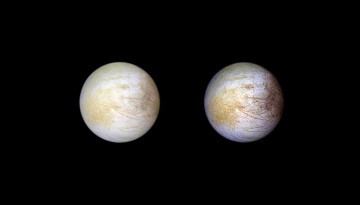
Astronomers using data from NASA’s James Webb Space Telescope have identified CO2 on the icy surface of Jupiter’s moon Europa – one of a handful of worlds in our solar system that could potentially harbor conditions suitable for life.
Enabled by a custom thermometer, Cornell researchers have observed superfluid fluctuation effects, possibly gaining new insight for quantum computing and the physics of the early universe.
An international team of researchers, including chemist Robert DiStasio of Cornell, has introduced a novel concept, “freedom of design,” that has important implications in the fields of rational molecular design and computational drug discovery.
The Mildred Cohn Young Investigator Award recognizes Nozomi Ando's advances in diffuse scattering and her dedication to diversity, equity, and inclusion in STEM.
Along with a new minor, students can also take advantage of an expanded set of upper-level classes, participate in a number of ASL events on campus and be part of an active student club.
Nobel Prize-winning physicist Carl Wieman will visit campus Sept. 25-29 as an A.D. White Professor-at-Large, working with students and faculty and offering a public talk about his work in science education.
The newly upgraded Linac Coherent Light Source X-ray free-electron laser at the Department of Energy’s SLAC National Accelerator Laboratory has produced its first X-rays, and researchers are ready to kick off an ambitious science program.