Four Cornell-funded projects are expanding efforts to preserve and highlight the Gayogohó:nǫˀ (Cayuga Nation) language and culture, in western New York and throughout the country.
Neuroscientist Antonio Fernandez-Ruiz has received a New Innovator Director’s Award from the National Institutes of Health’s High-Risk, High-Reward Research program.
Researchers from the Cornell Lab of Ornithology and the Institute for Computational Sustainability are using big data and AI to model hidden patterns in nature – not just for one bird species, but for entire ecological communities across continents.
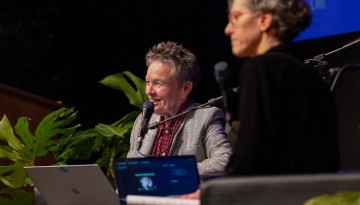
Multimedia artist Laurie Anderson took a captivated Cornell audience on a trip through the arc of her career during a Sept. 26 talk at the Schwartz Center for the Performing Arts.
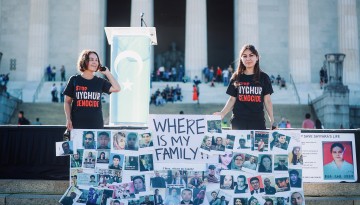
Reported violations of children’s rights will be explored in a symposium entitled “Uyghur Children in China’s Genocide” on Fri., Oct. 27, from 1-5 p.m. in Goldwin Smith Hall, Rm. 76. The symposium will be hybrid; register in advance for the livestream.
Two College of Arts and Sciences scholars have published the first wide-ranging anthology of theater theory and dramatic criticism by women and woman-identified writers, with entries by more than 80 scholars, including Cornell faculty and alumni.
In new research, Jamila Michener, associate professor of government, demonstrates how people within racially and economically marginalized communities can, through organizing, build political power in response to poor living conditions.