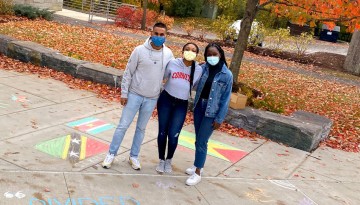
The newly renamed Latin American and Caribbean Studies Program is expanding its Caribbean focus – thanks to a collaboration with Caribbean undergraduates.
The Nevada county commissioner who told Miriam Shearing ‘56 that women don’t belong in the courtroom could never have predicted how those words would motivate Shearing throughout her life.
Seed grants and symposia based on themes from the Office of Academic Integration have bridged researchers from the Ithaca and New York campuses and have brought a high return on investment to Cornell.
Cornell assistant professors researching artificial intelligence, sustainable energy, digitization in manufacturing and chemistry have recently received early-career awards from the National Science Foundation and the Department of Energy.
The endowed professorships will fund ground-breaking research in the areas of psychology and human development, fiber science and apparel design, and nutritional sciences.
The ReSounds Festival Sept. 4-5 kicks off a yearlong project focused on innovation in acoustic instruments and includes installations at the Johnson Museum and concerts each day beginning at 4 p.m. that take listeners on a pilgrimage to various locations around the Arts Quad.
A new program provides undergraduates, graduate students and postdoctoral researchers from the College of Engineering and the College of Arts and Sciences with hands-on experience in developing innovative small spacecraft missions in high-priority areas of space science.
In a new book, “Movies on Our Minds: The Evolution of Cinematic Engagement,” psychology professor emeritus James Cutting explores the perceptual, cognitive and emotional reasons we enjoy popular films.