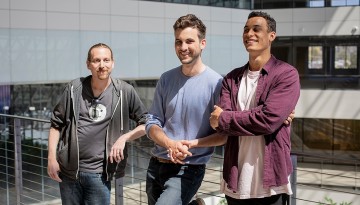
Andrés Gutiérrez ’15, M.S. ’19 and Adler Faulkner ’18 started their company Comake, a smart workstation that consolidates accounts and cloud services, while students in eLab.
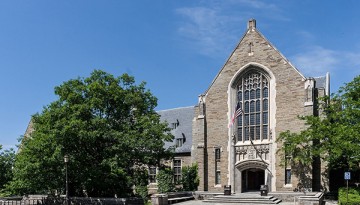
As Cornell recognizes the 50th anniversary of the occupation, dialogue around these important issues continues. Ezra offers two essays written by Cornellians who are among the many looking back on the occupation to explore its lessons, both broad and personal.
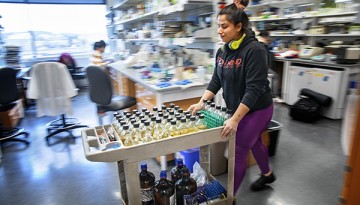
A decade ago, Cornell opened the doors of a pioneering new building, a home for innovative and collaborative life sciences research. The $162 million, 265,000-square-foot Weill Hall.
Cornell is a big place. Students find niches within the larger community, and musicians are no exception. Music shapes the experiences of thousands of alumni who are a special population of Cornellians.
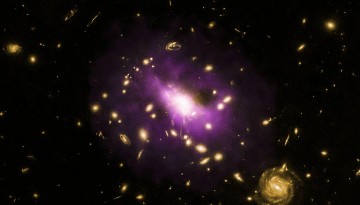
New research by physics and astronomy professor Eanna Flanagan, published last month in Physical Review D, identifies new ways to detect the passage of gravitational waves via their effect on matter.
The Johnson Museum has published a new, full-color “Handbook of the Collections,” its first in 20 years. It features more than 300 artworks, plus stories, histories and alumni artists.
The Cornell Presidential Postdoctoral Fellowship Program, which attracts some of the world’s best young talent to Cornell, has chosen eight new fellows.
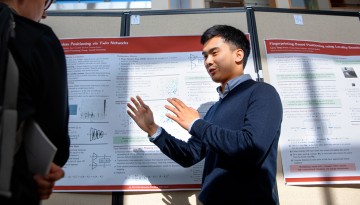
The student-run symposium recognizes research achievement and provides a venue for undergraduates to communicate their work in a scholarly environment.
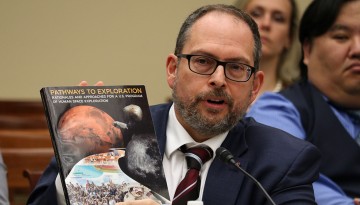
Cornell astronomer Jonathan Lunine suggested to Congress on May 8 reasonable, practical steps – including baby steps back to the moon – to help Americans one day put boots on the oxidized dust of Mars.