Cornell Tech’s Roosevelt Island campus earns bragging rights when the world's first high-rise residential building built to passive house standards - a rigorous energy use standard - rises on campus.
A building to rise at the heart of Cornell Tech’s Roosevelt Island campus - the Bridge at Cornell Tech - will offer space to startups and established companies pushing the edge of digital technology.
Cornell engineers have created a synthetic immune organ that produces antibodies and can be controlled in the lab, completely separate from a living organism.
In a breakthrough for computer vision and for bird-watching, researchers and bird enthusiasts have enabled computers to achieve a task that stumps most humans - identifying hundreds of bird species pictured in photos.
Cornell faculty members Christopher Batten and Robert Shepherd are recent recipients of Air Force Office of Scientific Research Young Investigator Research Program grants.
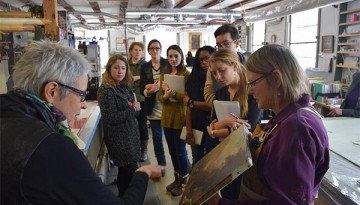
Using image processing tools and data analysis, Cornell scientists, scholars and curators shared their expertise with students and each other in a spring course on art and science intersections.
Engineers at Cornell and clinicians at Weill Cornell Medical College have created a comprehensive mouse model of exactly how colorectal tumors behave in real life, not just in a petri dish.
Under brilliant blue sky peppered with wispy clouds and comfortable temperatures, Cornell University graduated its 147th class May 24, sending about 6,000 accomplished women and men into the future.