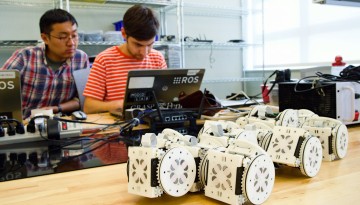
Applications are now open for Cornell’s new robotics doctoral program, which combines expertise across science and engineering, including mechanism design, modeling, dynamics, control, hardware, actuators, sensing, data science, machine learning, computing and social science.
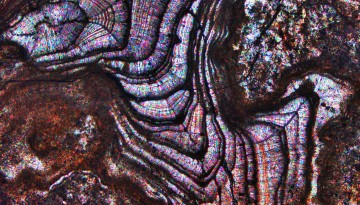
A Cornell-led team will use a $2 million National Science Foundation grant to develop a “microbe-mineral atlas,” a catalog of microorganisms and how they interact with minerals, key for mining critical metals used for generating sustainable energy.
The third cohort of Eric and Wendy Schmidt AI in Science Postdoctoral Fellows from Cornell will tackle critical scientific challenges in sustainability, the physical sciences and more.
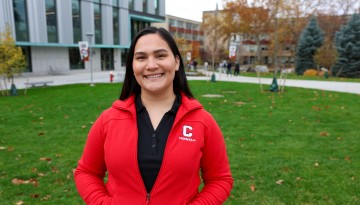
Katherine Ruelan ’27, a five-year veteran of the U.S. Marine Corps, is majoring in mechanical engineering and attending Cornell full time thanks to a number of resources, including the Cornell Veterans Engineering Scholarship.
Nominations are open for the AI for Sustainability Visiting Professorship, designed to bring faculty scholars from across the world to Cornell to tackle pressing global challenges in sustainability through the power of artificial intelligence.
Cornell researchers have uncovered new details about how high-speed metallic collisions can form strong, durable atomic bonds, offering insights that could enhance 3D printing and other manufacturing techniques.
High-school and undergraduate students searched campus for hidden transmitters as part of a digital ‘fox hunt’ organized by Cornell engineers to inspire an interest in microchip design.
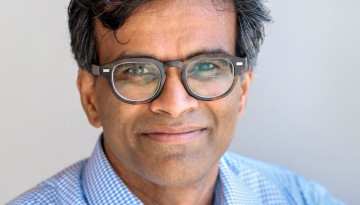
Sendhil Mullainathan ’93, a scholar and writer who uses machine learning to find new approaches to complex problems in medicine, policy and human behavior, will deliver the Messenger Lectures on Nov. 11-13.