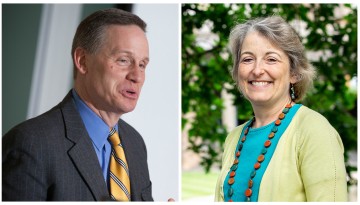
An acclaimed historian of the Caribbean and a multidisciplinary professor of the built environment have been appointed the newest A.D. White Professors-at-Large. Three full visits and three “mini” visits are planned for this semester.
The Presidential Advisors on Diversity and Equity have awarded three Belonging at Cornell innovation grants for 2022 programming, for projects addressing a range of topics involving diversity, equity and inclusion on all of Cornell’s campuses.
Researchers studying carbon removal and storage methods and novel additive manufacturing techniques are among the six Cornell faculty members who recently received National Science Foundation Faculty Early Career Development Awards.
A three-year, $15 million partnership between Cornell and NewYork-Presbyterian will employ artificial intelligence to help improve outcomes for people with cardiovascular disease.
Smart thermostats may be falling into a dumb trap. While these devices save homeowners money, Cornell engineers found they may be prompting unintentional energy spikes on the grid.
The Autonomy and Mobility in Engineered and Natural Environments Workshop at Cornell Tech highlighted research from the smart cities and urban technology academic communities in Ithaca, NYC and beyond.
Top private and public sector leaders, academics, experts, and practitioners will meet for a workshop at Cornell Tech focusing on new methods of infrastructure delivery. The issue is especially timely because of the $1.2 trillion infrastructure bill signed into law by President Biden.