Computer science professor Hakim Weatherspoon has developed a system in which signals sent at the speed of light over fiber-optic cables keep data center computers in sync to within a few nanoseconds.
Dr. Michael Satlin at Weill Cornell Medicine and Ilana Brito in Ithaca are researching how to fight drug-resistant bacteria – "superbugs" that threaten cancer patients' fragile immune systems.
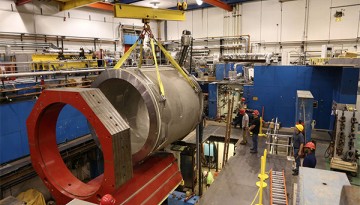
After 30 years and more than 500 peer-reviewed publications, the Cornell High Energy Synchrotron Source's CLEO detector has been removed and will resume data-collection at Jefferson Lab in Virginia.
Cornell has been awarded up to $7 million over five years to lead a consortium of universities exploring new transportation innovations that limit adverse impacts on public health and the environment.
A Cornell engineering group has devised a method for allowing strain and tactile sensing in a soft prosthetic hand, through the use of stretchable optical waveguides.
Cornell has been selected to host the national 2019 Science Olympiad, which will bring 2,500 high school students from across the U.S. to a unique competition.
Professor emeritus of civil and environmental engineering Daniel P. Loucks has been awarded the Prince Sultan Bin Abdulaziz Interntional Prize for Water, for his study of water resource management.
Emeritus professor Franklin Kingston Moore, who was awarded a NASA Exceptional Scientific Achievement Medal, died on Nov. 21 in Ithaca. A member of the National Academy of Engineering, Moore was 94.