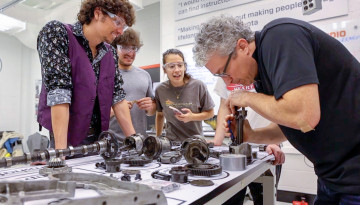
The funding will provide long-term support to programs that provide undergraduates with opportunities to participate on project teams, join research labs, develop and evaluate innovative technologies, and benefit from other hands-on learning activities.
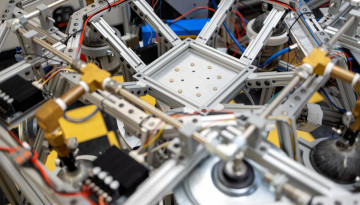
A new round of grants from the Cornell-led New York Consortium for Space Technology Innovation and Development will advance aerospace research, manufacturing and workforce development in New York state.
Engineering faculty and students traveled to Washington, D.C., for the inaugural U.S. Governors Cup Robotics Tournament, where they showcased a robot in hopes of inspiring young students.
In this week’s episode of Research Matters, Cornell professor Robert Shepherd explores a radically reimagined future of robotics – one built not from bolts and steel, but from living tissues, fungal networks and soft, 3D-printed materials.
A well-placed step can turn a high hurdle into an easier jump. The same idea applies to how nanoparticles transition into crystals, according to new research from the Cornell Duffield College of Engineering.
Fourteen members of Cornell’s faculty and staff are being recognized this year with Community-Engaged Practice and Innovation Awards from the David M. Einhorn Center for Community Engagement.
A Cornell-led collaboration used high-resolution 3D imaging to detect, for the first time, the atomic-scale defects in computer chips that can sabotage their performance.